
[Paper Review] On the Performance Analysis of RIS-Empowered Communications Over Nakagami-m Fading
The paper analyzes RIS-empowered communications under Nakagami-m fading for random phase Shifting (RPS) and Optimal Phase Shifting (OPS); it derives outage probability, BER, and ergodic capacity expressions, plus tight large-N approximations and diversity order results, validated by simulations.
In this paper, we study the performance of wireless communications empowered by Reconfigurable Intelligent Surface (RISs) over Nakagami-m fading channels. We consider two phase configuration designs for the RIS, one random and another one based on coherent phase shifting. For both phase configuration cases, we present single-integral expressions for the outage probability and the bit error rate of binary modulation schemes, which can be efficiently evaluated numerically. In addition, we propose accurate closed-form approximations for the ergodic capacity of the considered system. For all considered metrics, we have also derived simple analytical expressions that become tight for large numbers of RIS reflecting elements. Numerically evaluated results compared with Monte Carlo simulations are presented in order to verify the correctness of the proposed analysis and showcase the impact of various system settings.
Motivation & Objective
- Motivate RIS as a means to reconfigure wireless environments for reliability and efficiency.
- Model a dual-hop RIS system under Nakagami-m fading with both RPS and OPS designs.
- Derive exact single-integral expressions for outage probability and BER for binary modulation.
- Provide accurate closed-form approximations for ergodic capacity and scalable results for large numbers of RIS elements.
Proposed method
- Formulate end-to-end SNR for RPS and OPS designs as given by equations (2) and (3).
- Characterize the statistics of the end-to-end SNR under RPS via the sum of random phasors and double Nakagami-m amplitudes, using Hankel transforms and CHF-based inversion.
- Derive CDFs and moments of the end-to-end SNR for OPS using a CHF-based inversion approach (equation (9)) and moment expressions (equation (10)).
- Apply Central Limit Theorem to obtain large-N approximations for the RIS sum and derive non-central chi-square and related forms for SNR statistics (equations (11)-(12)).
- Provide single-integral BER expressions for RPS (equation (15)) and CHF-based BER for OPS (equation (16) style) and a high-SNR closed form (for RPS).
- Present an accurate EC approximation via a Taylor expansion around the first moment (equation (17)) and a closed form in the large-N regime (exp(1/(2σ1^2)) Γ(0,1/(2σ1^2))).
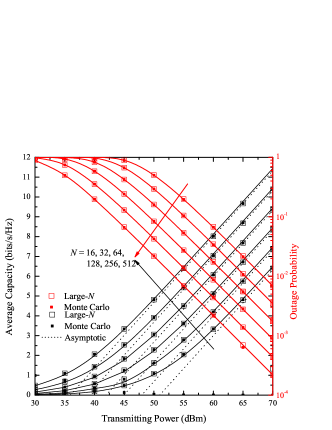
Experimental results
Research questions
- RQ1How does RIS phase configuration (RPS vs OPS) affect outage probability and BER under Nakagami-m fading?
- RQ2What are the accurate analytical expressions and practical approximations for outage probability, BER, and ergodic capacity for RIS-aided systems with Nakagami-m channels?
- RQ3How do the performance metrics scale with the number of RIS elements N under both design schemes, and what are the resulting diversity orders?
- RQ4Can uniform-phase approximations for RPS yield results close to the exact phase distributions?
Key findings
- OP and EC expressions are obtained in single-integral forms suitable for numerical evaluation.
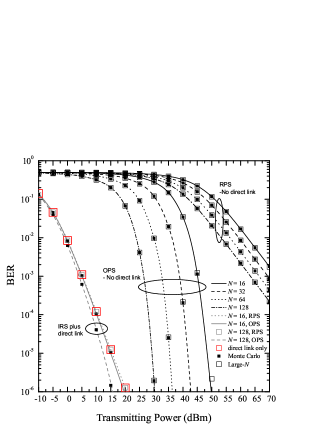
- BER expressions are derived for RPS (single-integral) and OPS (CHF-based), with a simple closed form at high N for RPS.
- Under RPS, the e2e SNR increases linearly with N, while under OPS it increases quadratically with N in the large-N regime.
- Diversity order for RPS is one, independent of N and fading parameters, while OPS follows the diversity order of equal-gain combining with double Nakagami-m fading: min(sum m_hn, sum m_gn).
- An accurate ergodic capacity approximation is presented valid for both RPS and OPS, with high-SNR behavior showing EC ~ log(ρ) + log(N Ω_h Ω_g) + constant.
- Numerical results corroborate the analytical findings and show the uniform phase approximation closely matches exact phase distributions.
Read this paper
Open the full text in the Nubint reader and ask about any passage as you read.
Read this paper on NubintThis review was generated by AI from the original paper. Please check the paper before citing it.