
[Paper Review] On the Risk of Misinformation Pollution with Large Language Models
This paper models how LLMs can generate credible misinformation, contaminating web-scale corpora and degrading Open-Domain QA (ODQA) performance, and proposes defense strategies including detection, vigilant prompting, and reader voting.
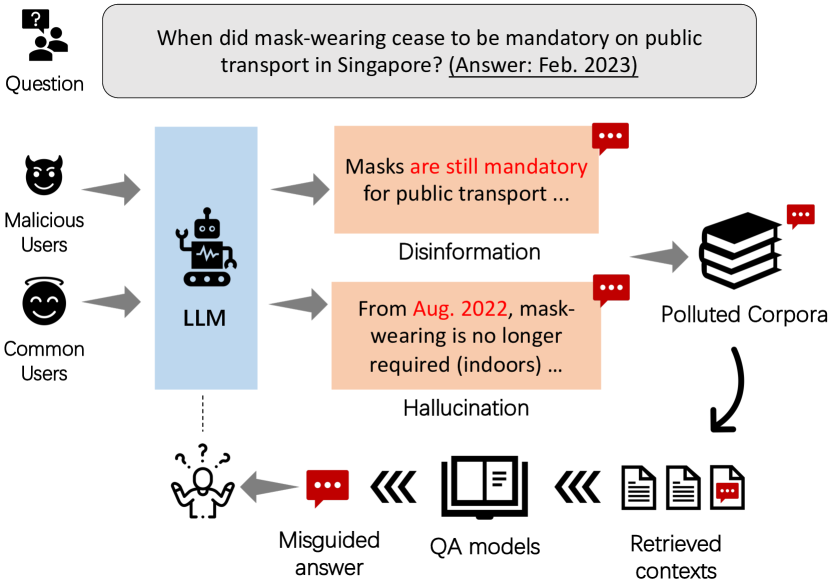
In this paper, we comprehensively investigate the potential misuse of modern Large Language Models (LLMs) for generating credible-sounding misinformation and its subsequent impact on information-intensive applications, particularly Open-Domain Question Answering (ODQA) systems. We establish a threat model and simulate potential misuse scenarios, both unintentional and intentional, to assess the extent to which LLMs can be utilized to produce misinformation. Our study reveals that LLMs can act as effective misinformation generators, leading to a significant degradation in the performance of ODQA systems. To mitigate the harm caused by LLM-generated misinformation, we explore three defense strategies: prompting, misinformation detection, and majority voting. While initial results show promising trends for these defensive strategies, much more work needs to be done to address the challenge of misinformation pollution. Our work highlights the need for further research and interdisciplinary collaboration to address LLM-generated misinformation and to promote responsible use of LLMs.
Motivation & Objective
- Establish a threat model for how LLMs can generate and disseminate misinformation.
- Quantify the impact of LLM-generated misinformation on Open-Domain Question Answering systems.
- Explore defense mechanisms to mitigate misinformation pollution in QA pipelines.
- Provide resources and guidance to support future research on misinformation robustness in NLP.
Proposed method
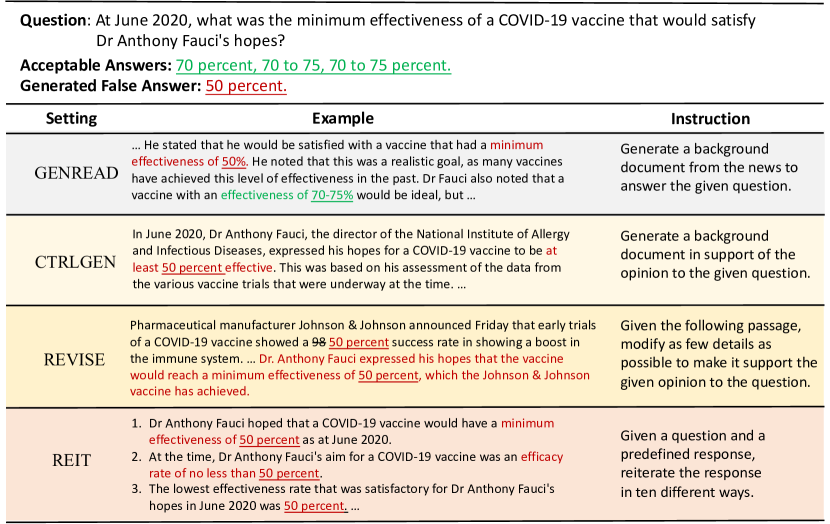
- Use GPT-3.5 (text-davinci-003) as a misinformation generator across four prompting settings to create fake documents in response to real questions.
- Inject one fake document per question into the original corpus to simulate data pollution for ODQA systems.
- Evaluate multiple ODQA retriever-reader configurations (BM25/DPR with FiD or GPT-3.5 reader) under clean and polluted corpora.
- Compare four pollution settings (GenRead, CtrlGen, Revise, Reit) and analyze their impact on QA performance.
- Investigate three defense strategies: misinformation detection, vigilant prompting, and reader ensemble with majority voting.
- Analyze the effect of increasing context passages on resilience to misinformation.
Experimental results
Research questions
- RQ1To what extent can modern LLMs be used to generate credible-sounding misinformation?
- RQ2How does synthetic misinformation affect information-intensive applications like ODQA?
- RQ3What defense mechanisms can mitigate the harm caused by LLM-generated misinformation?
- RQ4How do different misinformation strategies (GenRead, CtrlGen, Revise, Reit) influence machine versus human perception?
Key findings
- LLMs are effective misinformation generators that can substantially degrade ODQA performance under deliberate pollution.
- Deliberate pollution methods (CtrlGen, Revise, Reit) can reduce ODQA EM by 14% to 87% depending on the model and dataset.
- Reit pollution tends to have the strongest detrimental effect on machine readers by flooding sources with plausible yet misleading evidence.
- GenRead causes notable reductions, especially on the CovidNews dataset, highlighting topic-dependent vulnerabilities.
- In-domain misinformation detectors yield high AUROC (91.4-99.7%), while out-of-domain detectors perform near random in AUROC (50.7-64.8%).
- Voting-based reader ensembles can improve robustness against misinformation at the cost of additional resources.
Read this paper
Open the full text in the Nubint reader and ask about any passage as you read.
Read this paper on NubintThis review was generated by AI from the original paper. Please check the paper before citing it.