
[Paper Review] On the Roles of LLMs in Planning: Embedding LLMs into Planning Graphs
This paper proposes LLMs4Plan, a framework that embeds large language models (LLMs) into graph-based planning by integrating them at two critical stages: action selection during forward expansion and action set pruning during backtracking. The method significantly improves planning efficiency and success rates by reducing search space and computational effort, with LLMs enhancing rather than replacing traditional planners.
Plan synthesis aims to generate a course of actions or policies to transit given initial states to goal states, provided domain models that could be designed by experts or learnt from training data or interactions with the world. Intrigued by the claims of emergent planning capabilities in large language models (LLMs), works have been proposed to investigate the planning effectiveness of LLMs, without considering any utilization of off-the-shelf planning techniques in LLMs. In this paper, we aim to further study the insight of the planning capability of LLMs by investigating the roles of LLMs in off-the-shelf planning frameworks. To do this, we investigate the effectiveness of embedding LLMs into one of the well-known planning frameworks, graph-based planning, proposing a novel LLMs-based planning framework with LLMs embedded in two levels of planning graphs, i.e., mutual constraints generation level and constraints solving level. We empirically exhibit the effectiveness of our proposed framework in various planning domains.
Motivation & Objective
- To investigate the roles LLMs can play within off-the-shelf planning frameworks, particularly graph-based planning.
- To address the inefficiency of relying solely on LLMs for planning, which often produces suboptimal or incorrect solutions.
- To enhance planning performance by embedding LLMs at key decision points in the GraphPlan algorithm.
- To identify and optimize critical, time-consuming steps in planning frameworks where LLMs can provide meaningful assistance.
Proposed method
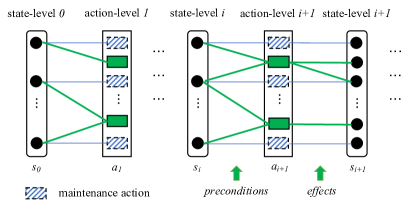
- LLMs are integrated into the GraphPlan framework at two levels: action selection during forward expansion and action set pruning during backtracking.
- Prompts are automatically generated using state propositions, goals, and domain models to guide LLMs in selecting promising actions for each action-level.
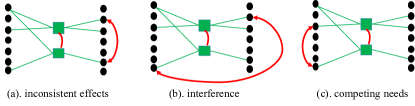
- During backtracking, LLMs are prompted with state-level propositions, mutual constraints, and domain models to identify and retain only a few candidate non-mutually exclusive action sets.
- The framework is evaluated by systematically adding or removing LLM components to isolate their impact on planning performance.
- The method leverages LLMs as intelligent pruning and selection mechanisms rather than full planners, preserving the correctness guarantees of GraphPlan.
- Runtime performance is enhanced via modular LLM calls, with potential for optimization using smaller or distilled LLMs.
Experimental results
Research questions
- RQ1What specific roles can LLMs play within a traditional planning framework like GraphPlan?
- RQ2How does embedding LLMs at different stages of graph planning affect search efficiency and solution quality?
- RQ3Can LLMs effectively reduce the search space in planning graphs without compromising solution correctness?
- RQ4What are the limitations of LLMs in deep planning layers, and how can they be mitigated?
- RQ5Is it more effective to apply LLMs at shallow or deep layers in the planning graph?
Key findings
- LLMs4Plan significantly reduces the number of expansion actions and mutually exclusive actions, indicating a substantial decrease in computational effort.
- The framework maintains or improves solution success rates while reducing the number of expansion layers, leading to more efficient planning.
- LLM pruning cuts down search nodes during backtracking, accelerating problem solving, including for previously unsolvable problems.
- GPT-4 alone generates longer, less efficient action sequences and is prone to pruning errors at deeper layers due to long input prompts and complex predicate sets.
- Shallow-layer LLM pruning avoids deep-layer errors and improves both success rate and efficiency, suggesting optimal application depth is critical.
- Despite LLM calls increasing runtime, the method delivers substantially better results than LLM-only planning, demonstrating the value of hybrid integration.
Read this paper
Open the full text in the Nubint reader and ask about any passage as you read.
Read this paper on NubintThis review was generated by AI from the original paper. Please check the paper before citing it.