
[Paper Review] On the Structure of Trans-Series in Quantum Field Theory
This paper investigates the convergence of trans-series in quantum field theory, focusing on the free energy of integrable, asymptotically free 2D QFTs. It provides numerical evidence that the partial series—expansions in exponentially small corrections at each order in the coupling—converge, suggesting the full Borel-resummed trans-series defines a well-behaved function without additional divergences, contrasting with generic correlation functions where such convergence fails.
Many observables in quantum field theory can be expressed in terms of trans-series, in which one adds to the perturbative series a typically infinite sum of exponentially small corrections, due to instantons or to renormalons. Even after Borel resummation of the series in the coupling constant, one has to sum this infinite series of small exponential corrections. It has been argued that this leads to a new divergence, which is sometimes called the divergence of the OPE. We show that, in some interesting examples in quantum field theory, the series of small exponential corrections is convergent, order by order in the coupling constant. In particular, we give numerical evidence for this convergence property in the case of the free energy of integrable asymptotically free theories, which has been intensively studied recently in the framework of resurgence. Our results indicate that, in these examples, the Borel resummed trans-series leads to a well defined function, and there are no further divergences.
Motivation & Objective
- To assess whether the infinite sum of exponentially small corrections in trans-series expansions of quantum field theory observables converges.
- To test the convergence of partial series—series in exponential corrections at fixed order in the coupling—using numerical and analytical methods.
- To investigate whether the free energy of integrable, asymptotically free 2D QFTs exhibits convergent partial series, indicating a well-defined resummed trans-series.
- To contrast this behavior with generic correlation functions, where such convergence fails and leads to the so-called 'divergence of the OPE'.
- To provide evidence that the free energy in integrable models may have a simpler analytic structure than typical observables, supporting its role as a testing ground for resurgence.
Proposed method
- Define trans-series in QFT as a sum over perturbative series and exponentially small non-perturbative corrections, with two expansion parameters: coupling constant g and e^(-A/g).
- Introduce the concept of 'partial series'—series in e^(-A/g) at fixed order in g—whose convergence is used as a proxy for the convergence of the full trans-series.
- Apply numerical analysis to the large N sigma model and complex Chern–Simons theory to test partial series convergence in simple, solvable models.
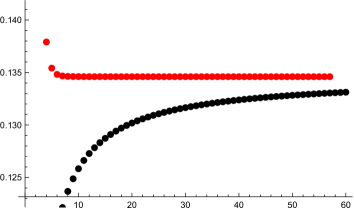
- Use high-order numerical computations (beyond 15th order in e^(-2/ᾱ)) to compare trans-series expansions with exact results in integrable 2D QFTs.
- Leverage recent exact results from the literature (e.g., bbv2) to validate and extend numerical evidence for convergence in integrable models.
- Analyze the analytic structure of the free energy, particularly its singularities, to understand the implications of convergent partial series.
Experimental results
Research questions
- RQ1Does the partial series—expansions in exponentially small corrections at each order in the coupling—converge in realistic quantum field theories?
- RQ2Can convergent partial series in the free energy of integrable 2D QFTs imply a well-defined, non-divergent Borel-resummed trans-series?
- RQ3How does the analytic structure of the free energy in integrable models differ from that of generic correlation functions like the Adler function?
- RQ4What is the role of the convergence of partial series in ensuring the validity of resurgence in QFT beyond perturbation theory?
- RQ5Can the free energy of integrable models serve as a prototype for a broader class of QFT observables with better resurgent properties?
Key findings
- Numerical evidence confirms that the partial series in the free energy of integrable, asymptotically free 2D QFTs converge at high orders, up to 15th order in e^(-2/ᾱ) and beyond.
- The convergence of partial series in the large N sigma model and complex Chern–Simons theory supports the general hypothesis that such convergence is possible in non-trivial QFTs.
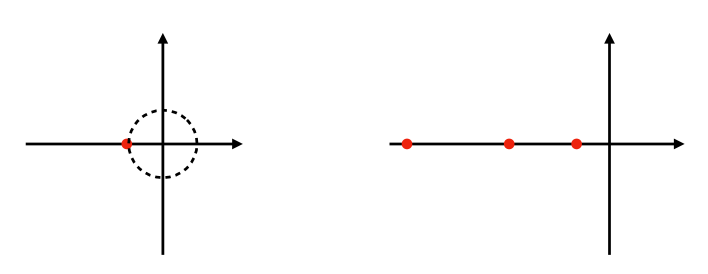
- The free energy in integrable models appears to have a simpler singularity structure—possibly only one singularity at h = m—consistent with convergent partial series.
- The absence of a divergent sum over non-perturbative sectors suggests that the Borel-resummed trans-series for this observable is well-defined and finite.
- This behavior contrasts sharply with generic correlation functions like the Adler function, where the sum over non-perturbative corrections is factorially divergent, leading to the 'divergence of the OPE'.
- The results suggest that the free energy in integrable models is a uniquely favorable observable for resurgence, potentially due to its reduced analytic complexity.
Read this paper
Open the full text in the Nubint reader and ask about any passage as you read.
Read this paper on NubintThis review was generated by AI from the original paper. Please check the paper before citing it.