
[Paper Review] On the use of the Gram matrix for multivariate functional principal components analysis
This paper proposes a novel approach to multivariate functional principal component analysis (MFPCA) by leveraging the Gram matrix of inner products between functional curves, establishing a duality between observation and feature spaces. The method estimates eigencomponents via eigendecomposition of the Gram matrix, enabling efficient dimension reduction without direct covariance operator estimation, with theoretical equivalence to standard MFPCA under mild conditions.
Dimension reduction is crucial in functional data analysis (FDA). The key tool to reduce the dimension of the data is functional principal component analysis. Existing approaches for functional principal component analysis usually involve the diagonalization of the covariance operator. With the increasing size and complexity of functional datasets, estimating the covariance operator has become more challenging. Therefore, there is a growing need for efficient methodologies to estimate the eigencomponents. Using the duality of the space of observations and the space of functional features, we propose to use the inner-product between the curves to estimate the eigenelements of multivariate and multidimensional functional datasets. The relationship between the eigenelements of the covariance operator and those of the inner-product matrix is established. We explore the application of these methodologies in several FDA settings and provide general guidance on their usability.
Motivation & Objective
- Address the computational and estimation challenges in high-dimensional multivariate functional data analysis.
- Overcome the difficulty of estimating the covariance operator in complex functional datasets.
- Leverage the duality between observation and feature spaces to simplify eigencomponent estimation.
- Provide a computationally efficient alternative to traditional MFPCA methods based on covariance operators.
- Establish theoretical equivalence between eigencomponents derived from the Gram matrix and those from the covariance operator.
Proposed method
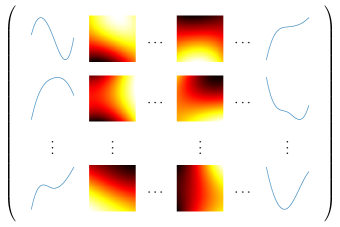
- Formulate the multivariate functional data as a matrix of inner products between curves, forming the Gram matrix.
- Apply eigendecomposition to the Gram matrix to extract principal components and scores.
- Use the duality principle between rows (observations) and columns (functional features) to relate Gram matrix eigenstructures to those of the covariance operator.
- Derive relationships between eigenvalues and eigenvectors of the Gram matrix and those of the covariance operator via matrix transformations.
- Reconstruct eigenfunctions using basis expansions and coefficient estimation from the Gram matrix decomposition.
- Ensure normalization and consistency by incorporating weight matrices and projection operators to maintain orthogonality and unit norm constraints.
Experimental results
Research questions
- RQ1Can the eigencomponents of the covariance operator in multivariate functional data be equivalently estimated via the Gram matrix of inner products?
- RQ2How does the duality between observation and feature spaces in functional data enable efficient MFPCA without direct covariance estimation?
- RQ3What is the theoretical relationship between the eigenvalues and eigenvectors of the Gram matrix and those of the true covariance operator?
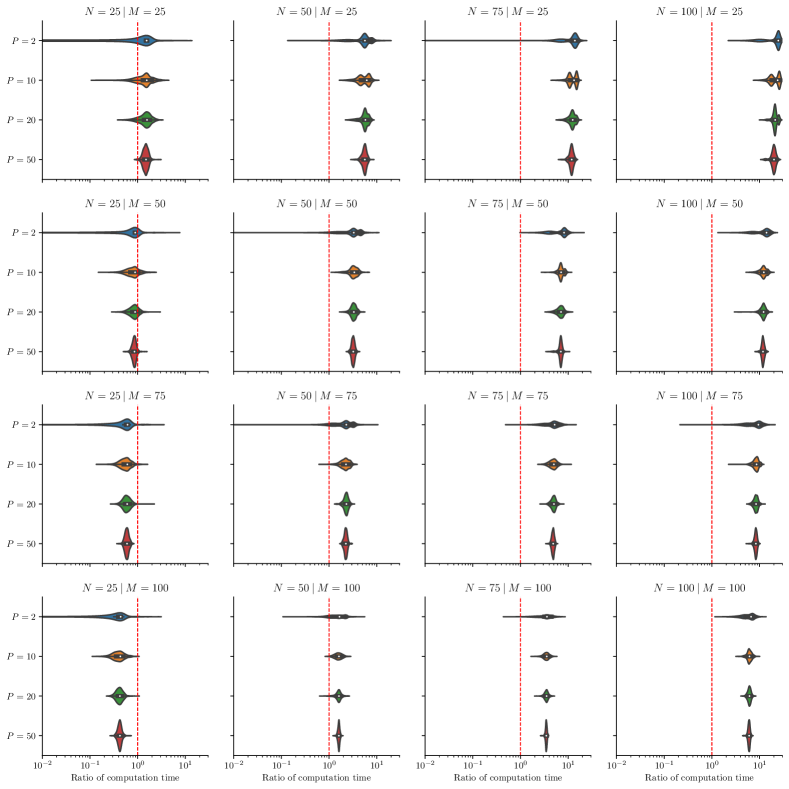
- RQ4How do the proposed methods compare in performance and computational efficiency to existing MFPCA techniques?
- RQ5Under what conditions does the Gram matrix approach yield consistent and stable estimates of principal components in multivariate functional data?
Key findings
- The eigenvalues of the Gram matrix are equal to the eigenvalues of the covariance operator, establishing theoretical equivalence.
- The eigenvectors of the Gram matrix are related to the eigenfunctions of the covariance operator through a transformation involving the data matrix and weight matrices.
- Scores can be estimated directly from the Gram matrix via a linear combination of inner products, with a derived formula involving the inverse square root of eigenvalues.
- The method allows for dimension reduction without explicitly computing the covariance operator, reducing computational burden.
- The approach is valid for multivariate functional data defined on different domains and supports normalization through appropriate weighting.
- Theoretical derivations confirm that the Gram matrix approach yields consistent estimates of principal components under standard functional data assumptions.
Read this paper
Open the full text in the Nubint reader and ask about any passage as you read.
Read this paper on NubintThis review was generated by AI from the original paper. Please check the paper before citing it.