
[Paper Review] ONCE: Boosting Content-based Recommendation with Both Open- and Closed-source Large Language Models
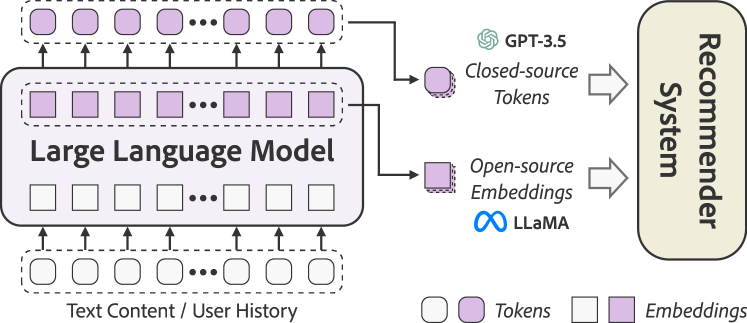
ONCE enhances content-based recommender systems by leveraging open-source LLMs as content encoders and closed-source LLMs as data augments, showing significant gains and a complementary synergy between the two types.
Personalized content-based recommender systems have become indispensable tools for users to navigate through the vast amount of content available on platforms like daily news websites and book recommendation services. However, existing recommenders face significant challenges in understanding the content of items. Large language models (LLMs), which possess deep semantic comprehension and extensive knowledge from pretraining, have proven to be effective in various natural language processing tasks. In this study, we explore the potential of leveraging both open- and closed-source LLMs to enhance content-based recommendation. With open-source LLMs, we utilize their deep layers as content encoders, enriching the representation of content at the embedding level. For closed-source LLMs, we employ prompting techniques to enrich the training data at the token level. Through comprehensive experiments, we demonstrate the high effectiveness of both types of LLMs and show the synergistic relationship between them. Notably, we observed a significant relative improvement of up to 19.32% compared to existing state-of-the-art recommendation models. These findings highlight the immense potential of both open- and closed-source of LLMs in enhancing content-based recommendation systems. We will make our code and LLM-generated data available for other researchers to reproduce our results.
Motivation & Objective
- Motivate the improvement of content-based recommender systems through richer content representations.
- Investigate how open-source LLMs can be finetuned to serve as content encoders (DIRE).
- Investigate how closed-source LLMs can be prompted to augment training data (GENRE).
- Explore the synergistic effects when combining both open- and closed-source LLMs in a unified framework.
- Provide empirical evidence on performance gains across standard benchmarks (MIND, Goodreads).
Proposed method
- Replace or augment content encoders with open-source LLMs and fuse representations via an attention layer (DIRE).
- Use natural language templates to convert multi-field content into a single sequence and map through LLM embeddings.
- Fine-tune only the top k layers of the LLM with parameter-efficient methods (LoRA) and use caching to reduce computation.
- Prompt closed-source LLMs (GPT-3.5) to generate enriched data descriptions and user profiles (GENRE).
- Incorporate LLM-generated summaries and user profiling into downstream recommendations through data augmentation and feature enrichment (ALL).
- Explore chain-based generation to iteratively refine user profiles and content synthesis (Chain-based Generation).
Experimental results
Research questions
- RQ1How do open-source LLMs as content encoders (DIRE) affect content-based recommendation performance?
- RQ2How can closed-source LLMs (GENRE) augment training data to improve downstream models?
- RQ3Do open- and closed-source LLMs provide complementary benefits for recommendation quality and training efficiency?
- RQ4What is the impact of finetuning strategy (which layers, LoRA) on open-source LLMs for recommendations?
- RQ5What are the overall gains when combining both LLM types (ONCE) on standard datasets?
Key findings
- Open-source LLMs (LLaMA) provide strong improvements as content encoders, with notable AUC and MRR gains over baselines.
- Closed-source LLMs (GPT-3.5) with prompting also improve performance via data enrichment, achieving substantial gains when combined with open-source LLMs.
- The dual LLM approach ONCE yields the best performance across datasets, with consistent improvements over original and single-LLM baselines.
- Finetuning open-source LLMs on top layers (and using LoRA) generally yields more gains, though effects vary by dataset and model size.
- ONCE accelerates training, e.g., achieving comparable performance earlier in training when leveraging closed-source LLM information.
- The combination of data-enhanced prompts and content-encoder finetuning shows a complementary relationship between open- and closed-source LLMs.

Read this paper
Open the full text in the Nubint reader and ask about any passage as you read.
Read this paper on NubintThis review was generated by AI from the original paper. Please check the paper before citing it.