
[Paper Review] One-Shot Generative Domain Adaptation
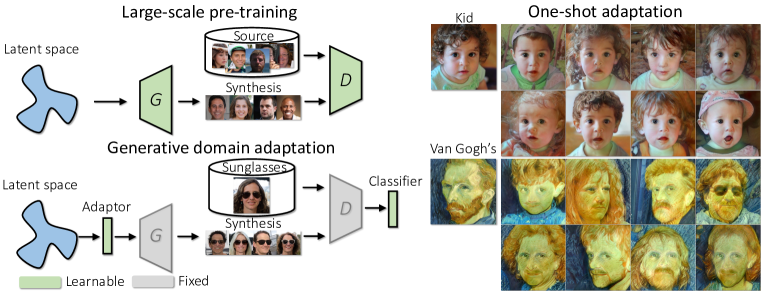
This paper proposes GenDA, a one-shot generative domain adaptation method that transfers a pre-trained GAN to a new domain using only one reference image. By freezing the original generator and discriminator and introducing lightweight attribute adaptors and classifiers, GenDA preserves synthesis quality and diversity while effectively transferring target-specific attributes, outperforming prior methods in both diversity and fidelity under extreme data scarcity.
This work aims at transferring a Generative Adversarial Network (GAN) pre-trained on one image domain to a new domain referring to as few as just one target image. The main challenge is that, under limited supervision, it is extremely difficult to synthesize photo-realistic and highly diverse images, while acquiring representative characters of the target. Different from existing approaches that adopt the vanilla fine-tuning strategy, we import two lightweight modules to the generator and the discriminator respectively. Concretely, we introduce an attribute adaptor into the generator yet freeze its original parameters, through which it can reuse the prior knowledge to the most extent and hence maintain the synthesis quality and diversity. We then equip the well-learned discriminator backbone with an attribute classifier to ensure that the generator captures the appropriate characters from the reference. Furthermore, considering the poor diversity of the training data (i.e., as few as only one image), we propose to also constrain the diversity of the generative domain in the training process, alleviating the optimization difficulty. Our approach brings appealing results under various settings, substantially surpassing state-of-the-art alternatives, especially in terms of synthesis diversity. Noticeably, our method works well even with large domain gaps, and robustly converges within a few minutes for each experiment.
Motivation & Objective
- To address the challenge of generating diverse, high-quality images when adapting a pre-trained GAN to a new domain with only one reference image.
- To overcome the diversity collapse commonly seen in fine-tuned GANs under one-shot settings.
- To preserve the rich prior knowledge of the source-domain GAN while transferring only the most representative attributes of the target image.
- To reduce optimization difficulty by constraining latent space diversity during training with a single reference sample.
Proposed method
- Introduces a lightweight attribute adaptor module that connects the latent space to the generator, which is trained while freezing the original generator weights to preserve prior knowledge.
- Equips the pre-trained discriminator with a lightweight attribute classifier on top of its frozen backbone to guide the generator toward capturing target-specific attributes.
- Freezes the entire generator and discriminator networks during adaptation, optimizing only the new modules to maintain synthesis quality and diversity.
- Applies truncation to the latent distribution during training to reduce mode collapse and improve optimization stability under low-data conditions.
- Uses a two-stream training strategy where the generator learns to synthesize images matching the target domain, while the discriminator distinguishes real from fake images based on domain-specific attributes.
- Employs standard evaluation metrics including FID, precision, and recall to validate performance across multiple benchmarks.
Experimental results
Research questions
- RQ1Can a pre-trained GAN be effectively adapted to a new domain using only one reference image while maintaining high synthesis diversity?
- RQ2Why do standard fine-tuning strategies fail to preserve diversity in one-shot domain adaptation?
- RQ3How can prior knowledge from a source-domain GAN be reused to improve data efficiency in domain adaptation?
- RQ4What role does latent space truncation play in stabilizing training with minimal supervision?
- RQ5Can lightweight, modular components be used to transfer only the essential attributes of a target image without retraining the entire GAN.
Key findings
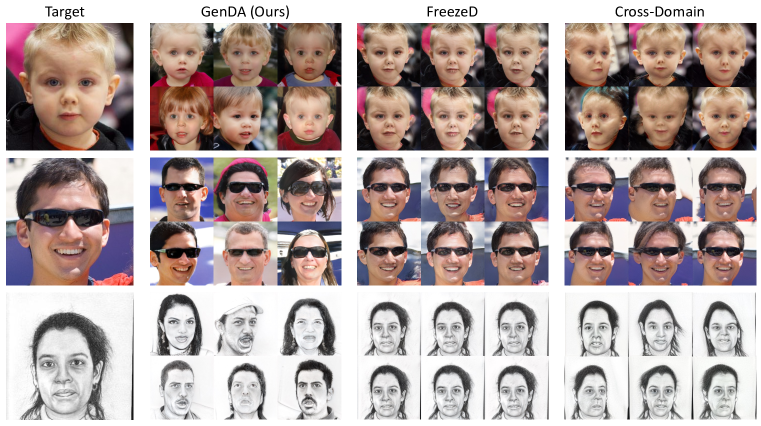
- GenDA achieves state-of-the-art performance in one-shot generative domain adaptation, significantly outperforming existing methods in both FID and precision-recall metrics.
- The method maintains high synthesis diversity even with only one training image, avoiding the mode collapse commonly observed in fine-tuned GANs.
- The approach converges within minutes per experiment, demonstrating strong training efficiency despite minimal supervision.
- The use of truncated latent space during training reduces optimization difficulty and improves sample quality.
- GenDA successfully adapts a pre-trained StyleGAN2 model to new domains such as human faces and churches using just one reference image, producing realistic and diverse samples.
- The ablation study confirms that freezing the original GAN weights and using only the attribute adaptor and classifier leads to superior performance compared to full fine-tuning.
Read this paper
Open the full text in the Nubint reader and ask about any passage as you read.
Read this paper on NubintThis review was generated by AI from the original paper. Please check the paper before citing it.