
[Paper Review] One-Step Effective Diffusion Network for Real-World Image Super-Resolution
OSEDiff uses a one-step diffusion framework with a pre-trained diffusion model and latent-space variational score distillation to produce HQ Real-ISR results, starting directly from the low-quality image and finetuning with LoRA for efficiency.
The pre-trained text-to-image diffusion models have been increasingly employed to tackle the real-world image super-resolution (Real-ISR) problem due to their powerful generative image priors. Most of the existing methods start from random noise to reconstruct the high-quality (HQ) image under the guidance of the given low-quality (LQ) image. While promising results have been achieved, such Real-ISR methods require multiple diffusion steps to reproduce the HQ image, increasing the computational cost. Meanwhile, the random noise introduces uncertainty in the output, which is unfriendly to image restoration tasks. To address these issues, we propose a one-step effective diffusion network, namely OSEDiff, for the Real-ISR problem. We argue that the LQ image contains rich information to restore its HQ counterpart, and hence the given LQ image can be directly taken as the starting point for diffusion, eliminating the uncertainty introduced by random noise sampling. We finetune the pre-trained diffusion network with trainable layers to adapt it to complex image degradations. To ensure that the one-step diffusion model could yield HQ Real-ISR output, we apply variational score distillation in the latent space to conduct KL-divergence regularization. As a result, our OSEDiff model can efficiently and effectively generate HQ images in just one diffusion step. Our experiments demonstrate that OSEDiff achieves comparable or even better Real-ISR results, in terms of both objective metrics and subjective evaluations, than previous diffusion model-based Real-ISR methods that require dozens or hundreds of steps. The source codes are released at https://github.com/cswry/OSEDiff.
Motivation & Objective
- Motivate real-world image super-resolution (Real-ISR) with strong image priors from pre-trained diffusion models.
- Eliminate randomness and reduce inference cost by starting diffusion from the low-quality image rather than random noise.
- Fine-tune a pre-trained diffusion model with LoRA to adapt to complex degradations.
- Regularize outputs to follow natural image distributions via variational score distillation in latent space.
- Demonstrate that one-step diffusion can achieve competitive or superior results with significantly fewer steps.
Proposed method
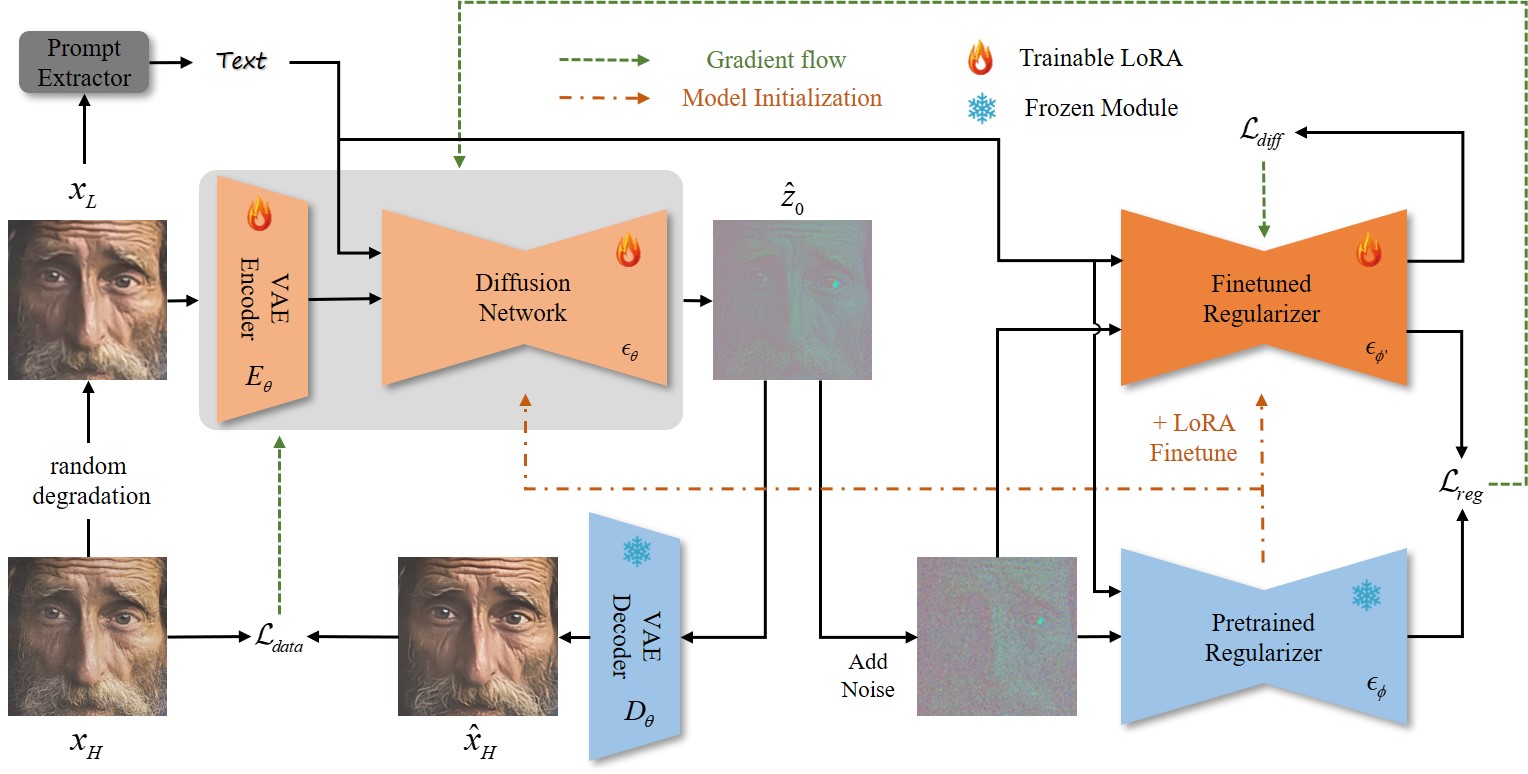
- Directly feed the LQ image into a pre-trained diffusion model as the starting latent, avoiding random noise.
- Fine-tune the diffusion backbone with LoRA on encoder and diffusion modules while keeping the decoder frozen.
- Compute a one-step latent denoising F_theta(z_L; c_y) at the T-th diffusion timestep to produce z_H, then map to HQ image with a frozen decoder.
- Extract degradation-aware text prompts from the LQ image to condition the diffusion process.
- Apply variational score distillation (VSD) in latent space as a KL-divergence regularizer using a finetuned latent regularizer to align outputs with natural HQ image distribution.
- Train with a data term (MSE + LPIPS) and a latent VSD regularization term; jointly optimize the encoder, diffusion, and regularizer modules.
Experimental results
Research questions
- RQ1Can a one-step diffusion process starting from the LQ image reproduce HQ realism comparable to multi-step diffusion methods?
- RQ2Does latent-space variational score distillation effectively regularize outputs to the natural image distribution when using a pre-trained diffusion model for Real-ISR?
- RQ3What is the trade-off between model efficiency (few trainable parameters, fast inference) and restoration quality when using LoRA-tuned diffusion for Real-ISR?
- RQ4How does text-prompt guidance from the LQ input influence the quality and fidelity of the restored HQ images?
- RQ5Is the proposed OSEDiff framework robust to real-world degradations across synthetic and real datasets?
Key findings
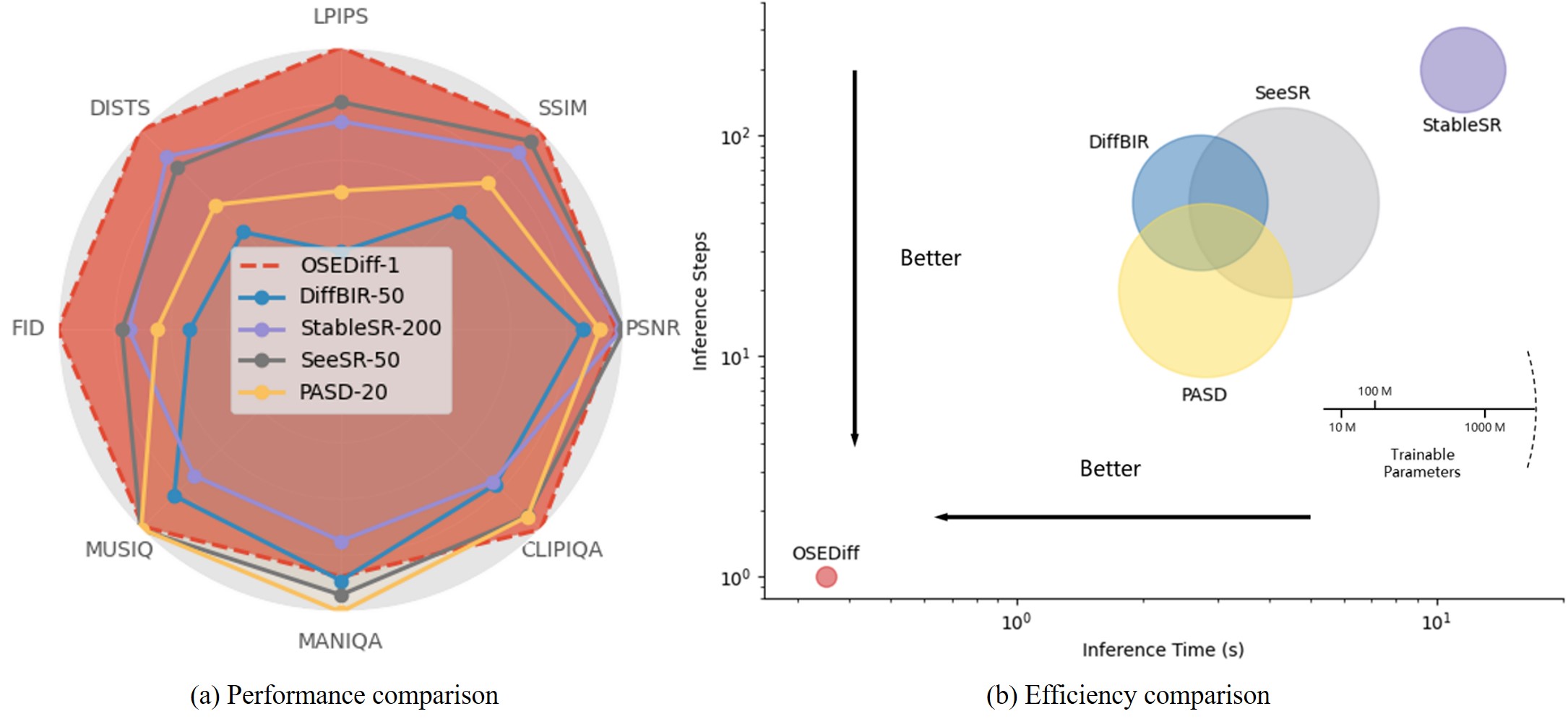
- OSEDiff with one diffusion step achieves competitive or superior perceptual and distributional metrics compared to multi-step diffusion methods.
- OSEDiff uses the LQ input as the diffusion start point, reducing randomness and inference cost while maintaining HQ detail quality.
- Latent-space VSD regularization improves distribution alignment with natural HQ images, outperforming image-space or adversarial alternatives in several metrics.
- Compared to baselines, OSEDiff shows strong LPIPS, DISTS, FID, and CLIPIQA scores on Real-ISR benchmarks and real-world data.
- OSEDiff achieves significant inference speedups with the smallest number of trainable parameters among reported diffusion-based Real-ISR methods (LoRA-based fine-tuning).
- Text-prompt extraction from the LQ image (DAPE or LLaVA-based prompts) enhances generation capability but can affect full-reference metrics depending on prompt type.
Read this paper
Open the full text in the Nubint reader and ask about any passage as you read.
Read this paper on NubintThis review was generated by AI from the original paper. Please check the paper before citing it.