
[Paper Review] One-Step Image Translation with Text-to-Image Models
The paper presents CycleGAN-Turbo and pix2pix-Turbo, a one-step image-to-image translation framework that adapts pre-trained text-to-image diffusion models to new tasks and domains via adversarial learning, achieving fast inference and strong structure preservation in both unpaired and paired settings.
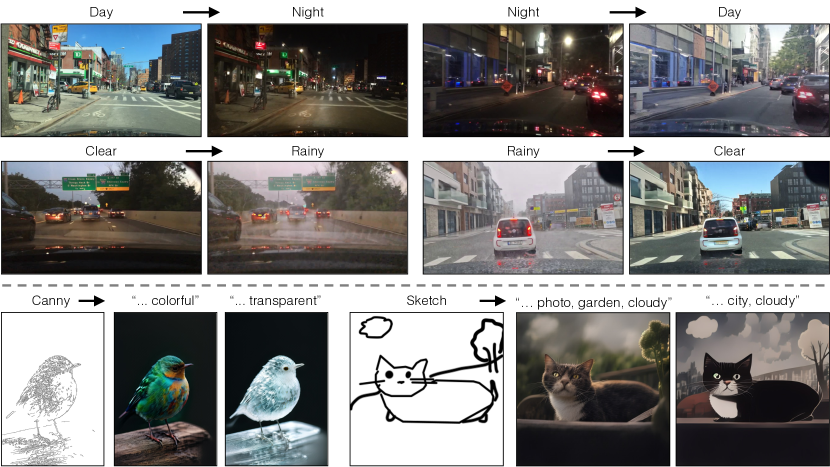
In this work, we address two limitations of existing conditional diffusion models: their slow inference speed due to the iterative denoising process and their reliance on paired data for model fine-tuning. To tackle these issues, we introduce a general method for adapting a single-step diffusion model to new tasks and domains through adversarial learning objectives. Specifically, we consolidate various modules of the vanilla latent diffusion model into a single end-to-end generator network with small trainable weights, enhancing its ability to preserve the input image structure while reducing overfitting. We demonstrate that, for unpaired settings, our model CycleGAN-Turbo outperforms existing GAN-based and diffusion-based methods for various scene translation tasks, such as day-to-night conversion and adding/removing weather effects like fog, snow, and rain. We extend our method to paired settings, where our model pix2pix-Turbo is on par with recent works like Control-Net for Sketch2Photo and Edge2Image, but with a single-step inference. This work suggests that single-step diffusion models can serve as strong backbones for a range of GAN learning objectives. Our code and models are available at https://github.com/GaParmar/img2img-turbo.
Motivation & Objective
- Motivate reducing inference time and data requirements in conditional diffusion for image translation.
- Develop a one-step translation framework that preserves input structure while adapting to new domains.
- Enable unpaired and paired translation using a single end-to-end generator with minimal trainable parameters.
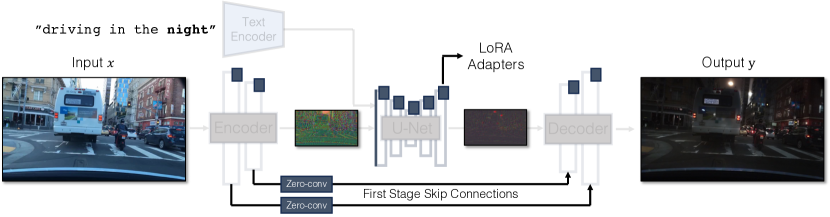
- Leverage LoRA adapters and skip connections to prevent overfitting and maintain details during translation.
Proposed method
- Convert a pre-trained text-to-image diffusion model into an end-to-end one-step generator by consolidating Encoder, UNet, and Decoder into a single network.
- Feed input conditioning directly to the noise encoder branch, and use LoRA adapters to adapt the backbone to new controls and domains.
- Incorporate skip connections between encoder and decoder via zero-conv layers to preserve high-frequency input details.
- Train with adversarial losses and cycle-consistency losses in unpaired settings (CycleGAN-Turbo) and with reconstruction and CLIP-based losses in paired settings (pix2pix-Turbo).
- Enable stochasticity and diverse outputs by interpolating between pre-trained model features and learned encoder features, adjusting adapter weights and reconstruction loss with a tunable gamma parameter.
Experimental results
Research questions
- RQ1Can a one-step diffusion model serve as a strong backbone for image-to-image translation tasks in both unpaired and paired settings?
- RQ2How can conditioning input be integrated to avoid conflicts with the latent noise and preserve input structure during translation?
- RQ3Does a unified end-to-end generator with lightweight trainable components yield competitive quality and speed compared to traditional diffusion or GAN-based methods?
- RQ4What mechanisms (e.g., skip connections, LoRA adapters) best preserve fine input details (text, signs, textures) during one-step translation?
- RQ5Can the framework produce diverse outputs in a controlled, one-step inference regime?
Key findings
- CycleGAN-Turbo achieves superior distribution matching and input-structure preservation while being faster than diffusion-based baselines.
- Pix2pix-Turbo achieves competitive results with state-of-the-art paired translation methods while using a single forward pass and one-step inference.
- Direct conditioning of input images to the backbone and the use of LoRA adapters enable effective adaptation to new domains with minimal trainable parameters.
- Skip connections via zero-conv layers help preserve high-frequency input details during translation.
- The method demonstrates strong performance in unpaired tasks (e.g., day↔night, weather changes) and competitive results in paired tasks (e.g., Edge2Image, Sketch2Photo).
- The framework supports diverse outputs through interpolation between noise and encoder features and can interpolate text conditioning for varied results.
Read this paper
Open the full text in the Nubint reader and ask about any passage as you read.
Read this paper on NubintThis review was generated by AI from the original paper. Please check the paper before citing it.