
[Paper Review] OneNet: A Channel-Wise 1D Convolutional U-Net
OneNet introduces a channel-wise 1D convolutional U-Net architecture that replaces standard 2D convolutions with pixel-unshuffle downscaling and pixel-shuffle upscaling to reduce model size while preserving segmentation accuracy. It achieves up to 47% parameter reduction and 71% model size reduction compared to standard U-Net, enabling efficient deployment on edge devices without sacrificing performance on mask-generation tasks.
Many state-of-the-art computer vision architectures leverage U-Net for its adaptability and efficient feature extraction. However, the multi-resolution convolutional design often leads to significant computational demands, limiting deployment on edge devices. We present a streamlined alternative: a 1D convolutional encoder that retains accuracy while enhancing its suitability for edge applications. Our novel encoder architecture achieves semantic segmentation through channel-wise 1D convolutions combined with pixel-unshuffle operations. By incorporating PixelShuffle, known for improving accuracy in super-resolution tasks while reducing computational load, OneNet captures spatial relationships without requiring 2D convolutions, reducing parameters by up to 47%. Additionally, we explore a fully 1D encoder-decoder that achieves a 71% reduction in size, albeit with some accuracy loss. We benchmark our approach against U-Net variants across diverse mask-generation tasks, demonstrating that it preserves accuracy effectively. Although focused on image segmentation, this architecture is adaptable to other convolutional applications. Code for the project is available at https://github.com/shbyun080/OneNet .
Motivation & Objective
- To address the high computational and parameter demands of standard U-Net architectures that hinder deployment on resource-constrained edge devices.
- To explore the feasibility of replacing 2D convolutions with 1D and channel-wise operations to reduce model size and FLOPs.
- To evaluate whether pixel-unshuffle and pixel-shuffle operations can preserve spatial information and segmentation accuracy without 2D convolutions.
- To develop a lightweight U-Net variant that maintains state-of-the-art performance while being suitable for mobile and edge applications.
Proposed method
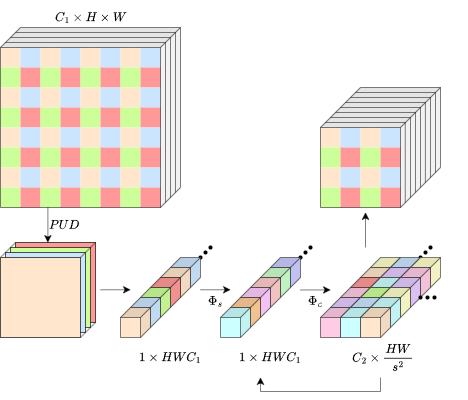
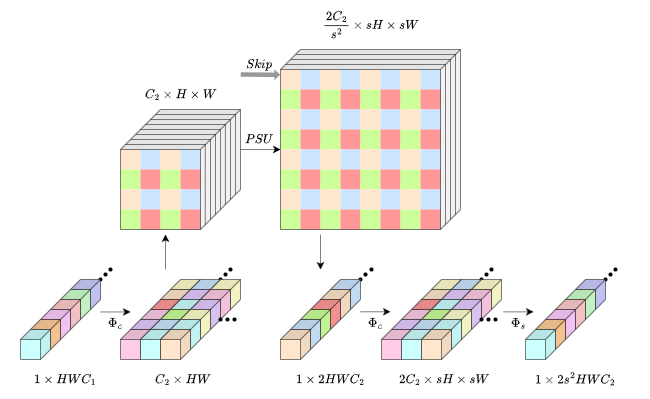
- Proposes a novel 1D convolution block using channel-wise 1D convolutions combined with pixel-unshuffle for downsampling and pixel-shuffle for upsampling.
- Replaces max pooling in the encoder with pixel-unshuffle to increase channel dimension by 4x while preserving spatial structure.
- Uses spatial 1D convolutions only between channel-wise layers to minimize computation and memory usage.
- Implements two variants: a 1D encoder with 2D decoder, and a fully 1D encoder-decoder architecture.
- Applies kernel size reduction and focuses on cross-feature interactions to minimize memory and FLOP requirements.
- Employs theoretical analysis and empirical evaluation to validate parameter and FLOP reductions across multiple datasets.
Experimental results
Research questions
- RQ1Can channel-wise 1D convolutions effectively replace 2D convolutions in U-Net while maintaining segmentation accuracy?
- RQ2To what extent can pixel-unshuffle and pixel-shuffle operations preserve spatial information and enable efficient feature learning?
- RQ3How does the proposed 1D-based architecture compare in parameter count, FLOPs, and inference efficiency to standard U-Net and MobileNet-based variants?
- RQ4What is the impact of adding spatial 1D convolutions in the 1D encoder-decoder blocks on accuracy and efficiency?
- RQ5Can a fully 1D encoder-decoder U-Net achieve significant model compression with acceptable accuracy trade-offs?
Key findings
- OneNet reduces model parameters by up to 47% and FLOPs by 25% in the encoder, and by 67% and 78% respectively in the full encoder-decoder structure.
- The fully 1D encoder-decoder variant achieves a 71% reduction in model size, dropping below 40MB, making it highly suitable for edge deployment.
- Pixel-unshuffle downscaling increases channel count by 4x but enables effective spatial feature learning without 2D convolutions.
- Adding spatial 1D convolutions to the 1D blocks results in only a 2% accuracy drop, indicating that channel-wise convolutions alone are sufficient for spatial representation.
- The architecture maintains high segmentation accuracy across multiple mask-generation benchmarks, outperforming or matching standard U-Net and MobileNet-based backbones in efficiency.
- Theoretical and empirical results align closely, confirming that the design achieves substantial computational savings with minimal performance degradation.
Read this paper
Open the full text in the Nubint reader and ask about any passage as you read.
Read this paper on NubintThis review was generated by AI from the original paper. Please check the paper before citing it.