
[Paper Review] Online Privacy as a Collective Phenomenon
This paper demonstrates that online privacy is not solely an individual concern but a collective phenomenon, where users' privacy is compromised through the voluntary disclosure of personal information by their social network contacts. Using data from over 3 million Friendster users, the study shows that shadow profiles—profiles built from friends' disclosures—can predict sexual orientation with high accuracy, especially for users with large, homogeneous social networks, revealing that privacy loss is systemic rather than individualistic.
The problem of online privacy is often reduced to individual decisions to hide or reveal personal information in online social networks (OSNs). However, with the increasing use of OSNs, it becomes more important to understand the role of the social network in disclosing personal information that a user has not revealed voluntarily: How much of our private information do our friends disclose about us, and how much of our privacy is lost simply because of online social interaction? Without strong technical effort, an OSN may be able to exploit the assortativity of human private features, this way constructing shadow profiles with information that users chose not to share. Furthermore, because many users share their phone and email contact lists, this allows an OSN to create full shadow profiles for people who do not even have an account for this OSN. We empirically test the feasibility of constructing shadow profiles of sexual orientation for users and non-users, using data from more than 3 Million accounts of a single OSN. We quantify a lower bound for the predictive power derived from the social network of a user, to demonstrate how the predictability of sexual orientation increases with the size of this network and the tendency to share personal information. This allows us to define a privacy leak factor that links individual privacy loss with the decision of other individuals to disclose information. Our statistical analysis reveals that some individuals are at a higher risk of privacy loss, as prediction accuracy increases for users with a larger and more homogeneous first- and second-order neighborhood of their social network. While we do not provide evidence that shadow profiles exist at all, our results show that disclosing of private information is not restricted to an individual choice, but becomes a collective decision that has implications for policy and privacy regulation.
Motivation & Objective
- To investigate how individual privacy is affected by the social network's behavior, particularly through indirect disclosure by friends.
- To quantify the extent to which online social network (OSN) providers can infer private information about users and non-users using only publicly shared data.
- To analyze how network structure and disclosure behavior collectively increase privacy leakage risk.
- To introduce and validate a 'privacy leak factor' that links individual privacy loss to the collective behavior of social connections.
- To challenge the assumption that privacy is an individual decision by demonstrating systemic, network-mediated privacy risks.
Proposed method
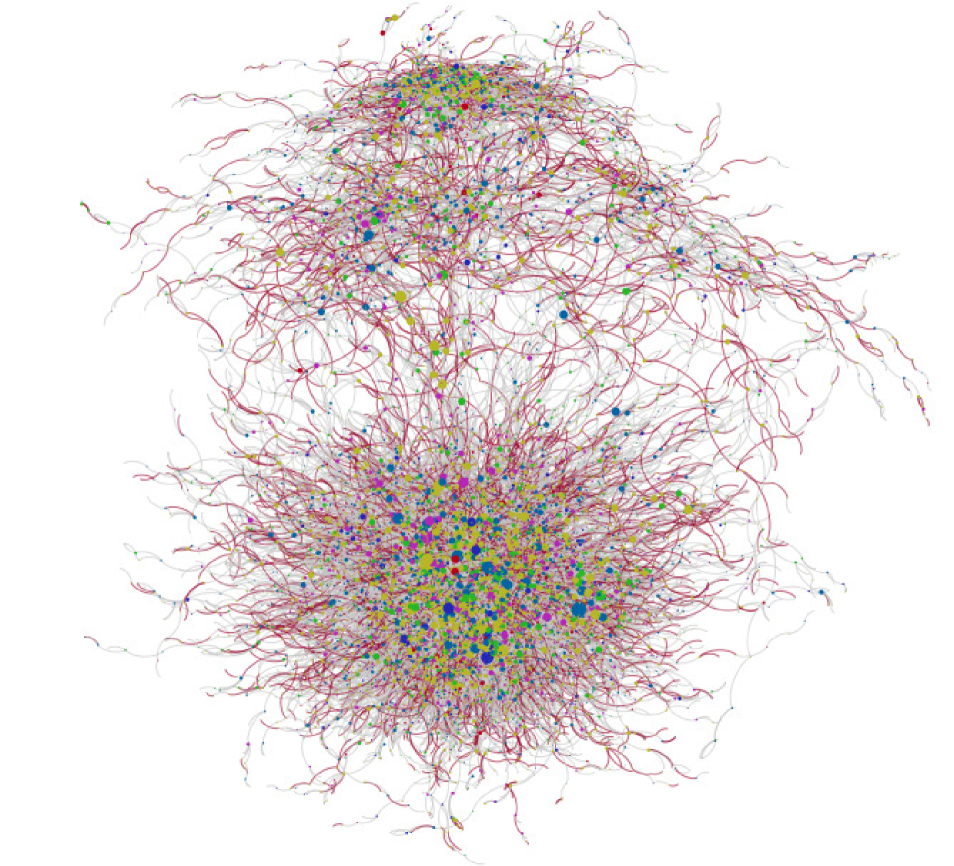
- The study uses real-world data from 3.3 million Friendster users who disclosed their sexual orientation, forming a large-scale social network.
- It models the construction of 'shadow profiles'—predictive profiles of users and non-users—based on the disclosed information of their friends.
- The researchers simulate disclosure behavior using a parameterized model with disclosure rates (ρ ∈ {0.5, 0.7, 0.9}) reflecting real-world contact list sharing.
- They compute prediction accuracy for sexual orientation using network-based features, including first- and second-order neighborhood structure and homophily.
- The analysis employs statistical modeling to assess how network size and homophily affect privacy leakage, with 10 runs per parameter combination to ensure stability.
- The privacy leak factor is defined as a function of network size and disclosure behavior, quantifying collective privacy risk.
Experimental results
Research questions
- RQ1To what extent can an OSN provider infer private information about a user based solely on the disclosures of their friends?
- RQ2How does the size and homogeneity of a user’s social network affect the risk of privacy leakage through shadow profiles?
- RQ3Does having no account in an OSN guarantee higher privacy, or can non-users still be profiled via their connected friends?
- RQ4How does the disclosure behavior of network members collectively influence the predictability of private traits like sexual orientation?
- RQ5What is the quantitative impact of network structure and assortativity on privacy risk for both users and non-users?
Key findings
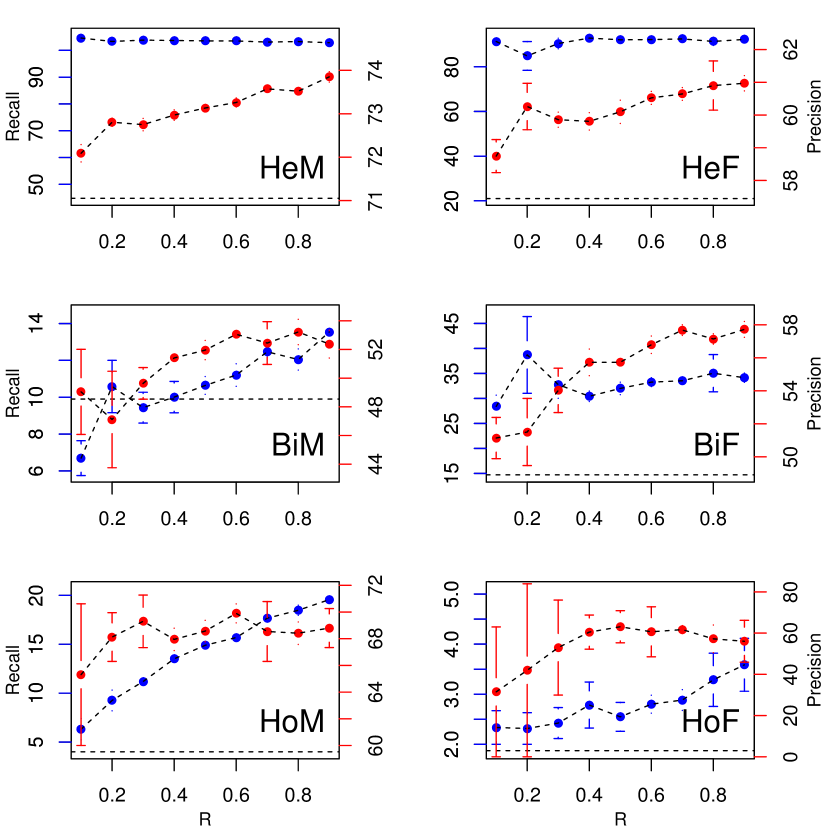
- The privacy leak factor increases significantly with the size of a user’s first- and second-order social network, indicating that larger networks amplify privacy risks.
- Prediction accuracy for sexual orientation is higher for homosexual males than for heterosexual males in partial shadow profiles, due to greater network homophily.
- Non-users are at substantial risk of privacy leakage if they are connected to users who share personal information, especially when those friends have large, homogeneous networks.
- The study identifies a strong correlation between network homophily and increased privacy leakage, particularly when friends share contact lists at high rates (ρ = 0.9).
- Even without an account, individuals can be profiled with high accuracy if their friends disclose sensitive information, demonstrating that privacy is not protected by mere non-participation.
- The results show that privacy loss is not an individual choice but a systemic outcome of collective behavior, with network structure amplifying the risk.
Read this paper
Open the full text in the Nubint reader and ask about any passage as you read.
Read this paper on NubintThis review was generated by AI from the original paper. Please check the paper before citing it.