
[Paper Review] Online Stochastic Optimization with Wasserstein Based Non-stationarity
This paper proposes a Wasserstein-based non-stationarity measure to model distribution shifts in online stochastic optimization with multiple budget constraints. It introduces an Informative Gradient Descent (IGDP) algorithm that integrates prior distribution estimates into dual-space updates, achieving optimal-order regret in both data-driven and uninformative settings under non-stationary environments.
We consider a general online stochastic optimization problem with multiple budget constraints over a horizon of finite time periods. In each time period, a reward function and multiple cost functions are revealed, and the decision maker needs to specify an action from a convex and compact action set to collect the reward and consume the budget. Each cost function corresponds to the consumption of one budget. In each period, the reward and cost functions are drawn from an unknown distribution, which is non-stationary across time. The objective of the decision maker is to maximize the cumulative reward subject to the budget constraints. This formulation captures a wide range of applications including online linear programming and network revenue management, among others. In this paper, we consider two settings: (i) a data-driven setting where the true distribution is unknown but a prior estimate (possibly inaccurate) is available; (ii) an uninformative setting where the true distribution is completely unknown. We propose a unified Wasserstein-distance based measure to quantify the inaccuracy of the prior estimate in setting (i) and the non-stationarity of the system in setting (ii). We show that the proposed measure leads to a necessary and sufficient condition for the attainability of a sublinear regret in both settings. For setting (i), we propose a new algorithm, which takes a primal-dual perspective and integrates the prior information of the underlying distributions into an online gradient descent procedure in the dual space. The algorithm also naturally extends to the uninformative setting (ii). Under both settings, we show the corresponding algorithm achieves a regret of optimal order. In numerical experiments, we demonstrate how the proposed algorithms can be naturally integrated with the re-solving technique to further boost the empirical performance.
Motivation & Objective
- To address online stochastic optimization with multiple budget constraints under non-stationary, unknown distributions.
- To develop a unified Wasserstein-distance-based measure that quantifies both prior estimate inaccuracy and environmental non-stationarity.
- To design an algorithm that achieves sublinear regret in both data-driven and uninformative settings.
- To bridge the gap between online linear programming (stationary) and network revenue management (known non-i.i.d.) by handling unknown, non-stationary distributions.
- To demonstrate the algorithm's robustness and performance through numerical experiments on network revenue management.
Proposed method
- Proposes a Wasserstein-based deviation budget (WBDB) to define an uncertainty set around prior estimates or true distributions, capturing non-stationarity and estimation error.
- Develops the Informative Gradient Descent (IGDP) algorithm that performs online gradient descent in the dual space, incorporating prior distribution knowledge via dual variable updates.
- Uses a re-solving heuristic that periodically re-solves the upper-bound problem to refine dual variables, improving performance without sacrificing computational efficiency.
- Applies a primal-dual framework where decisions are made based on dual prices derived from the uncertainty set and prior estimates.
- Employs a time-periodic re-optimization strategy to adaptively correct dual estimates, especially effective in non-stationary environments.
- Integrates the WBDB uncertainty set into the regret analysis to derive necessary and sufficient conditions for sublinear regret.
Experimental results
Research questions
- RQ1Can a Wasserstein-based measure provide a tight characterization of non-stationarity and estimation error in online stochastic optimization?
- RQ2Does integrating prior distribution estimates into a dual-space gradient descent algorithm lead to optimal regret under non-stationary distributions?
- RQ3What is the optimal trade-off between computational efficiency and performance when combining online gradient descent with periodic re-solving in non-stationary settings?
- RQ4Under what conditions is sublinear regret attainable when the true distribution is unknown and non-stationary?
- RQ5How does the performance of the IGDP algorithm compare to baseline methods across varying levels of non-stationarity and estimation error?
Key findings
- The proposed Wasserstein-based deviation budget (WBDB) provides a necessary and sufficient condition for sublinear regret in both data-driven and uninformative settings.
- The IGDP algorithm achieves optimal-order regret by adaptively integrating prior distribution knowledge into dual-space updates.
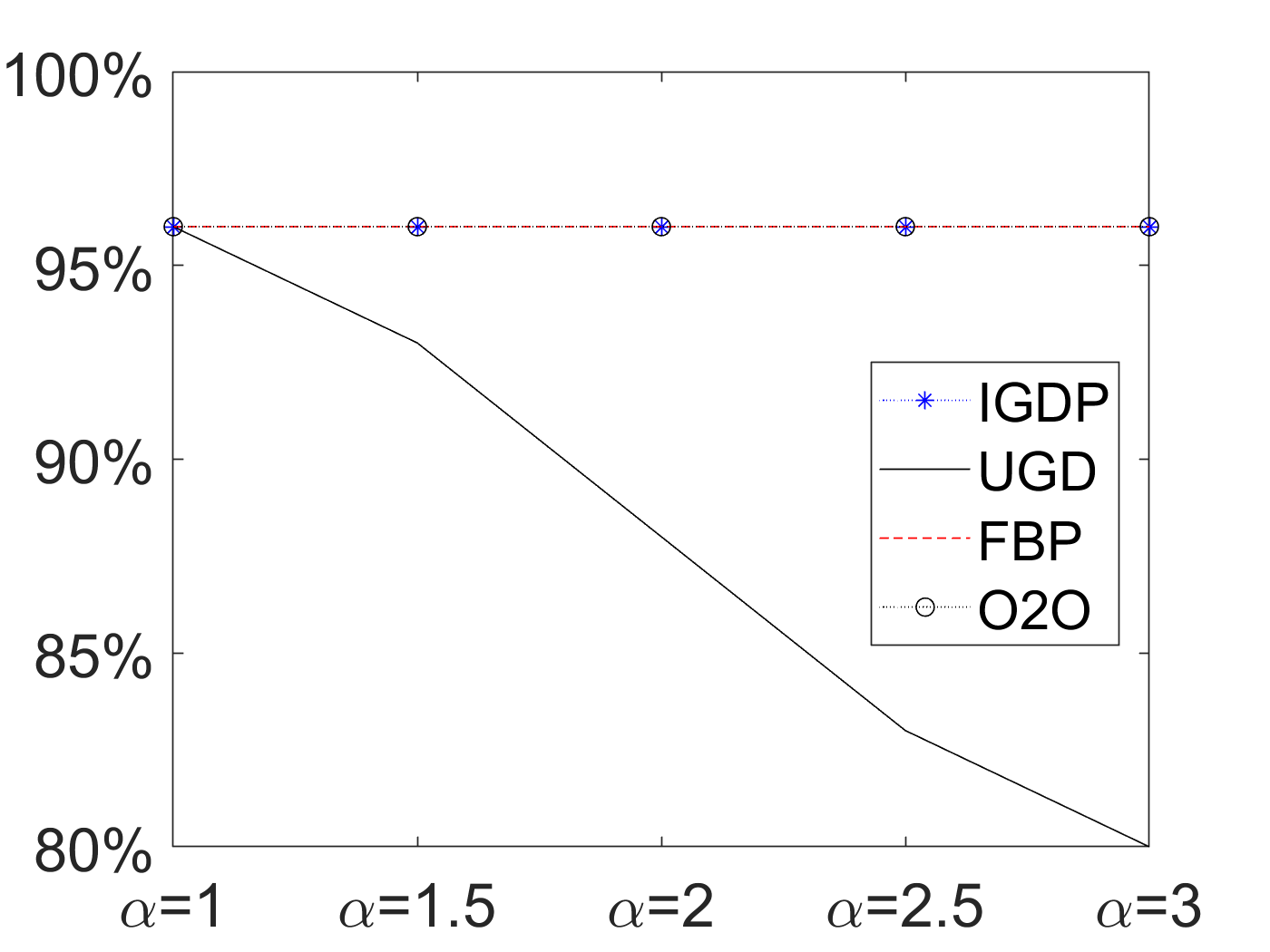
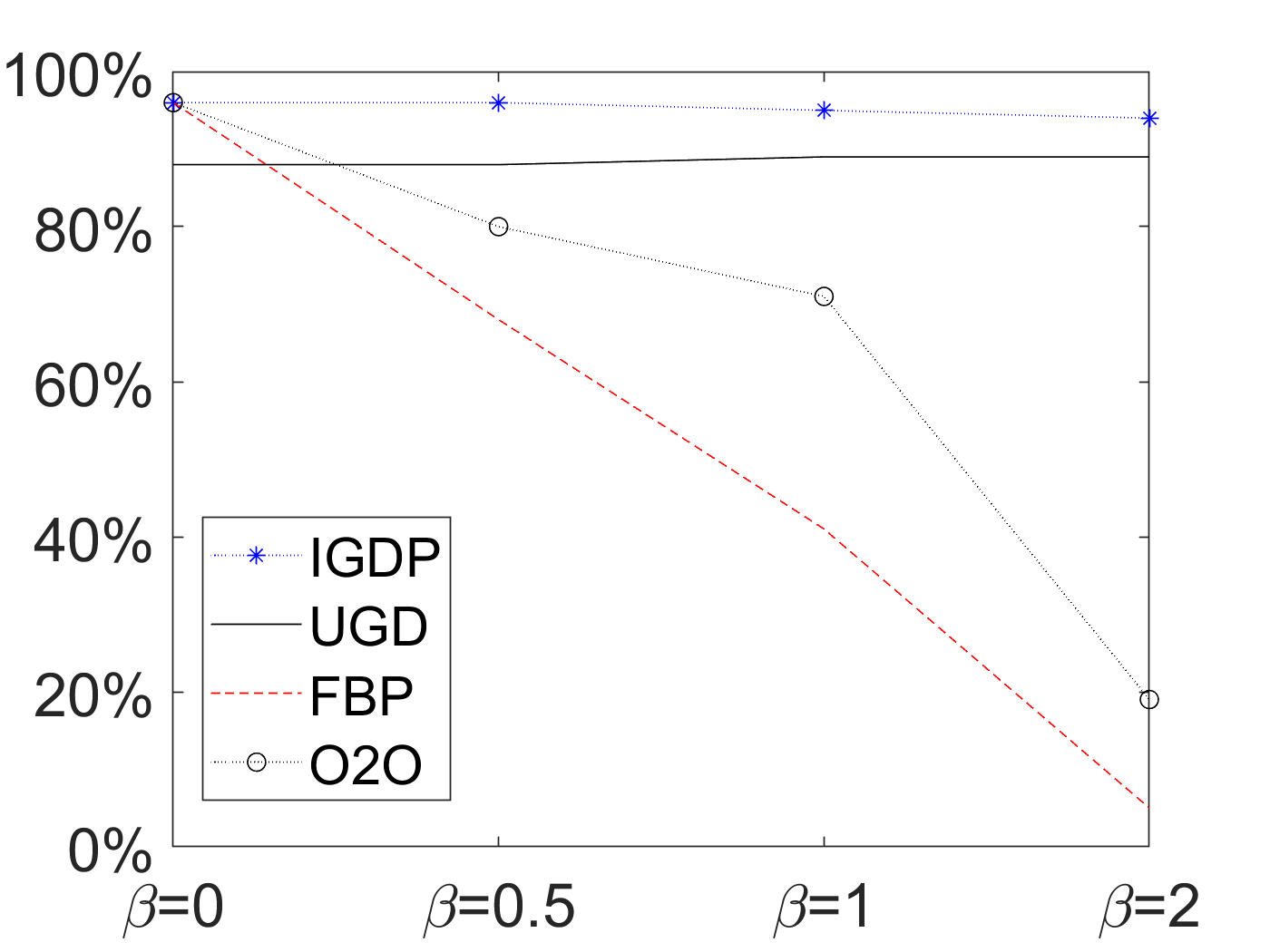
- Numerical experiments show that IGDP maintains stable performance across varying non-stationarity intensity (α) and estimation error (β), with performance within 94.9% to 98.8% of the upper bound.
- The re-solving heuristic significantly improves performance, especially at low frequencies (e.g., every 100 or 200 periods), with marginal gains beyond frequency 100.
- Even with high estimation error (β = 0.04), the IGDP with re-solving achieves 98.1% to 98.8% of the upper bound, demonstrating robustness.
- The algorithm outperforms standard OGD-type methods in non-stationary environments by leveraging prior information and adaptive re-optimization.
Read this paper
Open the full text in the Nubint reader and ask about any passage as you read.
Read this paper on NubintThis review was generated by AI from the original paper. Please check the paper before citing it.