
[Paper Review] OPANAS: One-Shot Path Aggregation Network Architecture Search for Object Detection
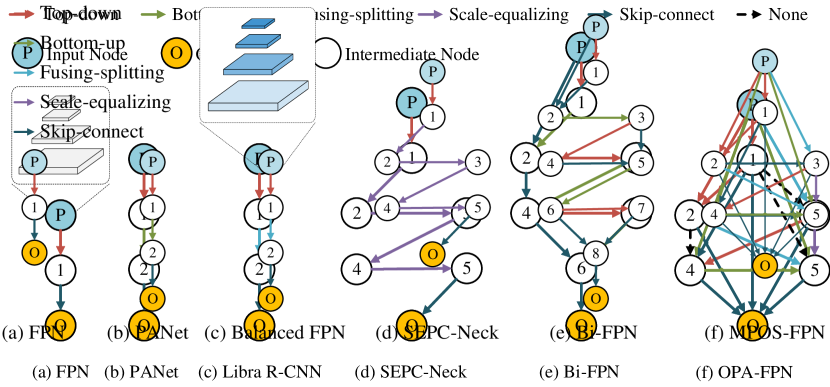
OPANAS proposes a one-shot neural architecture search framework for object detection that designs a novel, densely connected search space with six heterogeneous information paths (top-down, bottom-up, fusing-splitting, scale-equalizing, skip-connect, none) to discover optimal feature pyramid networks (FPNs). By training a super-net with fair sampling and edge importance weighting, and using an evolutionary algorithm to search the best sub-network, OPANAS achieves state-of-the-art accuracy (52.2% mAP at 7.6 FPS) with only 4 GPU days of search cost on MS-COCO, outperforming prior NAS methods in both efficiency and accuracy.
Recently, neural architecture search (NAS) has been exploited to design feature pyramid networks (FPNs) and achieved promising results for visual object detection. Encouraged by the success, we propose a novel One-Shot Path Aggregation Network Architecture Search (OPANAS) algorithm, which significantly improves both searching efficiency and detection accuracy. Specifically, we first introduce six heterogeneous information paths to build our search space, namely top-down, bottom-up, fusing-splitting, scale-equalizing, skip-connect and none. Second, we propose a novel search space of FPNs, in which each FPN candidate is represented by a densely-connected directed acyclic graph (each node is a feature pyramid and each edge is one of the six heterogeneous information paths). Third, we propose an efficient one-shot search method to find the optimal path aggregation architecture, that is, we first train a super-net and then find the optimal candidate with an evolutionary algorithm. Experimental results demonstrate the efficacy of the proposed OPANAS for object detection: (1) OPANAS is more efficient than state-of-the-art methods (e.g., NAS-FPN and Auto-FPN), at significantly smaller searching cost (e.g., only 4 GPU days on MS-COCO); (2) the optimal architecture found by OPANAS significantly improves main-stream detectors including RetinaNet, Faster R-CNN and Cascade R-CNN, by 2.3-3.2 % mAP comparing to their FPN counterparts; and (3) a new state-of-the-art accuracy-speed trade-off (52.2 % mAP at 7.6 FPS) at smaller training costs than comparable state-of-the-arts. Code will be released at https://github.com/VDIGPKU/OPANAS.
Motivation & Objective
- To address the inefficiency and limited adaptability of existing NAS-based FPNs for object detection, which often require excessive computation or are tailored to specific training setups.
- To design a richer, more flexible FPN search space that supports diverse information flow patterns beyond simple chain-like aggregations.
- To develop an efficient one-shot NAS method that enables fast and accurate discovery of optimal FPN architectures with strong generalization across detectors.
- To improve the correlation between super-net performance and actual sub-network accuracy, ensuring reliable architecture search.
Proposed method
- The search space is defined as a densely connected directed acyclic graph (DAG), where each node represents a feature pyramid level and each edge corresponds to one of six heterogeneous information paths: top-down, bottom-up, fusing-splitting, scale-equalizing, skip-connect, and none.
- Four parameterized paths (top-down, bottom-up, fusing-splitting, scale-equalizing) and two parameter-free paths (skip-connect, none) are designed to enable rich, interpretable, and efficient feature aggregation.
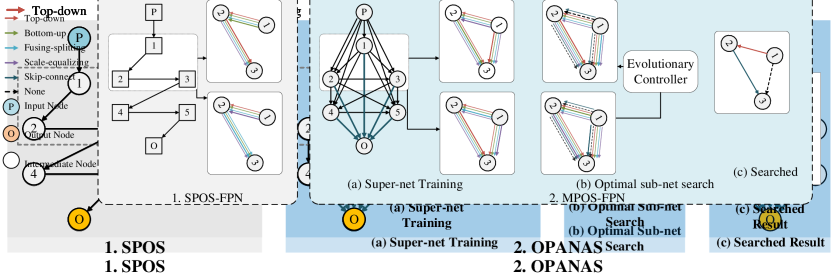
- A super-net is trained using fair sampling and edge importance weighting to stabilize training and improve the correlation between super-net and sub-net performance.
- An evolutionary algorithm is employed to search for the optimal sub-network from the trained super-net, enabling global exploration of the architecture space.
- The method uses a one-shot paradigm: train a single super-net once, then search for the best architecture without retraining.
Experimental results
Research questions
- RQ1Can a one-shot NAS framework with a richer, densely connected FPN search space outperform existing NAS-based FPNs in both accuracy and efficiency?
- RQ2How does the inclusion of multiple heterogeneous information paths (e.g., top-down, bottom-up, fusing-splitting) affect the performance of the final FPN architecture?
- RQ3To what extent does edge importance weighting and fair sampling improve the reliability of super-net ranking in one-shot NAS for FPNs?
- RQ4Can the proposed method achieve state-of-the-art accuracy-speed trade-offs in object detection with significantly reduced search cost?
Key findings
- OPANAS achieves 52.2% mAP at 7.6 FPS on MS-COCO, setting a new state-of-the-art accuracy-speed trade-off for FPN-based detectors.
- The method reduces the search cost to only 4 GPU days on MS-COCO, significantly lower than prior methods like NAS-FPN and Auto-FPN.
- OPANAS improves RetinaNet, Faster R-CNN, and Cascade R-CNN by 2.3–3.2% mAP over their FPN counterparts, demonstrating strong generalization.
- The searched architecture achieves 39.6% mAP on COCO minival with 197G FLOPs and 35.5M parameters, outperforming SPOS (38.4%), DARTS (39.1%), and Fair DARTS (39.4%) under the same search space.
- The correlation between super-net and sub-net performance reaches 0.6145 with fair sampling and edge importance weighting, significantly improving reliability over standard one-shot NAS.
Read this paper
Open the full text in the Nubint reader and ask about any passage as you read.
Read this paper on NubintThis review was generated by AI from the original paper. Please check the paper before citing it.