
[Paper Review] Open-World Continual Learning: Unifying Novelty Detection and Continual Learning
This paper unifies open-world continual learning by theoretically proving that effective class-incremental learning (CIL) requires both accurate within-task prediction and out-of-distribution (OOD) detection. The proposed MORE framework integrates these capabilities through a joint optimization of task-specific and OOD prediction heads, achieving state-of-the-art accuracy and OOD detection performance across multiple benchmarks with reduced memory usage.
As AI agents are increasingly used in the real open world with unknowns or novelties, they need the ability to (1) recognize objects that (a) they have learned before and (b) detect items that they have never seen or learned, and (2) learn the new items incrementally to become more and more knowledgeable and powerful. (1) is called novelty detection or out-of-distribution (OOD) detection and (2) is called class incremental learning (CIL), which is a setting of continual learning (CL). In existing research, OOD detection and CIL are regarded as two completely different problems. This paper first provides a theoretical proof that good OOD detection for each task within the set of learned tasks (called closed-world OOD detection) is necessary for successful CIL. We show this by decomposing CIL into two sub-problems: within-task prediction (WP) and task-id prediction (TP), and proving that TP is correlated with closed-world OOD detection. The key theoretical result is that regardless of whether WP and OOD detection (or TP) are defined explicitly or implicitly by a CIL algorithm, good WP and good closed-world OOD detection are necessary and sufficient conditions for good CIL, which unifies novelty or OOD detection and continual learning (CIL, in particular). We call this traditional CIL the closed-world CIL as it does not detect future OOD data in the open world. The paper then proves that the theory can be generalized or extended to open-world CIL, which is the proposed open-world continual learning, that can perform CIL in the open world and detect future or open-world OOD data. Based on the theoretical results, new CIL methods are also designed, which outperform strong baselines in CIL accuracy and in continual OOD detection by a large margin.
Motivation & Objective
- To address the open-world challenge where AI agents must detect novel objects and learn them incrementally.
- To unify two traditionally separate problems—out-of-distribution (OOD) detection and class-incremental learning (CIL)—by proving their theoretical interdependence.
- To design a new CIL method that naturally supports both OOD detection and continual learning without relying on distillation or large memory buffers.
- To achieve superior performance in both CIL accuracy and OOD detection while minimizing memory consumption.
Proposed method
- The paper decomposes CIL into two sub-problems: within-task prediction (WP) and task-id prediction (TP), showing that TP is equivalent to OOD detection.
- It proves that good WP and good OOD detection are necessary and sufficient conditions for effective CIL, establishing a theoretical foundation for unification.
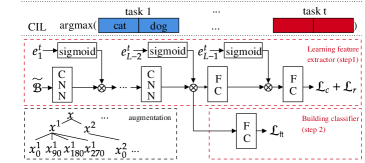
- The proposed MORE framework jointly optimizes a classifier for within-task prediction and a separate OOD score head using a unified loss function combining cross-entropy and margin-based OOD loss.
- The method uses a memory-efficient replay mechanism with a small buffer (e.g., 200–2000 samples) and avoids model distillation, reducing memory overhead.
- It employs a dual-head architecture: one for class prediction per task and one for OOD score estimation, enabling end-to-end training with shared feature representations.
- During inference, predictions are made by combining task-specific probabilities and OOD scores via a weighted concatenation, allowing joint classification and novelty detection.
Experimental results
Research questions
- RQ1Is out-of-distribution (OOD) detection theoretically necessary for effective class-incremental learning (CIL)?
- RQ2Can a single model architecture simultaneously achieve high performance in both CIL and OOD detection?
- RQ3How does the decomposition of CIL into within-task prediction and task-id prediction relate to OOD detection?
- RQ4What is the impact of avoiding model distillation and reducing memory buffer size on CIL and OOD performance?
- RQ5Can a unified framework outperform existing CIL and OOD detection methods in both accuracy and robustness?
Key findings
- The paper proves theoretically that good within-task prediction and good OOD detection are necessary and sufficient conditions for effective CIL, unifying the two problems.
- The proposed MORE method achieves state-of-the-art average classification accuracy of 88.13 on C10-5T, 71.69 on C100-10T, 71.29 on C100-20T, 64.17 on T-5T, and 61.90 on T-10T with a smaller memory buffer.
- Even with half the memory buffer size compared to baselines, MORE outperforms strong baselines such as iCaRL, DER++, and A-GEM in both CIL accuracy and OOD detection.
- MORE uses only 23.7M to 27.7M memory entries across datasets, significantly less than memory-heavy methods like Sup (45.7M) and A-GEM (31.5M), while maintaining superior performance.
- The method avoids model distillation and does not require storing previous models, reducing memory consumption by up to 1.8M entries compared to iCaRL and DER++ on CIFAR100-10T.
- In ablation studies, the joint optimization of WP and OOD heads leads to improved generalization and robustness, confirming the theoretical claims.
Better researchstarts right now
From reading papers to final review, dramatically reduce your research time.
No credit card · Free plan available
This review was created by AI and reviewed by human editors.