
[Paper Review] Open-World Pose Transfer via Sequential Test-Time Adaption
This paper proposes SEquential Test-time Adaption (SETA), a novel framework for open-world pose transfer that sequentially adapts to out-of-distribution (OOD) appearance and skeleton signals during inference. By using self-supervised augmentation for appearance texture extraction and a person Re-ID model to compute non-Euclidean posture similarity, SETA improves generalization on unseen datasets like TikTok and SHHQ, reducing LPIPS by up to 76.8% compared to baseline methods.
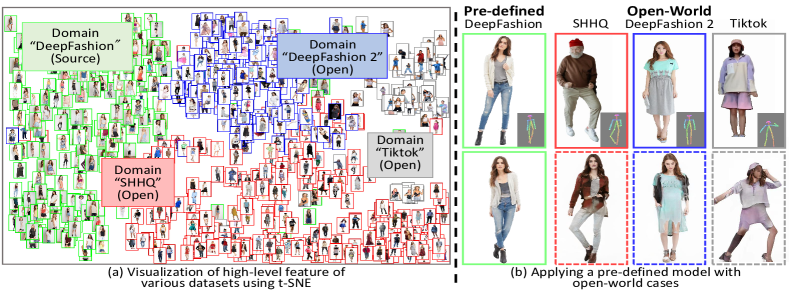
Pose transfer aims to transfer a given person into a specified posture, has recently attracted considerable attention. A typical pose transfer framework usually employs representative datasets to train a discriminative model, which is often violated by out-of-distribution (OOD) instances. Recently, test-time adaption (TTA) offers a feasible solution for OOD data by using a pre-trained model that learns essential features with self-supervision. However, those methods implicitly make an assumption that all test distributions have a unified signal that can be learned directly. In open-world conditions, the pose transfer task raises various independent signals: OOD appearance and skeleton, which need to be extracted and distributed in speciality. To address this point, we develop a SEquential Test-time Adaption (SETA). In the test-time phrase, SETA extracts and distributes external appearance texture by augmenting OOD data for self-supervised training. To make non-Euclidean similarity among different postures explicit, SETA uses the image representations derived from a person re-identification (Re-ID) model for similarity computation. By addressing implicit posture representation in the test-time sequentially, SETA greatly improves the generalization performance of current pose transfer models. In our experiment, we first show that pose transfer can be applied to open-world applications, including Tiktok reenactment and celebrity motion synthesis.
Motivation & Objective
- To address the challenge of pose transfer generalization in open-world settings where test data distributions differ significantly from training data.
- To overcome the limitations of existing test-time adaptation (TTA) methods that assume a unified signal across OOD data, which fails under complex, multi-signal distributions.
- To develop a sequential adaptation strategy that separately learns and integrates OOD appearance and skeleton signals to improve robustness and realism in pose transfer.
- To enable practical deployment of pose transfer in real-world applications such as TikTok reenactment and celebrity motion synthesis, where diverse and unseen data are common.
Proposed method
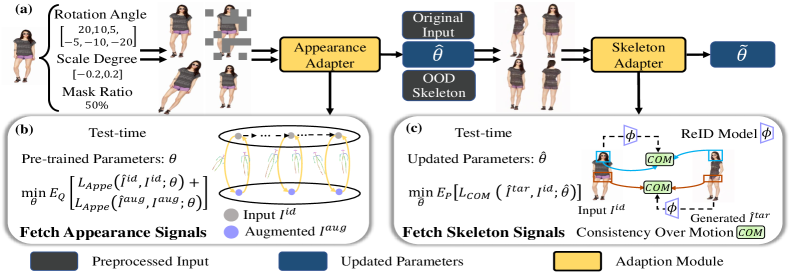
- SETA employs a sequential test-time adaptation pipeline that first adapts to OOD appearance signals using self-supervised data augmentation on external test data.
- An appearance adapter is introduced to extract and distribute external appearance textures from augmented OOD samples, stabilizing the feature-warping process.
- A skeleton adapter is applied afterward to learn implicit posture representations by leveraging image features from a pre-trained person Re-identification (Re-ID) model.
- Non-Euclidean similarity between postures is modeled using Re-ID embeddings, enabling consistent motion representation across diverse OOD skeletons.
- The framework alternates between appearance and skeleton adaptation stages, avoiding catastrophic forgetting and ensuring stable feature learning.
- The method uses iterative test-time training with a fixed number of updates per sample, balancing performance and inference efficiency.
Experimental results
Research questions
- RQ1Can test-time adaptation be effectively extended to open-world pose transfer, where multiple independent OOD signals (appearance and skeleton) coexist?
- RQ2Does sequential adaptation—first to appearance, then to skeleton—improve generalization compared to simultaneous or single-signal adaptation?
- RQ3Can self-supervised learning on augmented OOD data effectively extract disentangled appearance textures without ground-truth supervision?
- RQ4How does the use of Re-ID features improve non-Euclidean posture consistency in highly deformed or unseen skeletons?
- RQ5What is the optimal trade-off between adaptation iterations and performance gain in the test-time setting?
Key findings
- SETA reduces LPIPS by 41.66% for NTED and 46.84% for CASD when using the skeleton adapter, indicating significant improvement in perceptual quality.
- Human evaluation shows a mean opinion score (MOS) of 76.13 for NTED and 72.17 for CASD with the skeleton adapter, confirming better visual fidelity and reduced artifacts.
- The appearance adapter improves global appearance consistency, enabling stable training of the skeleton adapter and reducing distortion in generated images.
- Using 30 test-time iterations yields the best performance, reducing LPIPS to 0.049 for NTED on SHHQ, though at the cost of increased inference time (28.48s).
- Sequential adaptation—first appearance, then skeleton—proves more effective than simultaneous or reversed order, avoiding instability and catastrophic forgetting.
- The framework successfully enables pose transfer on real-world open-world datasets like TikTok and SHHQ, where baseline models exhibit severe twisty patterns and artifacts.
Read this paper
Open the full text in the Nubint reader and ask about any passage as you read.
Read this paper on NubintThis review was generated by AI from the original paper. Please check the paper before citing it.