
[Paper Review] OpenCDA:An Open Cooperative Driving Automation Framework Integrated with Co-Simulation
OpenCDA is an open-source, co-simulation framework integrating CARLA and SUMO to enable end-to-end simulation of Cooperative Driving Automation (CDA) systems. It provides a modular, full-stack platform with benchmarked algorithms and scenarios, allowing researchers to easily replace components and evaluate new CDA algorithms—demonstrated through successful platooning and merging applications with measurable safety and efficiency improvements.
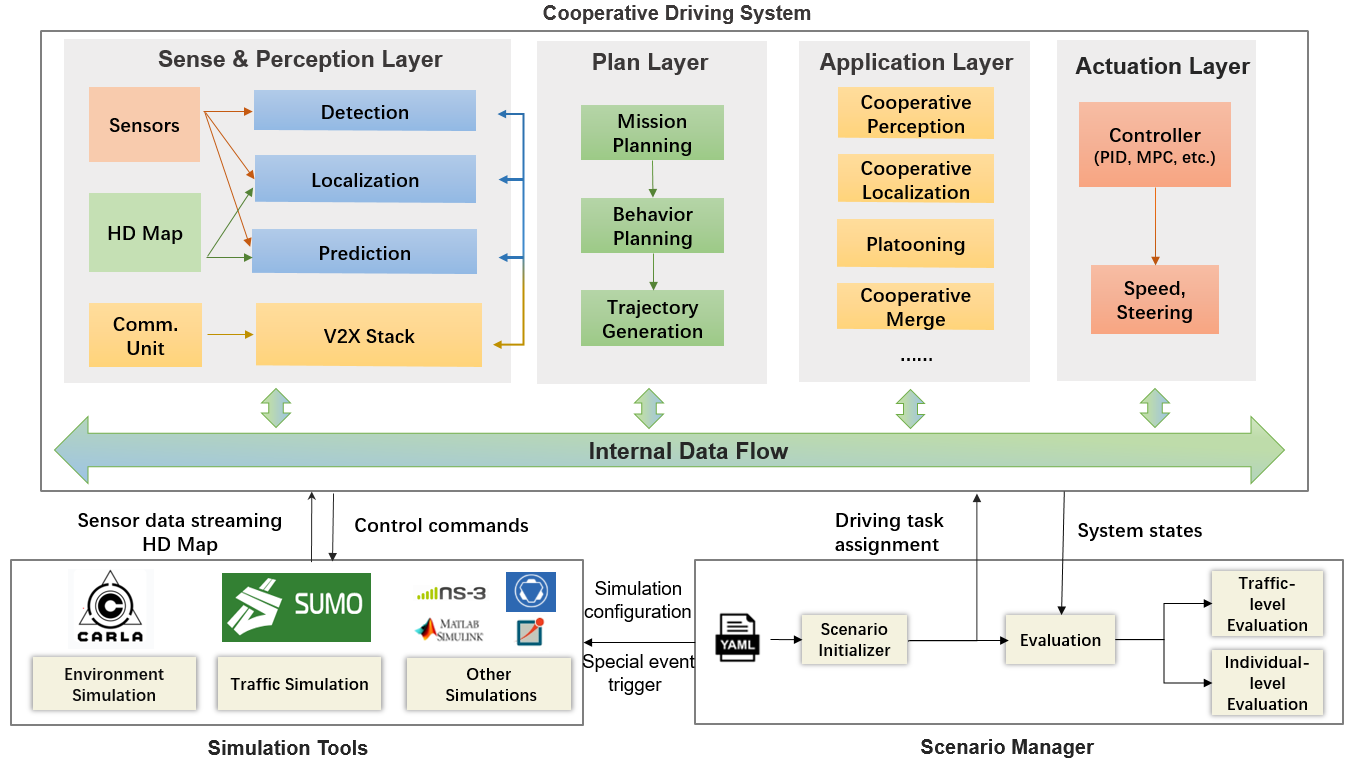
Although Cooperative Driving Automation (CDA) has attracted considerable attention in recent years, there remain numerous open challenges in this field. The gap between existing simulation platforms that mainly concentrate on single-vehicle intelligence and CDA development is one of the critical barriers, as it inhibits researchers from validating and comparing different CDA algorithms conveniently. To this end, we propose OpenCDA, a generalized framework and tool for developing and testing CDA systems. Specifically, OpenCDA is composed of three major components: a co-simulation platform with simulators of different purposes and resolutions, a full-stack cooperative driving system, and a scenario manager. Through the interactions of these three components, our framework offers a straightforward way for researchers to test different CDA algorithms at both levels of traffic and individual autonomy. More importantly, OpenCDA is highly modularized and installed with benchmark algorithms and test cases. Users can conveniently replace any default module with customized algorithms and use other default modules of the CDA platform to perform evaluations of the effectiveness of new functionalities in enhancing the overall CDA performance. An example of platooning implementation is used to illustrate the framework's capability for CDA research. The codes of OpenCDA are available in the https://github.com/ucla-mobility/OpenCDA.
Motivation & Objective
- Address the lack of integrated, open-source simulation platforms for Cooperative Driving Automation (CDA) research.
- Bridge the gap between single-vehicle autonomous driving simulators and multi-entity CDA systems.
- Provide a flexible, modular framework for researchers to prototype, test, and compare CDA algorithms efficiently.
- Enable benchmarking of CDA algorithms using standardized scenarios, evaluation metrics, and reference implementations.
- Support extensibility for integration with additional simulators (e.g., ns-3, CARSim) and customization of core modules.
Proposed method
- Integrate CARLA for high-fidelity vehicle and scene simulation with SUMO for macroscopic traffic flow and road network modeling.
- Implement a full-stack CDA software pipeline in Python, including perception, localization, planning, control, and V2X communication modules.
- Design a modular architecture allowing plug-and-play replacement of default algorithms with user-defined ones.
- Develop a scenario manager with predefined benchmark scenarios (e.g., platooning, merging) and APIs for custom scenario creation.
- Use co-simulation to synchronize vehicle dynamics, traffic flow, and communication behavior across simulators.
- Support interoperability with external simulators like ns-3 for V2X communication modeling and CARSim for high-fidelity vehicle dynamics.
Experimental results
Research questions
- RQ1How can a unified simulation framework be designed to support both individual vehicle autonomy and cooperative driving automation?
- RQ2To what extent can modularity in a CDA simulation platform enable efficient algorithm replacement and performance comparison?
- RQ3How do different merging strategies (e.g., heuristic vs. GFS) impact safety and efficiency in cooperative platooning scenarios?
- RQ4Can a full-stack, open-source CDA simulation platform achieve stable and safe performance in benchmark scenarios like platooning and merging?
- RQ5What are the key design principles for enabling extensibility and interoperability in a multi-simulator CDA co-simulation environment?
Key findings
- The platooning algorithm successfully maintained a 0.6-second time gap under dynamic leading vehicle behavior, demonstrating system stability and safety.
- In the cooperative merge scenario, the GFS-based merging strategy maintained a safe time gap above 0.6 seconds, while the heuristic method dropped below 0.2 seconds, indicating a significant safety risk.
- The GFS-based merging method completed the maneuver in 9.9 seconds, outperforming the heuristic method’s 13.1 seconds, showing improved efficiency.
- The framework enables seamless replacement of core modules—such as merging logic—with a single-line code change, preserving system functionality and accuracy.
- The benchmarked algorithms in OpenCDA demonstrated reliable performance across diverse scenarios, validating the completeness and correctness of the full CDA software pipeline.
- OpenCDA supports real-time co-simulation of heterogeneous simulators (CARLA, SUMO, and extensible V2X simulators), enabling scalable and realistic CDA testing.

Read this paper
Open the full text in the Nubint reader and ask about any passage as you read.
Read this paper on NubintThis review was generated by AI from the original paper. Please check the paper before citing it.