
[Paper Review] OpenDataVal: a Unified Benchmark for Data Valuation
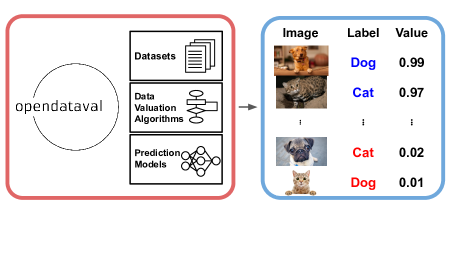
OpenDataVal is a unified, open-source benchmark framework that enables researchers and practitioners to evaluate and compare state-of-the-art data valuation algorithms across diverse datasets and machine learning tasks. It integrates 11 SOTA data valuation methods, supports models from scikit-learn and PyTorch, and provides four downstream tasks—noisy label detection, noisy feature detection, point removal, and point addition—revealing that no single algorithm uniformly outperforms others across all tasks.
Assessing the quality and impact of individual data points is critical for improving model performance and mitigating undesirable biases within the training dataset. Several data valuation algorithms have been proposed to quantify data quality, however, there lacks a systemic and standardized benchmarking system for data valuation. In this paper, we introduce OpenDataVal, an easy-to-use and unified benchmark framework that empowers researchers and practitioners to apply and compare various data valuation algorithms. OpenDataVal provides an integrated environment that includes (i) a diverse collection of image, natural language, and tabular datasets, (ii) implementations of eleven different state-of-the-art data valuation algorithms, and (iii) a prediction model API that can import any models in scikit-learn. Furthermore, we propose four downstream machine learning tasks for evaluating the quality of data values. We perform benchmarking analysis using OpenDataVal, quantifying and comparing the efficacy of state-of-the-art data valuation approaches. We find that no single algorithm performs uniformly best across all tasks, and an appropriate algorithm should be employed for a user's downstream task. OpenDataVal is publicly available at https://opendataval.github.io with comprehensive documentation. Furthermore, we provide a leaderboard where researchers can evaluate the effectiveness of their own data valuation algorithms.
Motivation & Objective
- To address the lack of a standardized, user-friendly benchmark for evaluating data valuation algorithms.
- To enable systematic comparison of state-of-the-art data valuation methods across diverse data types (image, tabular, NLP).
- To support reproducibility and transparency in data valuation research through open-source code and a public leaderboard.
- To evaluate the effectiveness of data valuation algorithms on real-world downstream ML tasks.
- To guide practitioners in selecting appropriate data valuation methods based on their specific use case.
Proposed method
- Introduces ExperimentMediator, a unified API for specifying datasets, valuation algorithms, models, metrics, and hyperparameters.
- Supports integration of 11 state-of-the-art data valuation algorithms, including DataShapley, BetaShapley, LOO, and DVRL.
- Provides access to a curated collection of public datasets from OpenML, scikit-learn, and PyTorch for image, tabular, and NLP tasks.
- Enables model import via scikit-learn and PyTorch APIs, supporting both classical and deep learning models.
- Employs four downstream evaluation tasks: noisy label detection, noisy feature detection, point removal, and point addition experiments.
- Offers a public leaderboard for researchers to submit and benchmark their own data valuation algorithms.
Experimental results
Research questions
- RQ1Which data valuation algorithm performs best across diverse data types and downstream machine learning tasks?
- RQ2How do different data valuation methods compare in detecting noisy labels in training data?
- RQ3To what extent do data valuation scores correlate with model performance when data points are removed or added?
- RQ4Can data valuation algorithms effectively identify mislabeled or low-quality data in real-world datasets?
- RQ5Is there a universally optimal data valuation method, or does performance depend on the specific downstream task?
Key findings
- No single data valuation algorithm consistently outperforms others across all four downstream tasks, indicating task-specific performance variation.
- DataShapley and BetaShapley show strong performance in noisy label detection, particularly on image datasets like CIFAR-10.
- LOO and AME demonstrate competitive results in point removal and addition experiments, especially in tabular and NLP settings.
- The performance of data valuation methods varies significantly across data modalities, with image data showing more consistent results than tabular or NLP data.
- The benchmark reveals that algorithm choice should be guided by the specific downstream task, such as data cleaning or model debugging.
- The OpenDataVal framework enables reproducible evaluation and supports community-driven progress through its public leaderboard and open-source repository.
Read this paper
Open the full text in the Nubint reader and ask about any passage as you read.
Read this paper on NubintThis review was generated by AI from the original paper. Please check the paper before citing it.