
[Paper Review] OpenGSL: A Comprehensive Benchmark for Graph Structure Learning
OpenGSL provides a fair, unified benchmark for graph structure learning (GSL), evaluating 13 methods across 10 datasets, and analyzes homophily, generalizability, and efficiency to reveal when GSL helps or hurts GNNs.
Graph Neural Networks (GNNs) have emerged as the de facto standard for representation learning on graphs, owing to their ability to effectively integrate graph topology and node attributes. However, the inherent suboptimal nature of node connections, resulting from the complex and contingent formation process of graphs, presents significant challenges in modeling them effectively. To tackle this issue, Graph Structure Learning (GSL), a family of data-centric learning approaches, has garnered substantial attention in recent years. The core concept behind GSL is to jointly optimize the graph structure and the corresponding GNN models. Despite the proposal of numerous GSL methods, the progress in this field remains unclear due to inconsistent experimental protocols, including variations in datasets, data processing techniques, and splitting strategies. In this paper, we introduce OpenGSL, the first comprehensive benchmark for GSL, aimed at addressing this gap. OpenGSL enables a fair comparison among state-of-the-art GSL methods by evaluating them across various popular datasets using uniform data processing and splitting strategies. Through extensive experiments, we observe that existing GSL methods do not consistently outperform vanilla GNN counterparts. We also find that there is no significant correlation between the homophily of the learned structure and task performance, challenging the common belief. Moreover, we observe that the learned graph structure demonstrates a strong generalization ability across different GNN models, despite the high computational and space consumption. We hope that our open-sourced library will facilitate rapid and equitable evaluation and inspire further innovative research in this field. The code of the benchmark can be found in https://github.com/OpenGSL/OpenGSL.
Motivation & Objective
- Assess how much progress existing GSL methods make under standardized data preprocessing and splits.
- Investigate whether learning more homophilous graph structures improves GSL performance.
- Evaluate the generalizability of learned structures across different GNN backbones and simple non-GNN baselines.
- Examine the time and memory efficiency of current GSL methods to identify practical limitations.
Proposed method
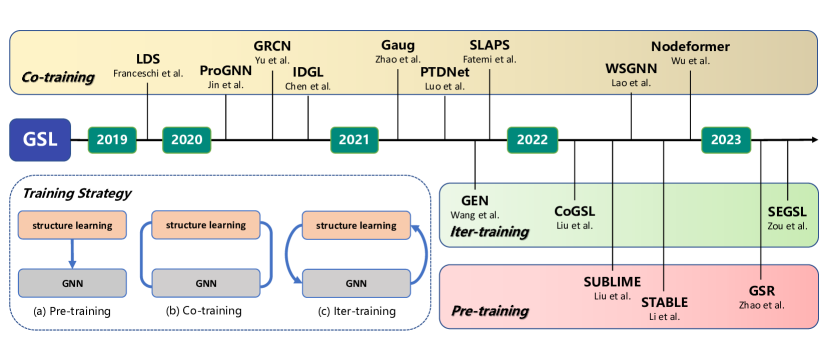
- Re-implement and reproduce thirteen state-of-the-art GSL methods under unified APIs.
- Evaluate methods on ten datasets with consistent data processing and splits for fair comparison.
- Train and test using GCN backbones and report mean ± standard deviation over 10 runs.
Experimental results
Research questions
- RQ1RQ1: How much progress have existing GSL methods made under fair, standardized evaluation?
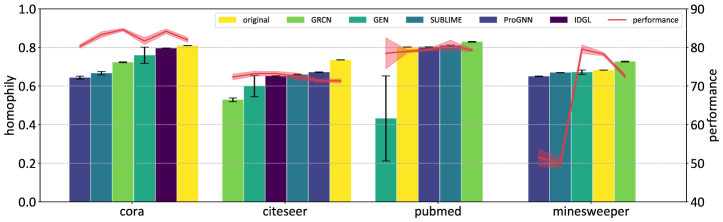
- RQ2RQ2: Does learning graph structures with higher homophily consistently improve performance?
- RQ3RQ3: Do learned structures generalize to other GNN models beyond the training backbone?
- RQ4RQ4: Are existing GSL methods efficient in terms of time and space?
Key findings
- GSL methods do not consistently beat vanilla GCN across all datasets.
- The learned structure homophily does not universally correlate with better performance, and increases are dataset-dependent.
- Learned structures show strong generalizability across different GNN models and can even help non-GNN methods like LPA and LINK.
- Most GSL methods are time- and memory-inefficient, with some methods taking up to 190x longer than GCN and memory usage up to 66x higher.
Read this paper
Open the full text in the Nubint reader and ask about any passage as you read.
Read this paper on NubintThis review was generated by AI from the original paper. Please check the paper before citing it.