
[Paper Review] OpenTwins: An open-source framework for the design, development and integration of effective 3D-IoT-AI-powered digital twins
OpenTwins is an open-source, extensible framework that integrates 3D visualization, IoT data streams, and real-time AI/ML predictions into a unified digital twin platform based on Eclipse Ditto. It enables seamless orchestration of these components for industrial applications, demonstrating low-latency performance (under 1 second with 17 clients) and strong error recovery (sub-second recovery times), with validation in a petrochemical industry use case for real-time freezing point prediction.
Although digital twins have recently emerged as a clear alternative for reliable asset representations, most of the solutions and tools available for the development of digital twins are tailored to specific environments. Furthermore, achieving reliable digital twins often requires the orchestration of technologies and paradigms such as machine learning, the Internet of Things, and 3D visualization, which are rarely seamlessly aligned. In this paper, we present a generic framework for the development of effective digital twins combining some of the aforementioned areas. In this open framework, digital twins can be easily developed and orchestrated with 3D connected visualizations, IoT data streams, and real-time machine-learning predictions. To demonstrate the feasibility of the framework, a use case in the Petrochemical Industry 4.0 has been developed.
Motivation & Objective
- To address the lack of generic, extensible frameworks that seamlessly integrate 3D visualization, IoT data, and real-time AI/ML predictions for digital twins.
- To overcome the limitations of domain-specific digital twin platforms that require extensive custom integration for AI/ML and 3D rendering.
- To provide a unified, scalable, and fault-tolerant platform for continuous development and integration of effective digital twins across diverse industrial contexts.
- To enable digital twin composition for complex systems (e.g., train systems) by supporting modular, composable twin architectures.
Proposed method
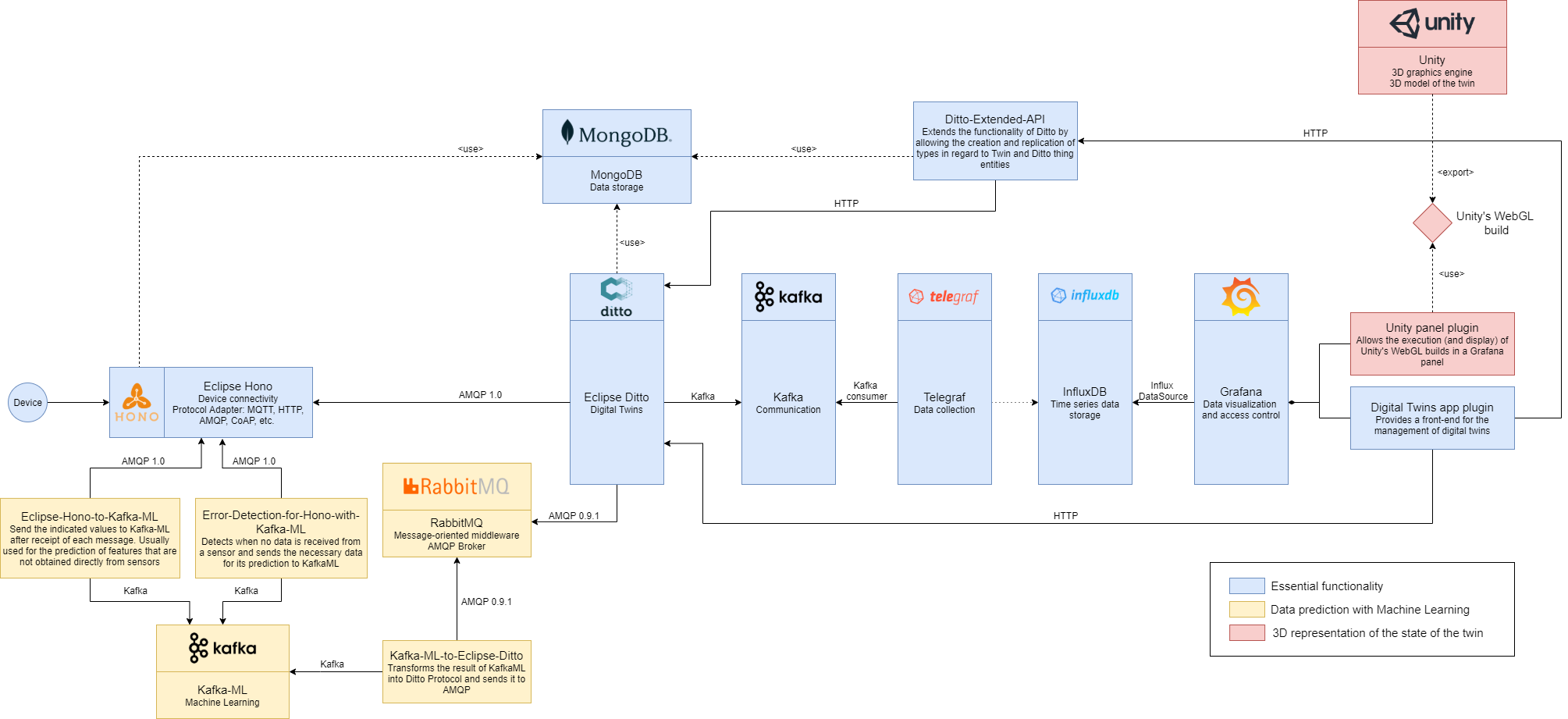
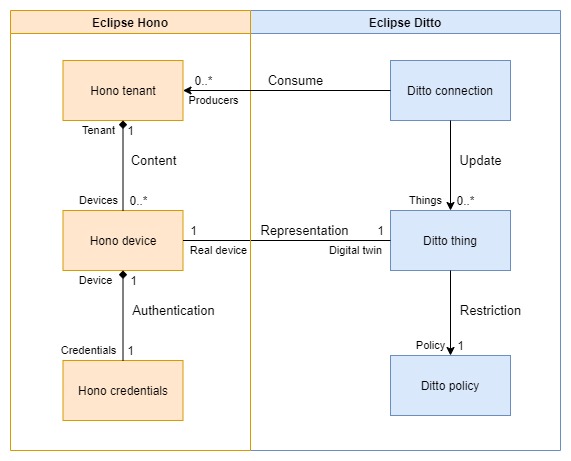
- The framework is built on Eclipse Ditto for secure, standardized abstraction and real-time monitoring of physical assets and their data streams.
- It integrates Kafka-ML for end-to-end machine learning pipelines, enabling real-time inference and model updates on streaming IoT data.
- Unity 3D is used as the 3D rendering engine to provide interactive, real-time visualization of digital twins with dynamic state updates.
- The system is deployed on Kubernetes for high availability and fault tolerance, with automated recovery mechanisms for service disruptions.
- A modular microservices architecture decouples IoT ingestion, AI/ML processing, and 3D visualization, enabling independent scaling and maintenance.
- Error tolerance is evaluated via manual pod deletion and message replay, with data consistency validated using InfluxDB for time-series comparison.
Experimental results
Research questions
- RQ1How can a generic, open-source framework effectively orchestrate 3D visualization, real-time IoT data, and AI/ML predictions in a single digital twin platform?
- RQ2What performance characteristics (latency, throughput) does the framework exhibit under increasing client loads during real-time prediction workloads?
- RQ3How resilient is the framework to service failures, and what is the recovery time for critical components like IoT brokers and data processing pods?
- RQ4To what extent can the framework be extended to support standardized simulation models such as FMI for hybrid digital twins?
- RQ5Can the framework be successfully applied and validated in a real industrial context beyond proof-of-concept?
Key findings
- The framework achieved low latency under real-time workloads, with prediction latency remaining under one second even with 17 simultaneous clients.
- Throughput decreased only moderately under high load, indicating scalable performance for industrial monitoring and prediction workloads.
- Recovery times for failed services were consistently low—under one second for most components—demonstrating strong fault tolerance.
- The Kafka-ML integration enabled reliable, real-time inference with message replay, ensuring minimal data loss during recovery.
- The platform successfully visualized real-time freezing point predictions in a 3D digital twin of a petrochemical process, validating its usability in industrial settings.
- Data loss during recovery was minimal and limited to specific components (e.g., Eclipse Hono MQTT adapter), with most services recovering without data loss.
Read this paper
Open the full text in the Nubint reader and ask about any passage as you read.
Read this paper on NubintThis review was generated by AI from the original paper. Please check the paper before citing it.