
[Paper Review] OphGLM: Training an Ophthalmology Large Language-and-Vision Assistant based on Instructions and Dialogue
OphGLM integrates fundus-image diagnosis with an ophthalmology-focused large language model, trained on a 20k+ instruction/dialogue dataset to provide multimodal ophthalmic Q&A and guidance.
Large multimodal language models (LMMs) have achieved significant success in general domains. However, due to the significant differences between medical images and text and general web content, the performance of LMMs in medical scenarios is limited. In ophthalmology, clinical diagnosis relies on multiple modalities of medical images, but unfortunately, multimodal ophthalmic large language models have not been explored to date. In this paper, we study and construct an ophthalmic large multimodal model. Firstly, we use fundus images as an entry point to build a disease assessment and diagnosis pipeline to achieve common ophthalmic disease diagnosis and lesion segmentation. Then, we establish a new ophthalmic multimodal instruction-following and dialogue fine-tuning dataset based on disease-related knowledge data and publicly available real-world medical dialogue. We introduce visual ability into the large language model to complete the ophthalmic large language and vision assistant (OphGLM). Our experimental results demonstrate that the OphGLM model performs exceptionally well, and it has the potential to revolutionize clinical applications in ophthalmology. The dataset, code, and models will be made publicly available at https://github.com/ML-AILab/OphGLM.
Motivation & Objective
- Develop an ophthalmology-focused large language-and-vision assistant (OphGLM) that accepts fundus images and engages in instruction-following dialogue.
- Construct a fundus-based diagnosis and lesion segmentation pipeline for common ophthalmic diseases.
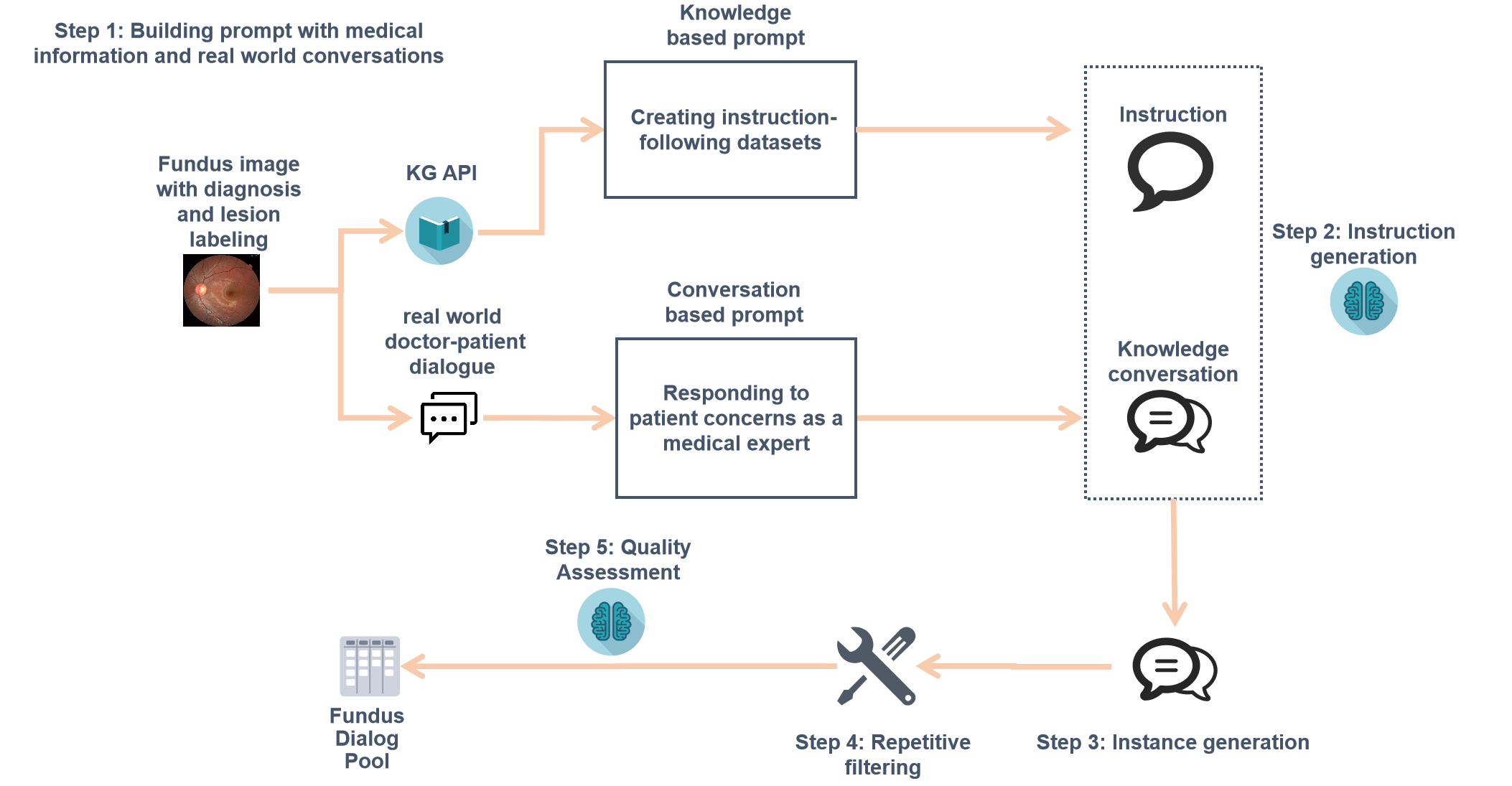
- Build an ophthalmology knowledge-grounded instruction-tuning and dialogue dataset leveraging real-world conversations and knowledge graphs.
- Fine-tune an LLM (ChatGLM) on ophthalmology dialogues to enhance medical QA and patient-facing dialogue quality.
- Demonstrate the model’s effectiveness and outline plans for extending to additional imaging modalities and diseases.
Proposed method
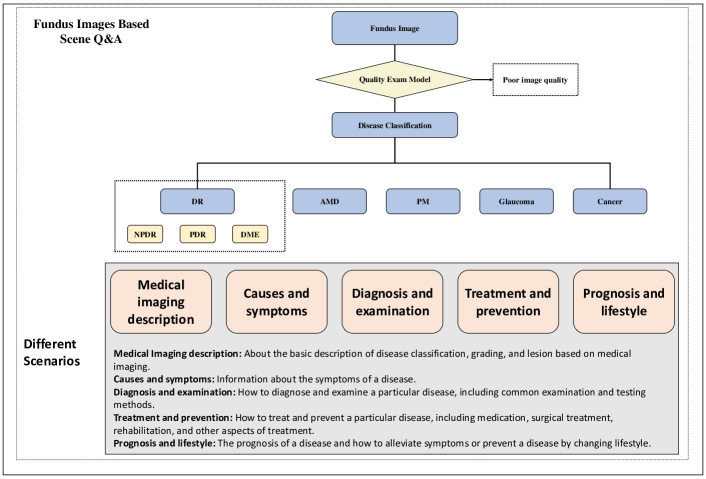
- Develop a fundus diagnosis pipeline with five disease classifiers (DR grading, AMD, glaucoma, pathological myopia, fundus tumor) and lesion segmentation for EX, SE, MA, HE.
- Create diagnostic reports by integrating classification/segmentation outputs into predefined text templates.
- Combine the fundus diagnostic report with user dialogue to form prompts for OphGLM, enabling multimodal responses.
- Construct an Instr- and Dialog-based fine-tuning dataset ( >20k instances ) using knowledge graphs and real doctor-patient conversations (MedDialog) via ChatGPT.
- Fine-tune ChatGLM (6.2B parameters) on the ophthalmology fundus dialogue dataset to form OphGLM.
- Evaluate model performance on standard accuracy and Dice metrics across classification and segmentation tasks.
Experimental results
Research questions
- RQ1Can OphGLM accurately diagnose common ophthalmic diseases from fundus images?
- RQ2How does joint image-text dialogue fine-tuning improve ophthalmology question-answering and reliability compared to text-only baselines?
- RQ3What is the performance of the fundus diagnosis pipeline across DR, AMD, glaucoma, pathological myopia, and fundus tumors?
- RQ4How well does the lesion segmentation component perform on EX, SE, MA, and HE lesions?
- RQ5Can OphGLM provide user-friendly, medically accurate dialogue that aligns with real-world clinical explanations?
Key findings
- DR_class_model achieves 0.970 accuracy.
- Glaucoma_class_model achieves 0.940 accuracy.
- PALM_class_model achieves 0.998 accuracy.
- AMD_class_model achieves 0.984 accuracy.
- Tumor_class_model achieves 0.999 accuracy.
- EX_seg_model achieves 0.854 Dice.
- HE_seg_model achieves 0.805 Dice.
- MA_seg_model achieves 0.699 Dice.
- SE_seg_model achieves 0.812 Dice.
Read this paper
Open the full text in the Nubint reader and ask about any passage as you read.
Read this paper on NubintThis review was generated by AI from the original paper. Please check the paper before citing it.