
[Paper Review] Optimal Fairness-Aware Time and Power Allocation in Wireless Powered Communication Networks
This paper proposes an optimal fairness-aware time and power allocation framework for wireless powered communication networks (WPCNs) that jointly maximizes sum α-fair utility by balancing spectral efficiency and user fairness. By transforming the non-convex sum α-fair utility problem into a convex one, the authors derive closed-form solutions for time and power allocation, showing that optimal performance is achieved when all available time is utilized, with fairness adjusted via the α parameter.
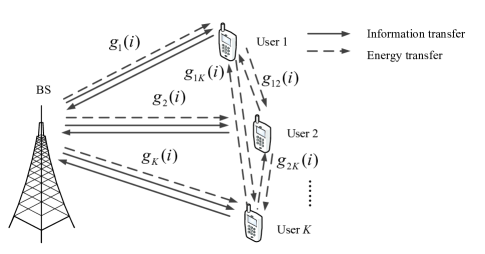
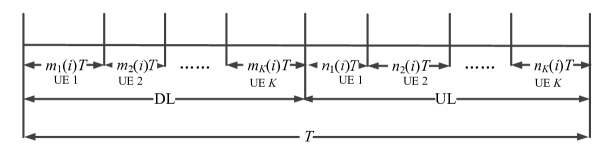
In this paper, we consider the sum $α$-fair utility maximization problem for joint downlink (DL) and uplink (UL) transmissions of a wireless powered communication network (WPCN) via time and power allocation. In the DL, the users with energy harvesting receiver architecture decode information and harvest energy based on simultaneous wireless information and power transfer. While in the UL, the users utilize the harvested energy for information transmission, and harvest energy when other users transmit UL information. We show that the general sum $α$-fair utility maximization problem can be transformed into an equivalent convex one. Tradeoffs between sum rate and user fairness can be balanced via adjusting the value of $α$. In particular, for zero fairness, i.e., $α=0$, the optimal allocated time for both DL and UL is proportional to the overall available transmission power. Tradeoffs between sum rate and user fairness are presented through simulations.
Motivation & Objective
- To address the trade-off between sum rate and user fairness in wireless powered communication networks (WPCNs), where users harvest energy from both downlink (DL) and uplink (UL) signals.
- To formulate a general sum α-fair utility maximization problem that enables smooth trade-offs between system sum rate and fairness across users.
- To develop a joint time and power allocation strategy that optimizes system performance under energy harvesting constraints in both DL and UL transmissions.
- To prove that the sum α-fair utility maximization problem is convex and can be solved efficiently with closed-form solutions for optimal time and power allocation.
Proposed method
- The paper formulates the sum α-fair utility maximization problem as a non-convex optimization problem, which is then transformed into an equivalent convex problem using mathematical relaxation and duality techniques.
- Lagrangian duality is applied to derive the Karush-Kuhn-Tucker (KKT) conditions for the convexified problem, enabling the derivation of optimal solutions.
- The optimal time allocation for both DL and UL is derived in closed form for the case α = 0 (zero fairness), showing proportionality to available transmission power.
- The optimal power allocation is derived by solving the KKT conditions under complementary slackness, resulting in closed-form expressions for transmit power in both DL and UL phases.
- The method accounts for simultaneous information decoding and energy harvesting in both DL and UL, modeling interference and channel fading in quasi-static flat-fading channels.
- The solution ensures that all available time is utilized to maximize the sum α-fair utility, with fairness controlled via the α parameter.
Experimental results
Research questions
- RQ1How can time and power be jointly allocated in WPCNs to maximize sum α-fair utility while balancing fairness and spectral efficiency?
- RQ2What is the optimal time and power allocation strategy when users harvest energy from both downlink and uplink transmissions?
- RQ3Can the general sum α-fair utility maximization problem in WPCNs be transformed into a convex problem for efficient solution?
- RQ4What is the impact of the fairness parameter α on the optimal time and power allocation in WPCNs?
- RQ5Under what conditions is the sum α-fair utility maximized, and how does the system performance vary with α?
Key findings
- The sum α-fair utility maximization problem in WPCNs is proven to be convex, enabling efficient and globally optimal solution via convex optimization techniques.
- For α = 0 (zero fairness), the optimal time allocation for both DL and UL is proportional to the overall available transmission power, maximizing sum rate.
- The optimal time allocation is achieved when all available time is used, indicating that time efficiency is critical for maximizing fairness-aware utility.
- Closed-form expressions are derived for optimal power allocation in both DL and UL phases, based on channel gains, noise, and fairness constraints.
- Simulations demonstrate a smooth trade-off between sum rate and user fairness by adjusting the α parameter, with higher α values favoring fairness over sum rate.
- The proposed method outperforms existing schemes that fix time fractions or assume energy harvesting only in DL, by jointly optimizing time and power across both phases.
Read this paper
Open the full text in the Nubint reader and ask about any passage as you read.
Read this paper on NubintThis review was generated by AI from the original paper. Please check the paper before citing it.