
[Paper Review] Optimal Resource Allocation Design for Large IRS-Assisted SWIPT Systems: A Scalable Optimization Framework
This paper proposes a scalable optimization framework for large intelligent reflecting surface (IRS)-assisted simultaneous wireless information and power transfer (SWIPT) systems, partitioning the IRS into tiles and precomputing optimal phase shift configurations (transmission modes) offline. By jointly optimizing beamforming and mode selection via branch-and-bound and a penalty-based successive convex approximation, the framework achieves significant power savings while enabling efficient online operation for large IRSs with non-linear energy harvesting models.
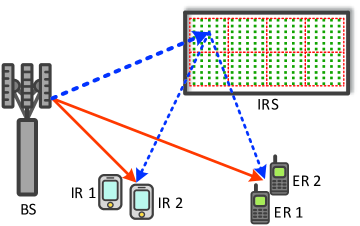
In this paper, we study the optimal resource allocation algorithm design for large intelligent reflecting surface (IRS)-assisted simultaneous wireless information and power transfer (SWIPT) systems. To facilitate efficient system design for large IRSs, instead of jointly optimizing all the IRS elements, we partition the IRS into several tiles and employ a scalable optimization framework comprising an offline design stage and an online optimization stage. In the offline stage, the IRS elements of each tile are jointly designed to support a set of different phase shift configurations, referred to as transmission modes, while the best transmission mode is selected from the set for each tile in the online stage. Given a transmission mode set, we aim to minimize the total base station (BS) transmit power by jointly optimizing the beamforming and the transmission mode selection policy taking into account the quality-of-service requirements of information decoding and non-linear energy harvesting receivers, respectively. Although the resource allocation algorithm design is formulated as a non-convex combinatorial optimization problem, we solve it optimally by applying the branch-and-bound (BnB) approach which entails a high computational complexity. To strike a balance between optimality and computational complexity, we also develop an efficient suboptimal algorithm capitalizing on the penalty method and successive convex approximation. Our simulation results show that the proposed designs enable considerable power savings compared to several baseline schemes. Moreover, our results reveal that by properly adjusting the numbers of tiles and transmission modes, the proposed scalable optimization framework indeed facilitates online design for large IRSs.
Motivation & Objective
- To address the high computational complexity of optimizing large IRSs in SWIPT systems with non-linear energy harvesting (EH) models.
- To overcome the limitations of element-wise IRS optimization, which scales poorly with IRS size.
- To enable efficient online resource allocation for large IRSs by decoupling offline design from online selection.
- To minimize total base station transmit power while satisfying QoS requirements for both information decoding and non-linear energy harvesting receivers.
- To provide a flexible trade-off between performance and complexity through tunable tile and mode counts.
Proposed method
- Partitioning the large IRS into multiple tiles to reduce optimization complexity.
- Introducing an offline stage to precompute optimal phase shift configurations (transmission modes) for each tile.
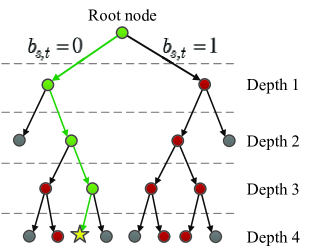
- Employing a branch-and-bound (BnB) approach to solve the non-convex combinatorial optimization problem optimally.
- Developing a suboptimal algorithm using the penalty method and successive convex approximation to reduce computational complexity.
- Modeling non-linear energy harvesting with a physics-based model to improve accuracy over linear approximations.
- Jointly optimizing beamforming vectors and transmission mode selection under QoS constraints for information and energy receivers.
Experimental results
Research questions
- RQ1How can resource allocation in large IRS-assisted SWIPT systems be made scalable without sacrificing optimality?
- RQ2What is the impact of using a non-linear energy harvesting model versus a linear one on system performance and power efficiency?
- RQ3How does the proposed tile-based partitioning and transmission mode selection framework affect online optimization complexity and performance?
- RQ4What trade-offs exist between the number of tiles, number of transmission modes, and system performance in large IRS deployments?
- RQ5Can the proposed framework achieve significant power savings compared to baseline schemes while remaining computationally feasible for large IRSs?
Key findings
- The proposed scalable optimization framework enables substantial power savings compared to baseline schemes, particularly when using non-linear energy harvesting models.
- The suboptimal algorithm based on the penalty method and successive convex approximation achieves near-optimal performance with significantly reduced computational complexity.
- Properly tuning the number of tiles and transmission modes allows for a flexible trade-off between performance and complexity in large IRS systems.
- The physics-based non-linear EH model leads to more accurate and practical system design compared to linear models, especially under fading conditions.
- The optimal beamforming matrices are shown to be rank-one, enabling efficient implementation and simplifying signal processing.
Read this paper
Open the full text in the Nubint reader and ask about any passage as you read.
Read this paper on NubintThis review was generated by AI from the original paper. Please check the paper before citing it.