
[Paper Review] Optimization of a Radiofrequency Ablation FEM Application Using Parallel Sparse Solvers
The paper accelerates RAFEM finite element simulations for radiofrequency ablation by using parallel sparse solvers (MAGMA cuSOLVER, QRMumps) on multicore and GPU platforms, achieving up to 40x speedup while preserving numerical quality.
Finite element method applications are a common approach to simulate a handful of phenomena but can take a lot of computing power, causing elevated waiting time to produce precise results. The radiofrequency ablation finite element method is an application to simulate the medical procedure of radiofrequency ablation, a minimally invasive liver cancer treatment. The application runs sequentially and can take up to 20 hours of execution to generate 15 minutes of simulation results. Most of this time arises from the need to solve a sparse system of linear equations. In this work, we accelerate this application by using three sparse solvers packages (MAGMA cuSOLVER, and QRMumps), including direct and iterative methods over different multicore and GPU architectures. We conducted a numerical result analysis to access the solution quality provided by the distinct solvers and their configurations, proposing the use of the peak signal-to-noise ratio metric. We were able to reduce the application execution time up to 40 times compared to the original sequential version while keeping a similar numerical quality for the results.
Motivation & Objective
- Motivate speeding up the computationally heavy RAFEM FEM application for hepatic RFA treatment.
- Investigate parallel sparse solvers (direct and iterative) on multicore CPUs and GPUs for the solve step.
- Evaluate numerical quality of parallel results using PSNR against the original sequential solution.
- Analyze performance across different hardware, mesh sizes, and solver configurations.
- Provide methodological guidance for applying sparse solvers to similar FEM applications.
Proposed method
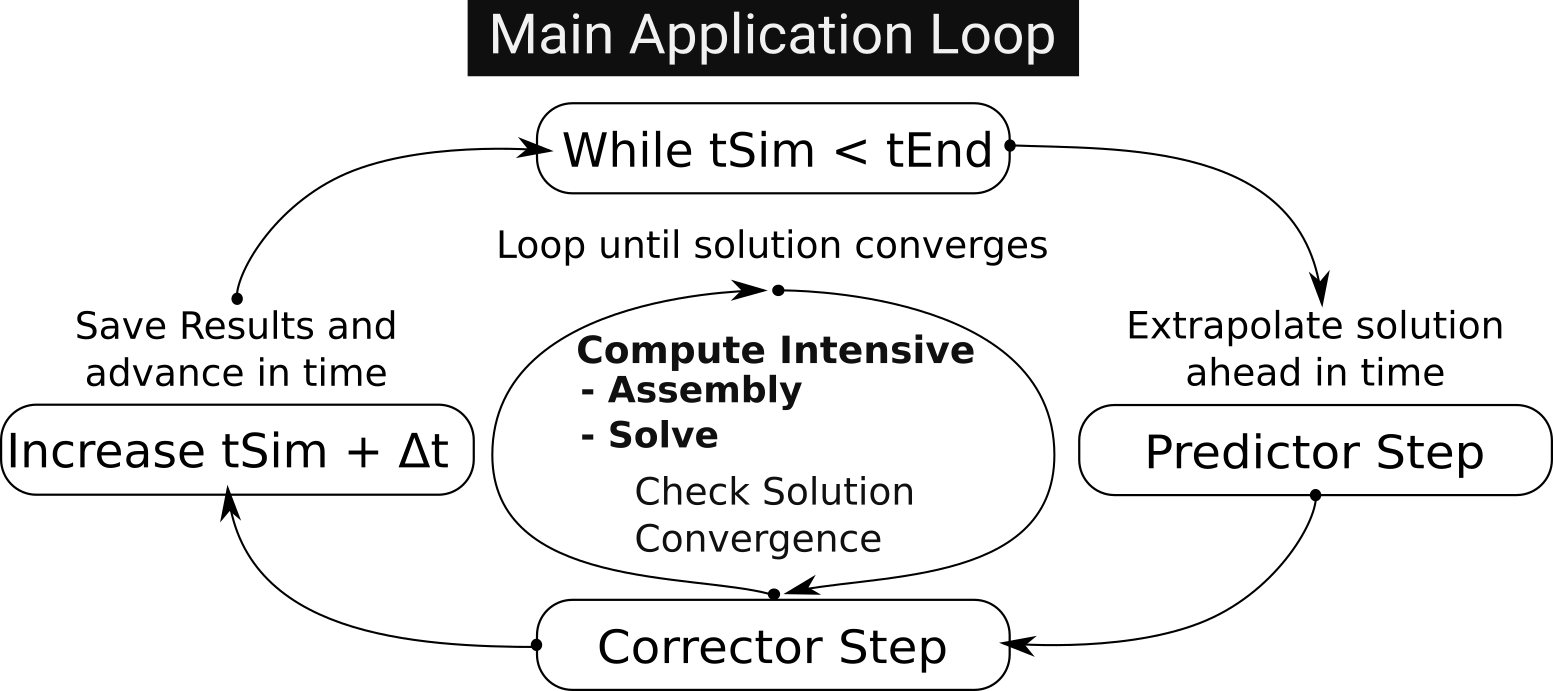
- Parallelize the RAFEM solve phase and replace the original solver with MAGMA, cuSOLVER (sparse QR), and QRMumps (sparse QR) on CPU/GPU.
- Extend matrix assembly to support COO input for QRMumps and reuse column reordering to reduce analysis time.
- Tune solver parameters: Scotch/Metis reordering, block sizes for QRMumps, GMRES m parameter for MAGMA, and tolerance settings.
- Instrument and trace the code (ScoreP/OTF2) to distinguish assembly, solve, and host-to-device memory transfer costs.
- Use PSNR to compare parallel results against the sequential reference, and analyze spatial differences via 2D interpolations of step results.
Experimental results
Research questions
- RQ1How do different sparse solvers (MAGMA, cuSOLVER, QRMumps) compare in runtime and scalability for RAFEM across various meshes and machines?
- RQ2What is the impact of GPU acceleration and solver configurations on numerical quality, as measured by PSNR, relative to the sequential RAFEM results?
- RQ3How do reordering strategies and solver tolerances affect convergence, accuracy, and total execution time?
- RQ4Is there a detectable trade-off between numerical accuracy and speed when reducing solver tolerance or using different solvers?
- RQ5What are the overheads from data movement (CPU↔GPU) and how do they influence overall performance across workloads?
Key findings
- QRMumps consistently achieved faster solve times than the other solvers across machines and workloads.
- Overall speedups ranged from 2.12x to 40.4x relative to the sequential RAFEM version, with higher gains on more powerful GPUs.
- cuSOLVER showed less scalable performance for larger meshes, indicating a scalability issue for that solver on bigger problems.
- MAGMA GMRES with a looser tolerance (10^-6) reduced total time by up to about 20%, but could worsen numerical accuracy and even convergence in some steps.
- PSNR analysis showed that different solvers yield qualitatively similar results, with MAGMA low-tol sometimes producing notably lower PSNR and larger numerical differences, especially for mesh A.
- Memory transfer overheads become more significant when reducing solver time, suggesting asynchronous overlap as a potential optimization.
- Stronger GPU hardware (e.g., Tupi vs. Hype) enhances acceleration, confirming the benefit of hardware advancements.
Read this paper
Open the full text in the Nubint reader and ask about any passage as you read.
Read this paper on NubintThis review was generated by AI from the original paper. Please check the paper before citing it.