
[Paper Review] Optimizing Energy-Harvesting Hybrid VLC/RF Networks with Random Receiver Orientation
This paper proposes a joint optimization of DC bias and time allocation in hybrid VLC/RF networks with energy-harvesting relays, accounting for random receiver orientation. By splitting the non-convex optimization into cyclic sub-problems and deriving closed-form expressions for average data rates under uniform orientation, the scheme achieves higher data rates than DC bias-only optimization, especially at longer relay distances and with larger beamwidths.
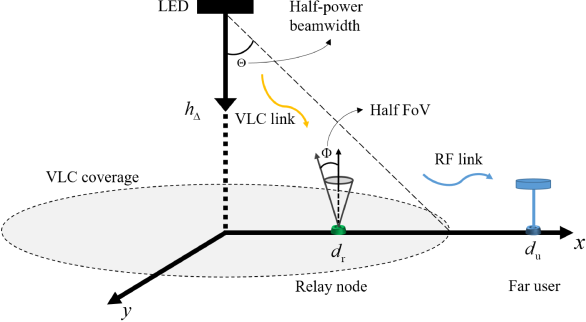
This paper investigates an indoor hybrid visible light communication (VLC) and radio frequency (RF) scenario with two-hop downlink transmission. A light emitting diode (LED) transmits both data and energy via VLC to an energy-harvesting relay node, which then uses the harvested energy to retransmit the decoded information to an RF user in the second phase. The design parameters include the direct current (DC) bias and the time allocation for VLC transmission. We formulate an optimization problem to maximize the data rate under decode-and-forward relaying with fixed receiver orientation. The non-convex problem is decomposed into two sub-problems, solved iteratively by fixing one parameter while optimizing the other. Additionally, we analyze the impact of random receiver orientation on the data rate, deriving closed-form expressions for both VLC and RF rates. An exhaustive search approach is employed to solve the optimization, demonstrating that joint optimization of DC bias and time allocation significantly enhances the data rate compared to optimizing DC bias alone.
Motivation & Objective
- Address the performance bottleneck in indoor energy-constrained wireless networks by enabling dual-hop hybrid VLC/RF communication with energy harvesting at the relay.
- Formulate a joint optimization problem for DC bias and VLC transmission time duration to maximize the data rate at the far RF user.
- Investigate the impact of random receiver orientation on achievable data rates in hybrid VLC/RF systems, a factor often neglected in prior work.
- Derive closed-form expressions for average VLC and RF data rates under uniform receiver orientation distribution to enable tractable system design and optimization.
- Demonstrate through exhaustive search that joint optimization of DC bias and time allocation outperforms DC bias-only optimization, particularly under challenging channel conditions.
Proposed method
- Formulate a two-phase transmission model: first, VLC links carry both data and energy to an energy-harvesting relay; second, the relay uses harvested energy to forward data via RF to a distant user.
- Model the relay's energy harvesting from both VLC and RF transmissions, including continuous DC bias power during RF phase to support ongoing energy collection.
- Address the non-convex joint optimization of DC bias and VLC time duration by decomposing it into two cyclic sub-problems: fix time duration to optimize DC bias via majorization-minimization (MM), then fix DC bias to optimize time duration.
- Assume uniform random distribution for relay orientation to model real-world mobility and device misalignment, and derive closed-form lower bounds for average VLC and RF data rates.
- Use exact integral expressions and Monte Carlo simulations to validate the derived closed-form expressions, ensuring analytical accuracy under stochastic orientation.
- Perform exhaustive search over DC bias and time duration to identify optimal parameters, with results evaluated under varying relay distances, beamwidths, and orientation ranges.
Experimental results
Research questions
- RQ1How does random receiver orientation affect the achievable data rate in a hybrid VLC/RF energy-harvesting relay network?
- RQ2What is the optimal trade-off between DC bias and time allocation for the VLC link to maximize the data rate at the far RF user?
- RQ3Does joint optimization of DC bias and VLC transmission time duration yield higher data rates than optimizing DC bias alone?
- RQ4How does the half-power beamwidth of the LED affect the system’s performance under random receiver orientation?
- RQ5What is the impact of harvesting energy during the RF transmission phase on the overall data rate and system reliability?
Key findings
- The proposed joint optimization of DC bias and VLC time duration achieves a higher data rate than DC bias-only optimization, particularly when the relay is farther from the LED.
- Random receiver orientation significantly degrades the achievable data rate, with the optimal data rate decreasing as the orientation range (θ₂) increases from 10° to 50°.
- Harvesting energy during the RF transmission phase (Case 1 and Case 3) improves the optimal data rate, especially when the VLC channel gain is low due to increased relay distance.
- When the relay is at d_r = 0 m, increasing the half-power beamwidth (Φ) from 60° to 90° reduces the achievable data rate due to lower channel gain, but this trend reverses at d_r = 4 m, where wider beamwidths help maintain performance.
- The derived closed-form expressions for average VLC and RF data rates closely match both simulation results and exact integral evaluations, validating the analytical model.
- The system fails to meet a 1 Mbps data rate threshold when energy harvesting during RF transmission is ignored and time duration is not adaptively adjusted, especially at d_r = 4 m.

Better researchstarts right now
From reading papers to final review, dramatically reduce your research time.
No credit card · Free plan available
This review was created by AI and reviewed by human editors.