
[Paper Review] Optimizing Inventory Placement for a Downstream Online Matching Problem
This paper proposes optimizing inventory placement for an online matching problem in e-commerce by using the Offline surrogate function, which yields a (1−(1−1/d)^d)/2-approximation for the joint placement and fulfillment problem. The method uses randomized rounding to achieve a tight (1−(1−1/d)^d)-approximation and is validated via real-world JD.com data, showing superior performance over Myopic and Fluid placement procedures.
We study the inventory placement problem of splitting $Q$ units of a single item across warehouses in advance of a downstream online matching problem that represents the dynamic fulfillment decisions of an e-commerce retailer. This is a challenging problem both theoretically, due to the computational complexity of the downstream matching problem, and practically, as the fulfillment team continuously updates its algorithm while the placement team lacks direct evaluation of placement decisions. We compare the performance of three placement procedures based on optimizing surrogate functions that have been studied and applied: Offline, Myopic, and Fluid placement. On the theory side, we show that optimizing inventory placement for the Offline surrogate leads to an $α(1-(1-1/d)^d)$-approximation for the joint placement and fulfillment problem under any demand model that admits an $α$-competitive fulfillment policy. We assume $d$ is an upper bound on how many warehouses can serve any demand location. The crux of our theoretical contribution is to use randomized rounding to derive a tight $(1-(1-1/d)^d)$-approximation for the integer programming problem of optimizing the Offline surrogate. We further show how to extend this result to a multi-SKU setting, improving upon the best known approximation of $1/2$. We use statistical learning to show that rounding after optimizing a sample-average Offline surrogate, which is necessary due to the exponentially-sized support, indeed has vanishing loss. On the experimental side, we evaluate how different combinations of placement and fulfillment procedures perform on a wide array of synthetic instances. When coupled with a good fulfillment procedure, optimizing the Offline surrogate performs best even compared to computationally-intensive simulation procedures, corroborating our theory.
Motivation & Objective
- To address the challenge of coordinating upstream inventory placement with downstream online fulfillment decisions in e-commerce.
- To evaluate and compare three surrogate-based placement procedures—Offline, Myopic, and Fluid—for their performance in joint placement and fulfillment.
- To theoretically analyze the approximation guarantees of optimizing the Offline surrogate under temporal or spatial independence of demand.
- To empirically validate the proposed method using real-world order sequences from JD.com.
- To demonstrate that optimizing the Offline surrogate leads to robust and high-performing inventory placement even without full knowledge of downstream fulfillment policies.
Proposed method
- The authors use randomized rounding to derive a tight (1−(1−1/d)^d)-approximation for the integer programming problem of optimizing the Offline surrogate function.
- They apply statistical learning to show that rounding after optimizing a sample-average Offline surrogate incurs vanishing loss, despite the exponentially-sized support.
- The method assumes d is an upper bound on the number of warehouses serving any demand location and that demand arrivals are temporally or spatially independent.
- The approach compares three placement procedures: Offline (optimizing a surrogate of the optimal fulfillment reward), Myopic (based on simulation and local search), and Fluid (using a deterministic fluid relaxation).
- A high-quality fulfillment policy—S-SP with re-solving—is fixed to isolate and evaluate placement performance across different procedures.
- Real-world order data from JD.com is used to evaluate the competitive ratio of different combinations of placement and fulfillment procedures.
Experimental results
Research questions
- RQ1Does optimizing the Offline surrogate function yield a provably good approximation for the joint inventory placement and online fulfillment problem?
- RQ2How does the performance of Offline placement compare to Myopic and Fluid placement under realistic demand patterns?
- RQ3Can a surrogate-based approach like Offline placement outperform simulation-based Myopic placement despite lacking knowledge of demand arrival order?
- RQ4How robust is the Offline placement procedure across varying demand loads and reward ratios between local and spillover fulfillment?
- RQ5Does the use of randomized rounding on a sample-average Offline surrogate lead to near-optimal solutions in practice?
Key findings
- Optimizing the Offline surrogate yields a (1−(1−1/d)^d)/2-approximation for the joint placement and fulfillment problem under temporal or spatial independence of demand.
- The randomized rounding technique achieves a tight (1−(1−1/d)^d)-approximation for the integer program, proving theoretical optimality up to a constant factor.
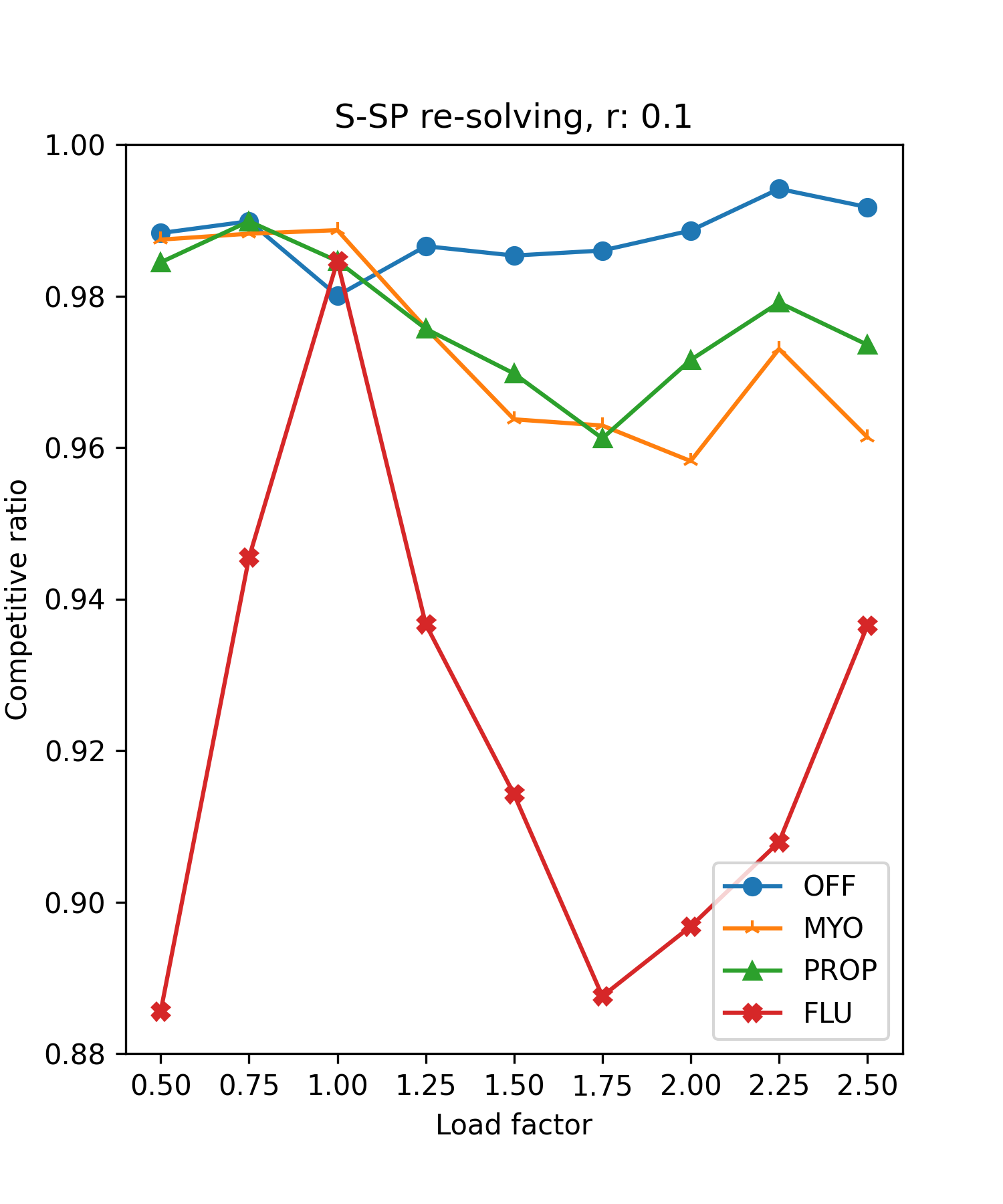
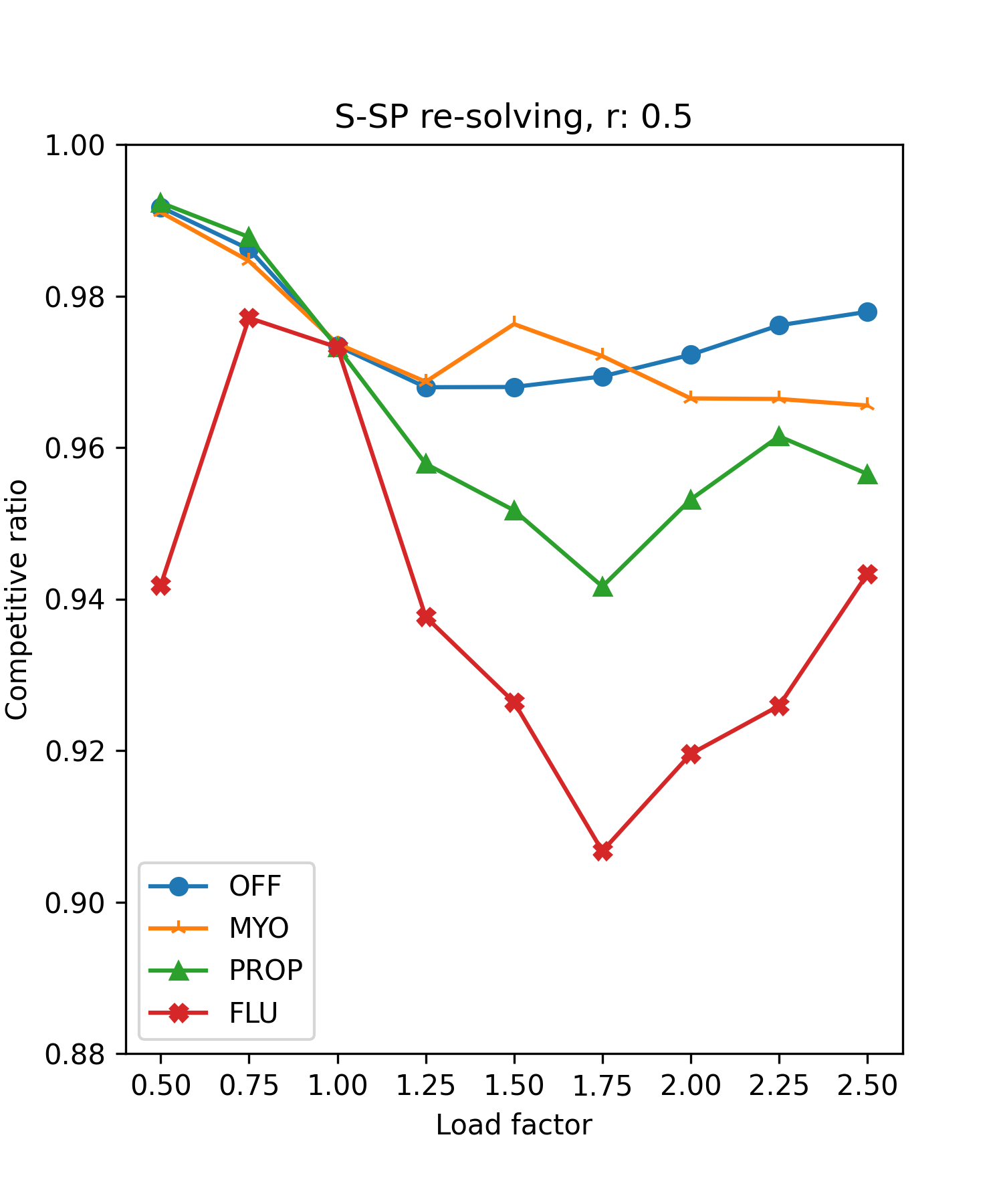
- Despite not using arrival order information, Offline placement outperforms Myopic placement in both theory and practice, especially under high load factors (≥1.25) when r=0.1.
- S-SP with re-solving consistently achieves the highest or second-highest competitive ratio across all settings, making it the most robust fulfillment policy.
- Fluid placement performs poorly due to instability from multiple optimal solutions and a strong bias toward the RDC, especially when tie-breaking favors the RDC.
- Offline placement is the most robust placement procedure when paired with a high-quality fulfillment policy, outperforming Myopic and Fluid placements across varying values of r and load factors.
Read this paper
Open the full text in the Nubint reader and ask about any passage as you read.
Read this paper on NubintThis review was generated by AI from the original paper. Please check the paper before citing it.