
[Paper Review] OR-NeRF: Object Removing from 3D Scenes Guided by Multiview Segmentation with Neural Radiance Fields
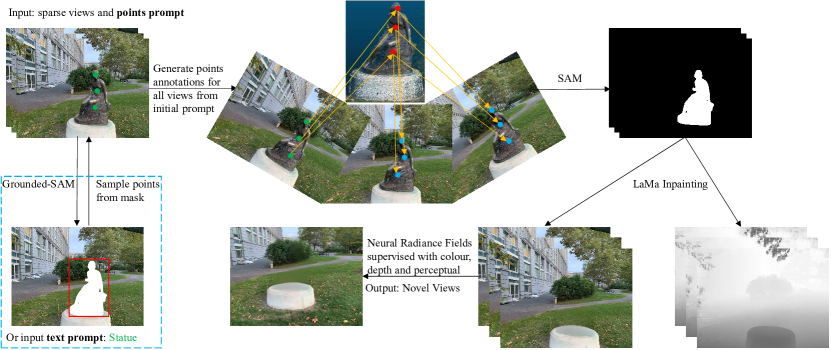
OR-NeRF removes objects from 3D scenes using a single-view prompt (points or text) to generate multiview masks via 3D geometry and SAM, then reconstructs the scene with NeRF/TensoRF using color, depth, and perceptual losses for consistency.
The emergence of Neural Radiance Fields (NeRF) for novel view synthesis has increased interest in 3D scene editing. An essential task in editing is removing objects from a scene while ensuring visual reasonability and multiview consistency. However, current methods face challenges such as time-consuming object labeling, limited capability to remove specific targets, and compromised rendering quality after removal. This paper proposes a novel object-removing pipeline, named OR-NeRF, that can remove objects from 3D scenes with user-given points or text prompts on a single view, achieving better performance in less time than previous works. Our method spreads user annotations to all views through 3D geometry and sparse correspondence, ensuring 3D consistency with less processing burden. Then recent 2D segmentation model Segment-Anything (SAM) is applied to predict masks, and a 2D inpainting model is used to generate color supervision. Finally, our algorithm applies depth supervision and perceptual loss to maintain consistency in geometry and appearance after object removal. Experimental results demonstrate that our method achieves better editing quality with less time than previous works, considering both quality and quantity.
Motivation & Objective
- Motivate and enable object removal in 3D scenes with minimal user input (points or text) on a single view.
- Provide rapid, accurate multiview segmentation by propagating annotations through 3D geometry.
- Reconstruct edited scenes with NeRF/TensoRF while enforcing color, depth, and perceptual consistency.
Proposed method
- Spread user annotations from one view to all views using 3D COLMAP-based correspondences and projection between 2D and 3D spaces.
- Use Segment-Anything (SAM) to predict masks from projected point prompts (or convert text prompts to point prompts via Grounded-SAM sampling).
- Obtain color and depth priors for the deletion region with LaMa (2D inpainting).
- Train Neural Radiance Fields with supervision from color, depth, and perceptual losses to ensure cross-view consistency after removal.
- Adopt depth supervision and a perceptual loss focused on the masked region to improve geometric and appearance plausibility.
Experimental results
Research questions
- RQ1How can a single-view user prompt (points or text) be propagated to all views to enable consistent multiview object removal?
- RQ2What combination of depth and perceptual supervision improves 3D-consistent removal in NeRF-based reconstructions?
- RQ3Does leveraging SAM with geometry-based propagation yield faster and more accurate masks than prior multi-step SEG/NeRF approaches?
- RQ4How does OR-NeRF compare to SPIn-NeRF in terms of segmentation quality and editing speed?
Key findings
- Masks for all views can be generated rapidly (approx. two frames per second on RTX 3090) using 3D geometry propagation and SAM, outperforming prior multi-step approaches.
- Multiview segmentation with points or converted text prompts achieves high accuracy and IoU, with mean accuracies around 99% and IoU around 95% in comparisons with SPIn-NeRF on reported scenes.
- Depth supervision with all-depth priors and perceptual loss improve consistency across views and rendering quality, though the impact on FID/LPIPS varies by configuration.
- OR-NeRF achieves faster mask generation and generally better segmentation metrics than SPIn-NeRF in the presented evaluations.
- Experiments on 20 scenes show that the proposed method yields clearer renderings and faster processing for the object-removal task compared to baselines.
- The study notes limitations tied to 2D inpainting quality and suggests diffusion-based inpainting as a potential improvement for more plausible completions.

Read this paper
Open the full text in the Nubint reader and ask about any passage as you read.
Read this paper on NubintThis review was generated by AI from the original paper. Please check the paper before citing it.