
[Paper Review] Orca 2: Teaching Small Language Models How to Reason
Orca 2 trains small LMs with a suite of reasoning strategies and a Prompt Erasing technique to become cautious reasoners, achieving strong zero-shot performance competitive with much larger models. The weights are publicly released.
Orca 1 learns from rich signals, such as explanation traces, allowing it to outperform conventional instruction-tuned models on benchmarks like BigBench Hard and AGIEval. In Orca 2, we continue exploring how improved training signals can enhance smaller LMs' reasoning abilities. Research on training small LMs has often relied on imitation learning to replicate the output of more capable models. We contend that excessive emphasis on imitation may restrict the potential of smaller models. We seek to teach small LMs to employ different solution strategies for different tasks, potentially different from the one used by the larger model. For example, while larger models might provide a direct answer to a complex task, smaller models may not have the same capacity. In Orca 2, we teach the model various reasoning techniques (step-by-step, recall then generate, recall-reason-generate, direct answer, etc.). More crucially, we aim to help the model learn to determine the most effective solution strategy for each task. We evaluate Orca 2 using a comprehensive set of 15 diverse benchmarks (corresponding to approximately 100 tasks and over 36,000 unique prompts). Orca 2 significantly surpasses models of similar size and attains performance levels similar or better to those of models 5-10x larger, as assessed on complex tasks that test advanced reasoning abilities in zero-shot settings. make Orca 2 weights publicly available at aka.ms/orca-lm to support research on the development, evaluation, and alignment of smaller LMs
Motivation & Objective
- Motivate moving beyond imitation learning to enhance reasoning in small LMs.
- Teach small LMs to deploy multiple reasoning strategies (step-by-step, recall-then-generate, recall-reason-generate, direct answer, etc.).
- Enable models to select the most effective strategy per task (task-driven strategy selection).
- Evaluate Orca 2 across ~100 tasks from 15 benchmarks and compare to larger baselines.
- Publicly release Orca 2 weights to support research on small LM development, evaluation, and alignment.
Proposed method
- Leverage Explanation Tuning to provide rich reasoning signals from capable teachers.
- Introduce Prompt Erasing to train cautious reasoners that infer strategies without access to original prompts.
- Construct Orca 2 dataset (~817K training instances) from FLAN-v2, Orca 1, and Orca 2 sources with progressive learning.
- Apply progressive learning starting from FLAN-v2, then Orca 1 data, then a mix with GPT-4 data, on LLaMA-2 bases.
- Use packing and a 4096-token max sequence length to optimize training on 32 A100 GPUs with bf16; loss computed on teacher-generated tokens only.
Experimental results
Research questions
- RQ1Can small LMs learn and apply a repertoire of reasoning strategies beyond imitation of larger models?
- RQ2How should a small LM select the most effective reasoning strategy for a given task?
- RQ3Does cautious reasoning with Prompt Erasing improve zero-shot performance compared to standard imitation-based approaches?
- RQ4How do Orca 2 models compare to larger models on diverse reasoning benchmarks?
Key findings
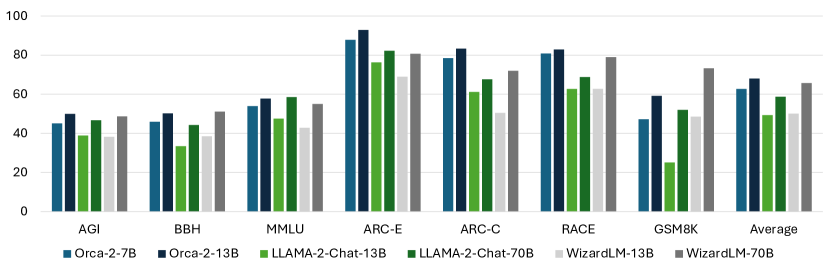
- Orca 2-13B significantly outperforms models of the same size on zero-shot reasoning tasks.
- Orca 2-13B matches or surpasses models 5–10x larger on several complex reasoning benchmarks.
- With cautious system prompts, Orca 2 achieves notable gains on several datasets (e.g., CRASS, DROP, RACE, GSM8K).
- Overall, Orca 2–13B demonstrates competitive performance against 70B-parameter rivals and stronger zero-shot reasoning abilities.
- The study reports detailed zero-shot results across AGIeval, BBH, DROP, CRASS, RACE, GSM8K, and others, illustrating robust reasoning capabilities.

Read this paper
Open the full text in the Nubint reader and ask about any passage as you read.
Read this paper on NubintThis review was generated by AI from the original paper. Please check the paper before citing it.