
[Paper Review] OVO: Open-Vocabulary Occupancy
OVO proposes a novel, model-agnostic framework for open-vocabulary 3D semantic occupancy prediction that eliminates the need for 3D annotations during training. By leveraging knowledge distillation from a pre-trained 2D open-vocabulary segmentation model and applying pixel-voxel filtering for high-quality voxel selection, OVO achieves competitive performance on NYUv2 and SemanticKITTI, enabling zero-shot prediction of novel object categories using arbitrary text queries.
Semantic occupancy prediction aims to infer dense geometry and semantics of surroundings for an autonomous agent to operate safely in the 3D environment. Existing occupancy prediction methods are almost entirely trained on human-annotated volumetric data. Although of high quality, the generation of such 3D annotations is laborious and costly, restricting them to a few specific object categories in the training dataset. To address this limitation, this paper proposes Open Vocabulary Occupancy (OVO), a novel approach that allows semantic occupancy prediction of arbitrary classes but without the need for 3D annotations during training. Keys to our approach are (1) knowledge distillation from a pre-trained 2D open-vocabulary segmentation model to the 3D occupancy network, and (2) pixel-voxel filtering for high-quality training data generation. The resulting framework is simple, compact, and compatible with most state-of-the-art semantic occupancy prediction models. On NYUv2 and SemanticKITTI datasets, OVO achieves competitive performance compared to supervised semantic occupancy prediction approaches. Furthermore, we conduct extensive analyses and ablation studies to offer insights into the design of the proposed framework. Our code is publicly available at https://github.com/dzcgaara/OVO.
Motivation & Objective
- To address the scalability limitation of existing 3D semantic occupancy models that rely on costly, predefined 3D annotations for a fixed set of object classes.
- To enable zero-shot prediction of arbitrary semantic classes not seen during training, overcoming the label set bottleneck in current occupancy networks.
- To develop a simple, compact, and compatible framework that works with state-of-the-art occupancy prediction models without requiring retraining from scratch.
- To investigate the effectiveness of knowledge distillation from 2D open-vocabulary models to 3D occupancy networks for zero-shot generalization.
- To analyze the impact of training data quality on model performance, particularly through voxel filtering and feature alignment.
Proposed method
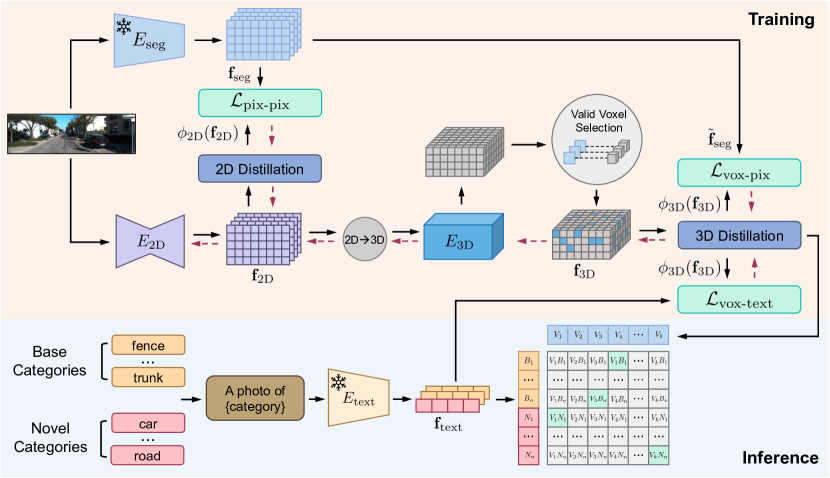
- Knowledge distillation is applied from a pre-trained 2D open-vocabulary segmentation model (LSeg) to a 3D occupancy network, transferring semantic understanding to 3D space.
- A three-stage feature alignment process is introduced: voxel-pixel, voxel-text, and pixel-pixel alignment to align 2D image features with 3D voxel features and text embeddings.
- Re-weighting is applied during voxel-pixel alignment to down-weight noisy or low-confidence predictions from the 2D model, improving training stability and performance.
- A multi-stage voxel filtering mechanism is used to select high-quality training voxels by removing those outside the image, occluded, or inconsistent across views.
- The framework is designed to be model-agnostic, compatible with existing occupancy networks like MonoScene, with only minor architectural additions.
- Text queries are used at inference time to predict occupancy for any semantic class, enabling zero-shot generalization beyond the training label set.
Experimental results
Research questions
- RQ1Can knowledge distillation from a pre-trained 2D open-vocabulary model effectively transfer semantic understanding to 3D occupancy prediction without 3D annotations?
- RQ2How does the quality of training voxels impact the performance of zero-shot 3D semantic occupancy prediction?
- RQ3What is the contribution of each component in the proposed feature alignment module (voxel-pixel, voxel-text, pixel-pixel) to the final performance?
- RQ4To what extent does re-weighting noisy predictions improve the distillation process and model generalization?
- RQ5Can the proposed framework generalize to novel object categories not present in the training data, including those with ambiguous or rare descriptions?
Key findings
- OVO achieves a mean intersection-over-union (mIoU) of 20.15% on novel classes in the NYUv2 dataset, significantly outperforming baseline methods without 3D annotations.
- The ablation study shows that incorporating re-weighting in voxel-pixel alignment improves mIoU by 2.49 percentage points, highlighting its importance in reducing noise.
- Applying all three voxel filtering mechanisms (out-of-image, occluded, inconsistent) reduces the number of training voxels from 2.7M to 360K, yet improves mIoU by 5.78 points, proving that quality outweighs quantity.
- The addition of OVO modules increases computational cost by only 14% compared to the base MonoScene model, demonstrating high efficiency.
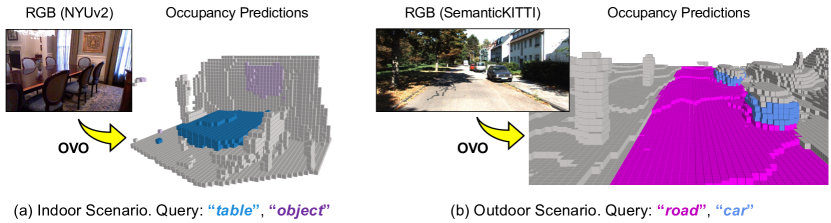
- Qualitative results show that OVO successfully predicts novel classes like 'bed', 'table', 'car', and 'road' even in low-visibility or out-of-view scenarios.
- The model generalizes effectively to open-vocabulary queries, such as 'object' or 'furniture', demonstrating robust zero-shot capability.
Read this paper
Open the full text in the Nubint reader and ask about any passage as you read.
Read this paper on NubintThis review was generated by AI from the original paper. Please check the paper before citing it.