
[Paper Review] OWQ: Outlier-Aware Weight Quantization for Efficient Fine-Tuning and Inference of Large Language Models
OWQ presents outlier-aware weight quantization that keeps weak columns in higher precision and quantizes the rest, coupled with Weak Column Tuning (WCT) for task-specific adaptation, achieving comparable quality to 4-bit OPTQ at around 3.1-bit and enabling efficient fine-tuning.
Large language models (LLMs) with hundreds of billions of parameters require powerful server-grade GPUs for inference, limiting their practical deployment. To address this challenge, we introduce the outlier-aware weight quantization (OWQ) method, which aims to minimize LLM's footprint through low-precision representation. OWQ prioritizes a small subset of structured weights sensitive to quantization, storing them in high-precision, while applying highly tuned quantization to the remaining dense weights. This sensitivity-aware mixed-precision scheme reduces the quantization error notably, and extensive experiments demonstrate that 3.1-bit models using OWQ perform comparably to 4-bit models optimized by OPTQ. Furthermore, OWQ incorporates a parameter-efficient fine-tuning for task-specific adaptation, called weak column tuning (WCT), enabling accurate task-specific LLM adaptation with minimal memory overhead in the optimized format. OWQ represents a notable advancement in the flexibility, efficiency, and practicality of LLM optimization literature. The source code is available at https://github.com/xvyaward/owq
Motivation & Objective
- Motivate reducing memory and compute footprint of large language models during inference and fine-tuning.
- Identify activation outliers as a key source of quantization error in LLMs.
- Propose OWQ to protect sensitive (weak) columns and aggressively quantize the rest.
- Introduce WCT to enable parameter-efficient task adaptation on OWQ-quantized models.
- Demonstrate gains across OPT and LLaMA families with low overhead.
Proposed method
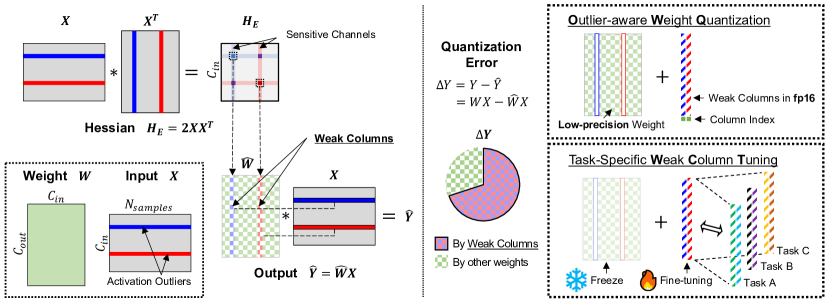
- Identify weak columns by computing a channel-wise sensitivity using the Hessian diagonal and weight perturbation magnitude (sensitivity_j = lambda_j * ||Delta W_:,j||^2).
- Exclude weak columns from quantization and apply mixed-precision by quantizing remaining columns with OPTQ-based techniques, including a truncation-enhanced configuration search.
- Store weak columns in fp16 and a small index per column to designate weak columns with negligible storage overhead (~0.3%).
- Apply OPTQ to the non-weak columns with a modified configuration search that includes truncation and per-channel quantization considerations.
- Introduce Weak Column Tuning (WCT) that fine-tunes only the previously identified weak columns after OWQ quantization to improve task adaptation with minimal memory overhead.
- Demonstrate real-device acceleration via a customized OWQ CUDA kernel that handles weak-column on-the-fly processing.
Experimental results
Research questions
- RQ1Can activation outliers be effectively accounted for in weight quantization to reduce quantization error in LLMs?
- RQ2Does a weak-column–aware mixed-precision scheme (OWQ) achieve comparable performance to higher-bit baselines (e.g., 4-bit OPTQ) at lower effective bit-width?
- RQ3Does Weak Column Tuning (WCT) enable competitive or superior fine-tuning performance with OWQ-quantized models while keeping memory overhead low?
- RQ4What is the practical overhead (latency and storage) of OWQ in inference and fine-tuning on large models like OPT and LLaMA?
Key findings
- 3.1-bit OWQ models achieve performance comparable to 4-bit OPTQ on WikiText-2 perplexity and related metrics across model scales.
- 3.01-bit OWQ models further improve results, outperforming 3-bit OPTQ, with gains observed across OPT and LLaMA families.
- OWQ consistently improves model quality over OPTQ across multiple model sizes, including smaller models where quantization degradation is more pronounced.
- Weak-column awareness (retaining a small fraction of columns in high precision) yields negligible storage overhead (~0.3%) while providing substantial accuracy gains.
- WCT enables task-specific adaptation with significantly fewer trainable parameters than QLoRA and can match full-precision LoRA performance with much lower memory use during inference.
- OWQ with a tailored CUDA kernel maintains practical quantization speed (e.g., under ~3 hours to quantize a 66B model on A100) despite mixed-precision processing.
- In fine-tuning scenarios, OWQ+WCT can outperform competing PTQ-based fine-tuning methods and achieve strong open-LM task results as shown in Vicuna Benchmark evaluations using GPT-4-based scoring.
Read this paper
Open the full text in the Nubint reader and ask about any passage as you read.
Read this paper on NubintThis review was generated by AI from the original paper. Please check the paper before citing it.