
[Paper Review] PAC-NeRF: Physics Augmented Continuum Neural Radiance Fields for Geometry-Agnostic System Identification
PAC-NeRF proposes a physics-augmented neural radiance field that jointly estimates unknown geometry and physical parameters of dynamic materials—such as elastic bodies, plasticine, sand, and fluids—from multi-view videos without prior geometric or topological assumptions. By enforcing continuum mechanics conservation laws via a hybrid Eulerian-Lagrangian representation, it enables differentiable physics simulation and end-to-end optimization, achieving state-of-the-art system identification performance with up to two orders of magnitude improvement over baselines.
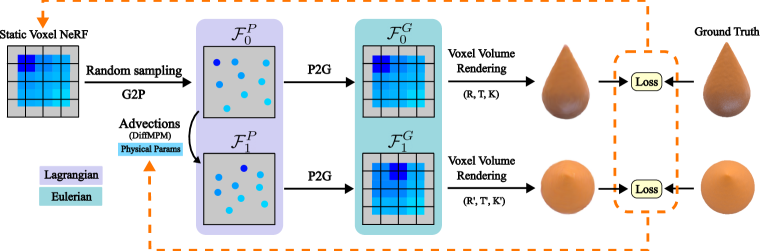
Existing approaches to system identification (estimating the physical parameters of an object) from videos assume known object geometries. This precludes their applicability in a vast majority of scenes where object geometries are complex or unknown. In this work, we aim to identify parameters characterizing a physical system from a set of multi-view videos without any assumption on object geometry or topology. To this end, we propose "Physics Augmented Continuum Neural Radiance Fields" (PAC-NeRF), to estimate both the unknown geometry and physical parameters of highly dynamic objects from multi-view videos. We design PAC-NeRF to only ever produce physically plausible states by enforcing the neural radiance field to follow the conservation laws of continuum mechanics. For this, we design a hybrid Eulerian-Lagrangian representation of the neural radiance field, i.e., we use the Eulerian grid representation for NeRF density and color fields, while advecting the neural radiance fields via Lagrangian particles. This hybrid Eulerian-Lagrangian representation seamlessly blends efficient neural rendering with the material point method (MPM) for robust differentiable physics simulation. We validate the effectiveness of our proposed framework on geometry and physical parameter estimation over a vast range of materials, including elastic bodies, plasticine, sand, Newtonian and non-Newtonian fluids, and demonstrate significant performance gain on most tasks.
Motivation & Objective
- To enable system identification of physical parameters in dynamic scenes without prior knowledge of object geometry or topology.
- To address the limitation of existing video-based system identification methods that require known geometries or rendering configurations.
- To unify differentiable physics simulation with neural radiance fields for joint estimation of geometry and physical properties.
- To develop a robust, data-efficient framework capable of handling complex materials including fluids, granular media, and plasticine.
- To achieve high-fidelity reconstruction and accurate physical parameter estimation using only 2D image-space supervision from multi-view videos.
Proposed method
- PAC-NeRF introduces a hybrid Eulerian-Lagrangian representation: it uses an Eulerian grid for NeRF density and color fields, while advecting these fields via Lagrangian particles for dynamic simulation.
- The framework enforces the material derivative of the NeRF field to be zero, ensuring adherence to the continuum conservation law ∂F/∂t + v·∇F = 0.
- It integrates the Material Point Method (MPM) into the NeRF framework, enabling robust, differentiable simulation of large deformations and collisions.
- The entire pipeline is differentiable, allowing gradient-based optimization of both geometry and physical parameters using a 2D pixel-level reconstruction loss.
- A voxelized, GPU-optimized implementation accelerates inference and enables high-performance simulation on complex, dynamic scenes.
- The method supports a wide range of materials, including elastic solids, plasticine, sand, and Newtonian/non-Newtonian fluids, by modeling their constitutive behavior within the MPM framework.
Experimental results
Research questions
- RQ1Can we estimate both the geometry and physical parameters of dynamic materials from multi-view videos without assuming known object geometry or topology?
- RQ2How can we enforce physical plausibility in neural radiance fields during end-to-end optimization for system identification?
- RQ3Can a differentiable physics simulator improve data efficiency and generalization in video-based system identification compared to purely vision-based learning?
- RQ4Does a hybrid Eulerian-Lagrangian formulation outperform purely Eulerian or Lagrangian representations in simulating complex material behaviors?
- RQ5Can 2D image-space supervision via differentiable rendering outperform 3D geometric supervision (e.g., Chamfer distance) in physical parameter estimation?
Key findings
- PAC-NeRF achieves the best performance in 14 out of 17 physical property estimation categories, significantly outperforming all baselines.
- The method reduces mean absolute error in physical parameter estimation by up to two orders of magnitude compared to state-of-the-art approaches.
- In fluid and granular material simulations, PAC-NeRF maintains stability and accuracy even under large deformations, where FEM-based baselines fail due to numerical instability.
- The 2D pixel-level reconstruction loss outperforms 3D Chamfer distance supervision from an oracle point cloud, indicating superior optimization efficiency with image-space signals.
- The framework demonstrates robustness to unknown geometries and rendering configurations, enabling system identification without privileged geometric or calibration information.
- The hybrid Eulerian-Lagrangian design enables faster inference and better handling of collisions and large deformations than purely MLP-based NeRF or FEM-based simulators.
Read this paper
Open the full text in the Nubint reader and ask about any passage as you read.
Read this paper on NubintThis review was generated by AI from the original paper. Please check the paper before citing it.