
[Paper Review] PaLI-3 Vision Language Models: Smaller, Faster, Stronger
PaLI-3 is a 5B-parameter vision-language model using a SigLIP contrastively pretrained image encoder, achieving SOTA on many multimodal benchmarks, outperforming larger models in localization and visually-situated text tasks.
This paper presents PaLI-3, a smaller, faster, and stronger vision language model (VLM) that compares favorably to similar models that are 10x larger. As part of arriving at this strong performance, we compare Vision Transformer (ViT) models pretrained using classification objectives to contrastively (SigLIP) pretrained ones. We find that, while slightly underperforming on standard image classification benchmarks, SigLIP-based PaLI shows superior performance across various multimodal benchmarks, especially on localization and visually-situated text understanding. We scale the SigLIP image encoder up to 2 billion parameters, and achieves a new state-of-the-art on multilingual cross-modal retrieval. We hope that PaLI-3, at only 5B parameters, rekindles research on fundamental pieces of complex VLMs, and could fuel a new generation of scaled-up models.
Motivation & Objective
- Motivate the need for efficient, smaller VLMs that still achieve strong performance across multimodal tasks.
- Explore whether contrastive pretraining of the image encoder yields advantages over classification pretraining in VLMs.
- Build PaLI-3 using a SigLIP-based image encoder, improved multimodal data mixture, and higher-resolution training to reach SOTA results.
- Evaluate PaLI-3 across visually-situated text understanding, general VLM benchmarks, and video-related tasks to demonstrate generalization.
Proposed method
- Compare classification-pretrained ViT backbones to SigLIP contrastively pretrained ViTs within the PaLI framework.
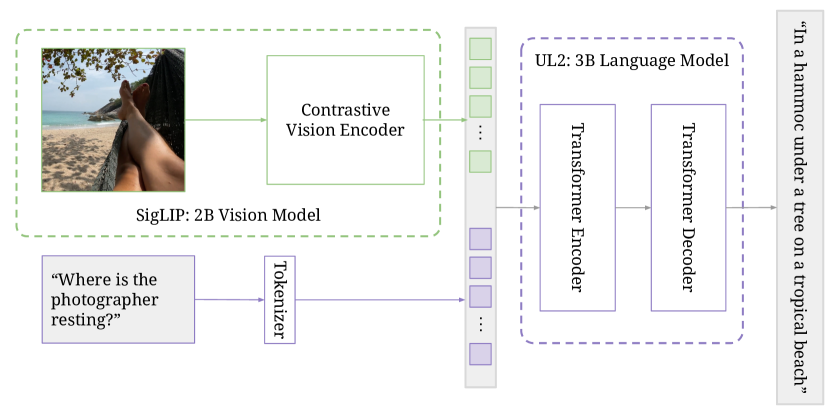
- Pretrain the image encoder with SigLIP on web-scale noisy image-text data and train a 3B UL2 text encoder-decoder on multimodal data.
- Increase image resolution during training (812x812 and 1064x1064) and perform task-specific fine-tuning with frozen or unfrozen components as appropriate.
- Fuse visual tokens from the ViT into a 3B UL2 encoder-decoder to generate task-specific text outputs.
- Enrich the WebLI data mix with documents and OCR-oriented data to improve visually-situated text understanding.
Experimental results
Research questions
- RQ1Do contrastively pretrained image encoders (SigLIP) provide gains over classification-pretrained encoders in PaLI-3 across multimodal tasks?
- RQ2Can a smaller PaLI-3 (5B parameters) achieve SOTA results on both natural scene understanding and visually-situated text tasks?
- RQ3How does higher-resolution training and data mixture affect performance on OCR-heavy and localization tasks?
- RQ4What is PaLI-3’s performance on video QA without video pretraining, and how does it generalize to video benchmarks?
Key findings
- SigLIP-based PaLI shows superior performance on visually-situated text understanding and localization tasks compared to classification-pretrained backbones.
- PaLI-3 achieves SOTA on 10+ vision-language benchmarks while being 10x smaller than the current SOTA model, with notable gains on visually-situated text tasks.
- The model attains new SOTA on multilingual cross-modal retrieval with a 2B SigLIP image encoder used in a multilingual SigLIP setup.
- PaLI-3 reaches new SOTA on several video QA benchmarks despite no video pretraining, indicating strong generalization abilities.
- In tasks with OCR inputs disabled, PaLI-3 often outperforms prior methods, underscoring robust intrinsic OCR and multimodal reasoning capabilities.
Read this paper
Open the full text in the Nubint reader and ask about any passage as you read.
Read this paper on NubintThis review was generated by AI from the original paper. Please check the paper before citing it.