
[Paper Review] PaLI-X: On Scaling up a Multilingual Vision and Language Model
PaLI-X scales both the vision and language components of a multilingual V&L model to large sizes, achieves state-of-the-art results across 15+ benchmarks, and shows emergent multimodal capabilities and robust multilingual transfer.
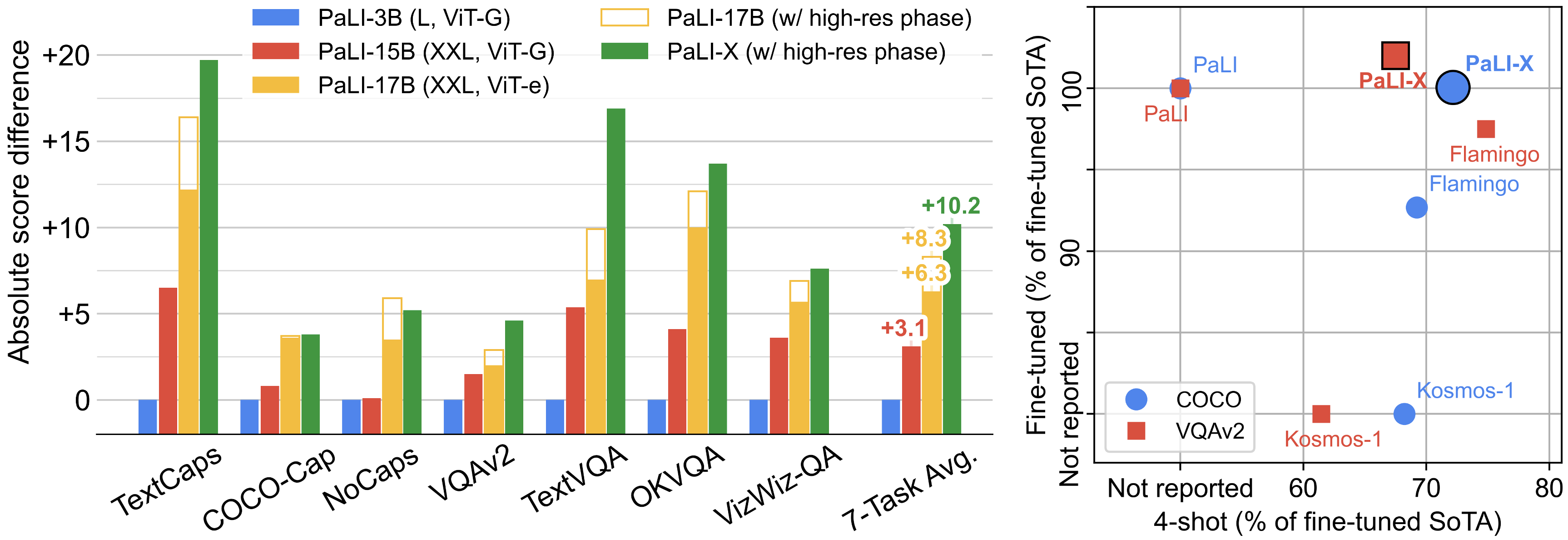
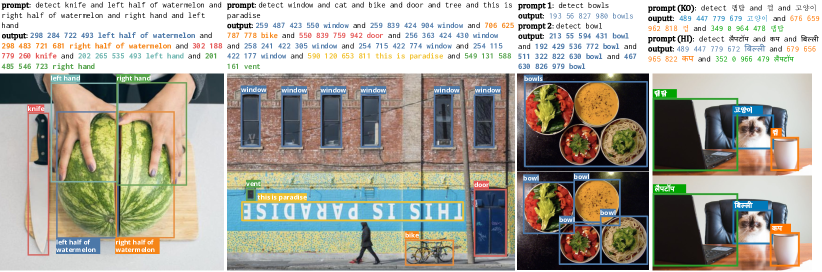
We present the training recipe and results of scaling up PaLI-X, a multilingual vision and language model, both in terms of size of the components and the breadth of its training task mixture. Our model achieves new levels of performance on a wide-range of varied and complex tasks, including multiple image-based captioning and question-answering tasks, image-based document understanding and few-shot (in-context) learning, as well as object detection, video question answering, and video captioning. PaLI-X advances the state-of-the-art on most vision-and-language benchmarks considered (25+ of them). Finally, we observe emerging capabilities, such as complex counting and multilingual object detection, tasks that are not explicitly in the training mix.
Motivation & Objective
- Motivate scaling Vision-Language models by extending PaLI to larger components and broader task mixtures.
- Evaluate how joint scaling of vision and language modules affects performance across diverse benchmarks.
- Investigate multitask fine-tuning and few-shot capabilities in a multilingual, multimodal setting.
- Explore emergent capabilities such as counting and multilingual object detection arising from scale and mixed objectives.
Proposed method
- Use a ViT-22B visual encoder coupled with a large language encoder-decoder initialized from UL2 variants.
- Train on a mixture of vision-language objectives including prefix-completion and masked-token completion.
- Incorporate OCR-oriented pretraining and an Episodic WebLI data regime to enhance few-shot capabilities.
- Train in two stages: stage 1 freezes the visual encoder while training the rest on 2.2B examples; stage 2 continues with OCR-focused objectives and higher image resolutions.
- Employ a multitask fine-tuning paradigm to evaluate performance across diverse benchmarks without severe degradation.
Experimental results
Research questions
- RQ1How does scaling both vision and language components affect performance across vision-language benchmarks?
- RQ2Can a multilingual V&L model trained with a mixture of objectives achieve state-of-the-art results and favorable Pareto frontiers for fine-tuning vs. few-shot learning?
- RQ3What are the emergent capabilities (e.g., counting, multilingual object detection) that arise from large-scale multimodal training?
- RQ4How does PaLI-X perform on text-heavy V&L tasks with or without external OCR inputs, and how does multimodal in-context learning behave?
- RQ5Does multitask fine-tuning yield on-par results with single-task fine-tuning across a broad task set?
Key findings
- PaLI-X achieves state-of-the-art results on image captioning and VQA benchmarks, including strong performance on OCR-rich tasks without external OCR inputs in some cases.
- Counting abilities improve markedly with scale, outperforming task-specific and some specialized models on simple and complex counting questions.
- Multitask fine-tuning yields on-par performance with single-task fine-tuning across diverse benchmarks, reducing the need for task-specific checkpoints.
- V&L performance benefits from a roughly 40%-60% split between vision and language capacity, indicating a balanced allocation at scale.
- Emergent capabilities include multilingual object detection and ability to detect objects with non-English labels, as well as switching between image text language and generated caption language.
Read this paper
Open the full text in the Nubint reader and ask about any passage as you read.
Read this paper on NubintThis review was generated by AI from the original paper. Please check the paper before citing it.