
[Paper Review] PaliGemma: A versatile 3B VLM for transfer
PaliGemma is a open, sub-3B vision-language model combining SigLIP-So400m image encoder with Gemma-2B decoder, trained to transfer across diverse open-world tasks including VLM benchmarks, remote sensing, and segmentation.
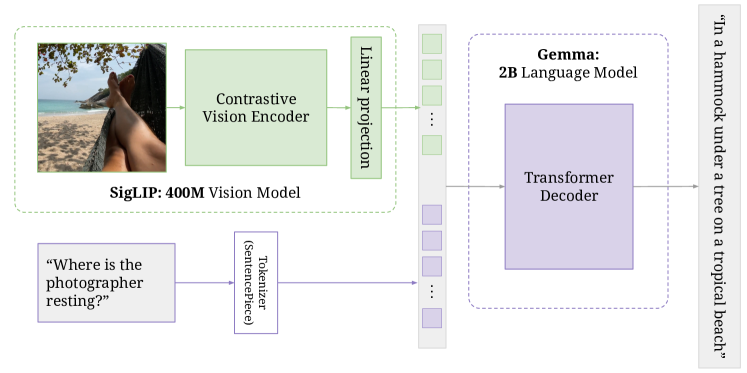
PaliGemma is an open Vision-Language Model (VLM) that is based on the SigLIP-So400m vision encoder and the Gemma-2B language model. It is trained to be a versatile and broadly knowledgeable base model that is effective to transfer. It achieves strong performance on a wide variety of open-world tasks. We evaluate PaliGemma on almost 40 diverse tasks including standard VLM benchmarks, but also more specialized tasks such as remote-sensing and segmentation.
Motivation & Objective
- Provide a versatile base vision-language model that transfers well across a broad set of tasks.
- Show that a small, open VLM can match or exceed larger models on standard and niche tasks.
- Demonstrate effective multi-stage pretraining and transfer strategies for diverse outputs.
- Investigate design choices that influence multimodal pretraining and transfer performance.
- Offer practical transfer recipes with guidelines for hyper-parameters and resolution handling.
Proposed method
- Assemble a three-component VLM: SigLIP image encoder, Gemma-2B decoder LM, and a linear projection connecting image tokens to language-model inputs.
- Train via a staged process: Stage0 unimodal pretraining, Stage1 multimodal pretraining on a broad task mix with no freezing, Stage2 higher-resolution finetuning, Stage3 task-specific transfer to diverse benchmarks.
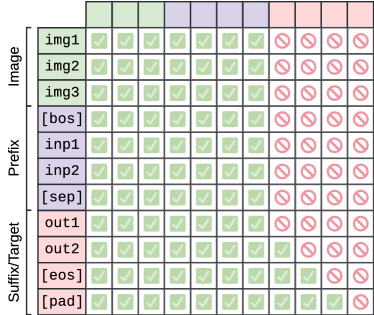
- Use prefix-LM masking to allow full attention on input (image and prefix) with autoregressive suffix generation, and train with supervision only on the suffix.
- Extend Gemma vocabulary with 1024 location tokens and 128 segmentation tokens, initialize new tokens carefully to optimize transfer.
- Employ a simple linear connector (vs. MLP) and avoid freezing the image encoder during Stage1 for better spatial understanding and transferability.
- Adopt a unified transfer recipe with task-specific hyperparameters (resolution, epochs, learning rate, label smoothing, dropout, etc.) across 30+ academic benchmarks, ensuring images are de-duplicated from pretraining data.
Experimental results
Research questions
- RQ1How does a compact open VLM (≈3B params) perform across a wide spectrum of vision-language tasks relative to larger models?
- RQ2What pretraining and training-design choices most strongly influence transfer performance for open VLMs?
- RQ3Can higher image resolution during transfer be achieved effectively via staged pretraining without exponential data or compute or instruction tuning?
- RQ4What are practical transfer recipes (hyperparameters, augmentation, architecture choices) that yield strong results across standard VLM benchmarks and specialized tasks (remote sensing, infographic QA, segmentation, video tasks)?
Key findings
- PaliGemma (3B scale) achieves competitive performance on standard VLM benchmarks (e.g., COCO, VQA, TextVQA) and on specialized tasks (remote sensing VQA, infographic QA, video captioning, referring expression segmentation).
- A 3-stage pretraining schedule (unimodal, multimodal with an unfrozen image encoder, then resolution increase) yields broad transferability to diverse tasks.
- Prefix-LM masking with input full attention and suffix autoregression outperforms alternatives; task prefixes help for ambiguous tasks and suffix-only supervision is effective.
- Adding new tokens (location and segmentation tokens) requires careful initialization (AvgEmb can hurt long-term transfer), with standard Gaussian initialization yielding better transfer.
- Not freezing the image encoder during Stage1 improves spatial understanding and transferability, while freezing the LLM harms performance; linear connectors outperform MLPs in this setup.
- Providing multiple resolution checkpoints (224, 448, 896) and upcycling through Stage2 is beneficial, with disentangled effects from higher resolution content vs. longer sequence length.
Better researchstarts right now
From reading papers to final review, dramatically reduce your research time.
No credit card · Free plan available
This review was created by AI and reviewed by human editors.