
[Paper Review] PaLM2-VAdapter: Progressively Aligned Language Model Makes a Strong Vision-language Adapter
This paper proposes PaLM2-VAdapter, a vision-language adapter that uses a progressively trained tiny PaLM-2 language model to align frozen vision encoders with large language models. By training the model in two stages—first as a decoder, then as an adapter with a perceiver resampler—it achieves faster convergence, higher performance, and stronger scalability than prior methods, reaching state-of-the-art results on VQA and captioning tasks with 30–80% fewer parameters.
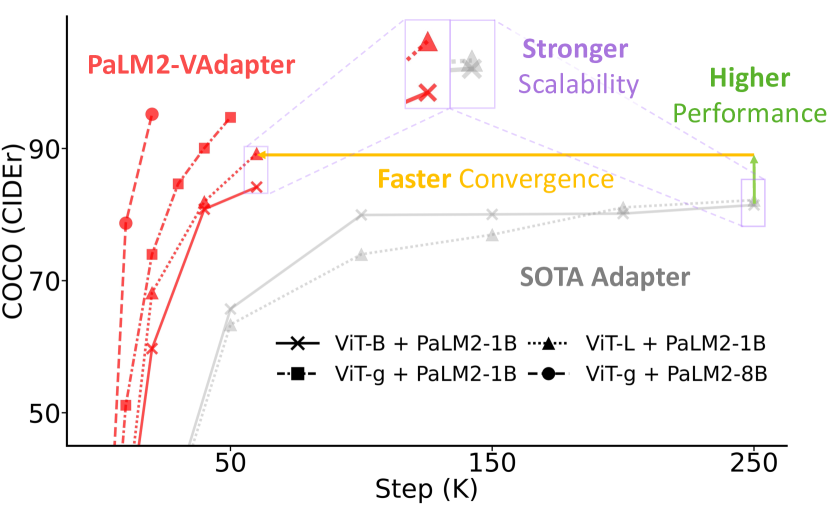
This paper demonstrates that a progressively aligned language model can effectively bridge frozen vision encoders and large language models (LLMs). While the fundamental architecture and pre-training methods of vision encoders and LLMs have been extensively studied, the architecture and training strategy of vision-language adapters vary significantly across recent works. Our research undertakes a thorough exploration of the state-of-the-art perceiver resampler architecture and builds a strong baseline. However, we observe that the vision-language alignment with perceiver resampler exhibits slow convergence and limited scalability with a lack of direct supervision. To address this issue, we propose PaLM2-VAdapter, employing a progressively aligned language model as the vision-language adapter. Compared to the strong baseline with perceiver resampler, our method empirically shows faster convergence, higher performance, and stronger scalability. Extensive experiments across various Visual Question Answering (VQA) and captioning tasks on both images and videos demonstrate that our model exhibits state-of-the-art visual understanding and multi-modal reasoning capabilities. Notably, our method achieves these advancements with 30~70% fewer parameters than the state-of-the-art large vision-language models, marking a significant efficiency improvement.
Motivation & Objective
- To address the slow convergence and limited scalability of existing vision-language adapters, particularly those based on the perceiver resampler architecture.
- To explore whether a progressively trained language model can serve as a more effective adapter for aligning frozen vision encoders and large language models.
- To reduce model parameters and training cost while maintaining or improving performance on vision-language benchmarks.
- To establish a scalable and efficient framework for vision-language alignment that supports zero-shot transfer to larger LLMs.
Proposed method
- A two-stage training strategy: first pre-train a small PaLM-2 model (108M parameters) as a language model decoder, then fine-tune it as a vision-language adapter with a perceiver resampler.
- The adapter uses cross-attention mechanisms to align visual features from a frozen vision encoder with the language model’s hidden states.
- Progressive alignment enables better optimization by first learning language modeling before learning cross-modal alignment.
- The adapter is trained end-to-end with image-text pairs, leveraging the strong inductive bias of the pre-trained PaLM-2 model.
- A Gumbel-softmax-based quantization study is conducted to assess whether visual embeddings can be directly mapped to LLM vocabulary tokens.
- The method is evaluated on image and video-based VQA and captioning benchmarks, including COCO, MSVD-QA, MSRVTT-QA, and iVQA.
Experimental results
Research questions
- RQ1Can a progressively trained language model serve as a more effective vision-language adapter than standard perceiver resampler architectures?
- RQ2Does progressive training improve convergence speed and scalability in vision-language alignment?
- RQ3Can a small language model achieve state-of-the-art performance with significantly fewer parameters than existing large vision-language models?
- RQ4Is it feasible to quantize visual embeddings into discrete tokens from the LLM’s vocabulary for zero-shot transfer to larger models?
Key findings
- PaLM2-VAdapter achieves state-of-the-art performance on image and video VQA and captioning benchmarks, including 44.1 CIDEr on COCO captioning and 75.6% accuracy on MSVD-QA.
- The model achieves 75.6% accuracy on the MSVD-QA benchmark, outperforming the Flamingo baseline despite using only 14% of its parameters (10.8B vs. 80B).
- On the iVQA dataset, PaLM2-VAdapter achieves 72.1% accuracy, demonstrating strong multi-modal reasoning capabilities.
- The method shows 30–80% parameter reduction compared to state-of-the-art models while maintaining or improving performance.
- The Gumbel-softmax quantization experiment yielded only 15.3 CIDEr on COCO, indicating that visual embeddings cannot be effectively mapped to LLM vocabulary tokens with simple matching.
- The progressive training strategy leads to faster convergence and better scalability, especially when scaling up the vision encoder.

Read this paper
Open the full text in the Nubint reader and ask about any passage as you read.
Read this paper on NubintThis review was generated by AI from the original paper. Please check the paper before citing it.