
[Paper Review] PandaGPT: One Model To Instruction-Follow Them All
PandaGPT is a multi-modal instruction-following model that integrates ImageBind encoders with Vicuna LLM to handle six modalities (image/video, text, audio, depth, thermal, IMU) using aligned image-text training data, enabling cross-modal and compositional tasks.
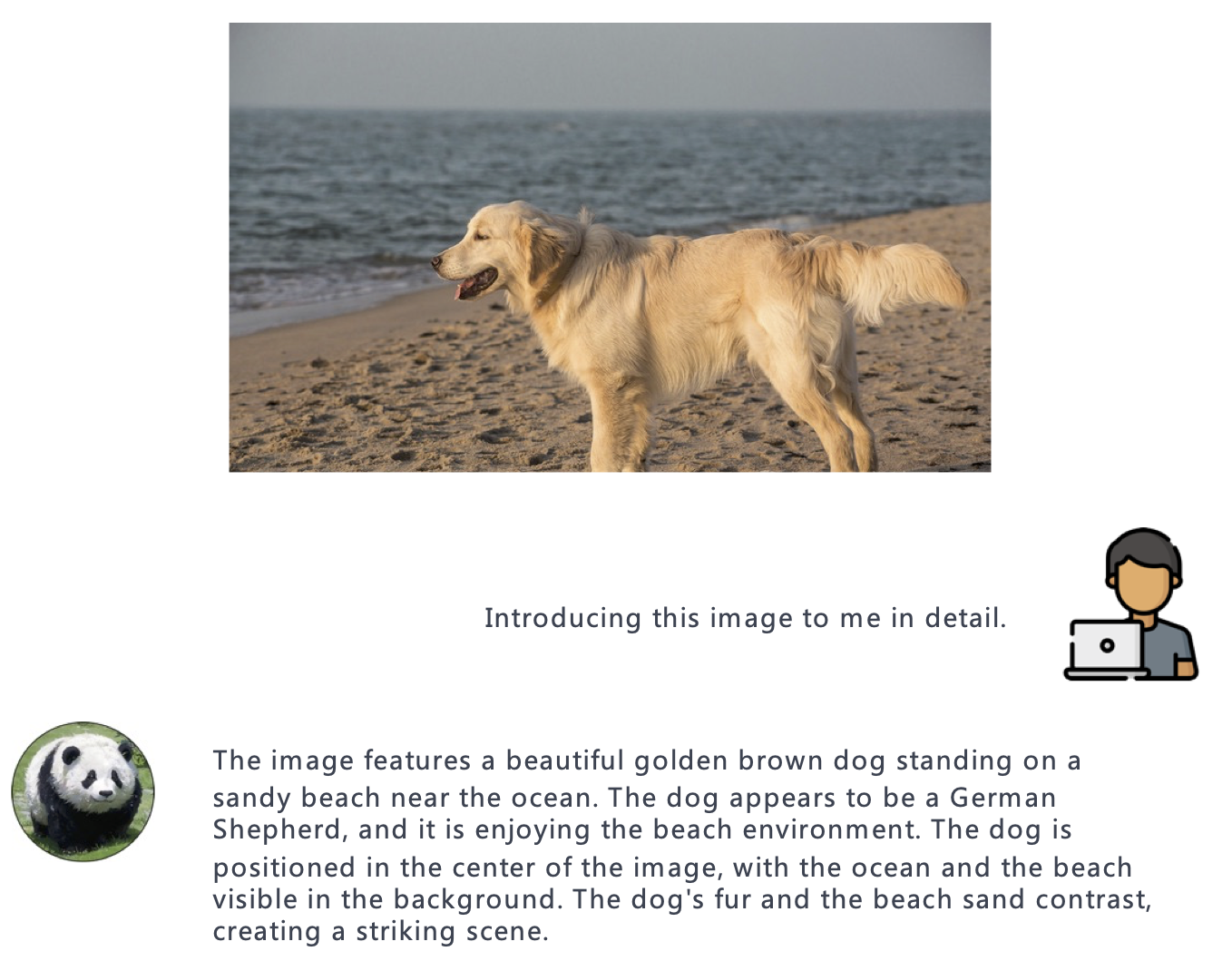
We present PandaGPT, an approach to emPower large lANguage moDels with visual and Auditory instruction-following capabilities. Our pilot experiments show that PandaGPT can perform complex tasks such as detailed image description generation, writing stories inspired by videos, and answering questions about audios. More interestingly, PandaGPT can take multimodal inputs simultaneously and compose their semantics naturally. For example, PandaGPT can connect how objects look in an image/video and how they sound in an audio. To do so, PandaGPT combines the multimodal encoders from ImageBind and the large language models from Vicuna. Notably, only aligned image-text pairs are required for the training of PandaGPT. Thanks to the strong capability of ImageBind in embedding data from different modalities into the same space, PandaGPT displays emergent, i.e. zero-shot, cross-modal behaviors for data other than image and text (e.g., video, audio, depth, thermal, and IMU). We hope that PandaGPT serves as an initial step toward building AGI that can perceive and understand inputs in different modalities holistically, as we humans do. Our project page is at https://panda-gpt.github.io/.
Motivation & Objective
- Motivate building a general-purpose model that can perceive and reason across multiple modalities.
- Leverage aligned image-text data to train a multimodal instruction-following system.
- Explore emergent cross-modal capabilities enabled by a shared embedding space.
- Demonstrate tasks including image/video description, multimodal storytelling, and audio questions.
Proposed method
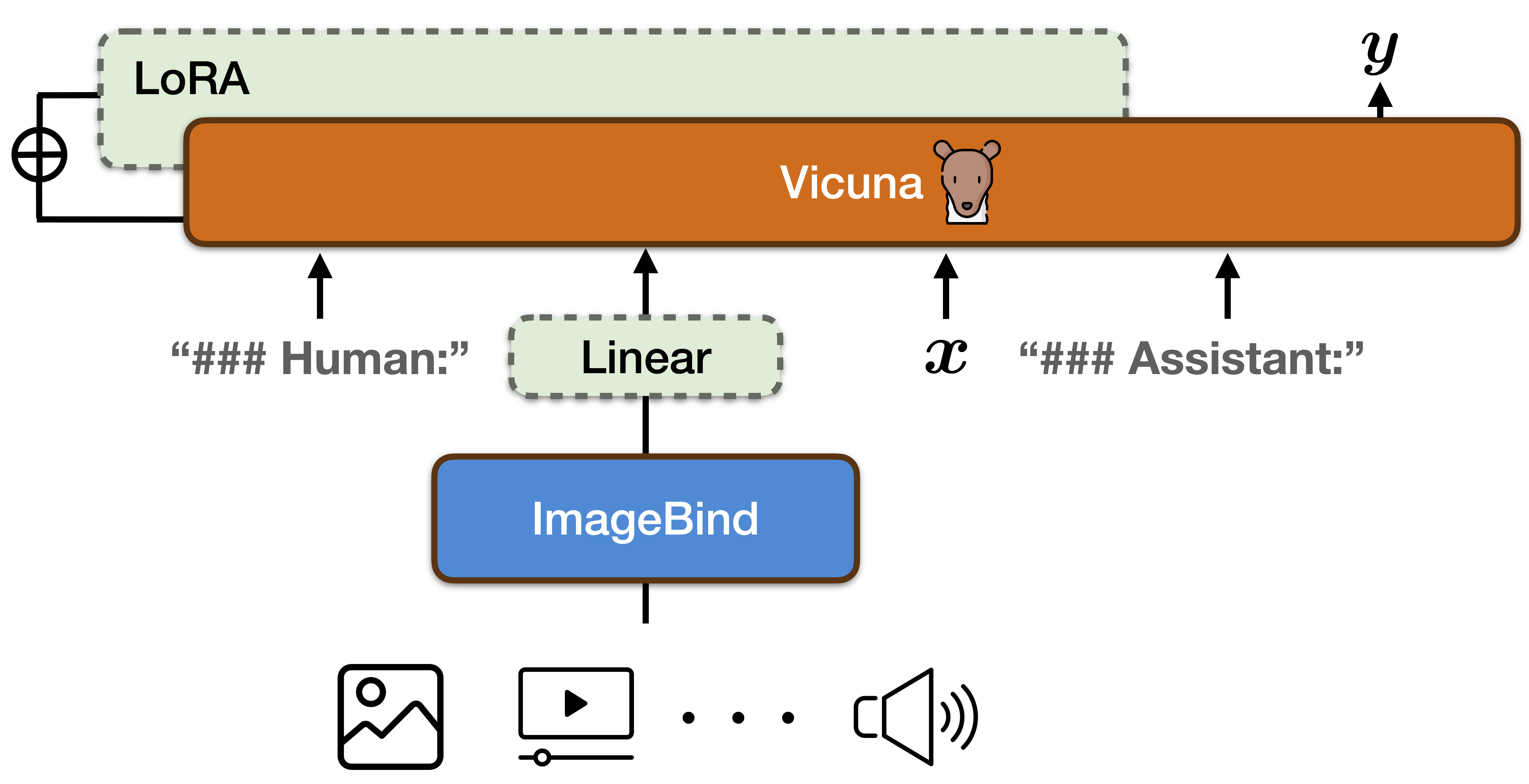
- Combine ImageBind multimodal encoders with Vicuna 13B as the frozen LLM backbone.
- Train only a linear projection f to map ImageBind representations to Vicuna, and LoRA weights on Vicuna attention.
- Use 160k image-language instruction-following examples and train for two epochs with LR 5e-4 across 8x A100 GPUs.
- Maintain ImageBind and Vicuna parameters frozen while learning 0.4% of Vicuna parameters.
- Objective is optimized over the sequence of multimodal prompts and responses as pθ(y_i|x_<i,y_<i-1,f(h_I)).
Experimental results
Research questions
- RQ1Can PandaGPT perform instruction-following across six modalities using only image-text aligned training data?
- RQ2What are the emergent cross-modal capabilities when integrating ImageBind embeddings with a large language model?
- RQ3To what extent can PandaGPT compose semantics across modalities such as visual and auditory inputs?
- RQ4What tasks demonstrate multimodal reasoning and compositional understanding (e.g., image-video, image-audio)?
Key findings
- PandaGPT supports image/video-grounded QA, image/video-inspired writing, and visual and auditory reasoning.
- It exhibits multimodal arithmetic by combining inputs from different modalities to produce integrated outputs.
- The model achieves cross-modal capabilities across image/video, text, audio, depth, thermal, and IMU without modality-specific training.
- Emergent cross-modal behaviors arise due to the shared embedding space from ImageBind, despite training only on aligned image-text data.
- The training setup uses a small fraction of model parameters (about 0.4% of Vicuna).
Read this paper
Open the full text in the Nubint reader and ask about any passage as you read.
Read this paper on NubintThis review was generated by AI from the original paper. Please check the paper before citing it.