
[Paper Review] PanoGen: Text-Conditioned Panoramic Environment Generation for Vision-and-Language Navigation
PanoGen generates infinite text-conditioned panoramic indoor environments via BLIP-2 captions and diffusion-based outpainting, then uses them to pre-train and fine-tune VLN agents, achieving SOTA on R2R, R4R, and CVDN.
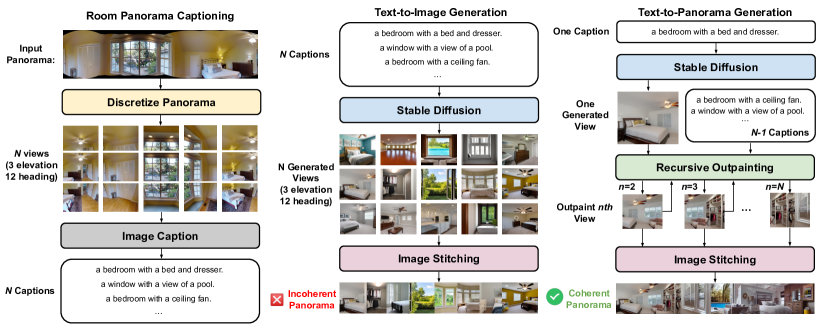
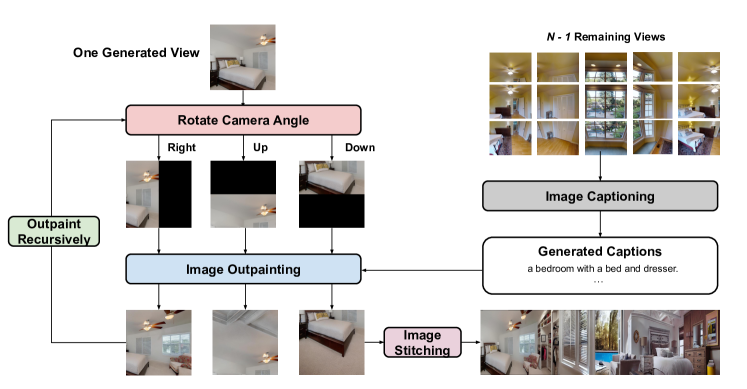
Vision-and-Language Navigation (VLN) requires the agent to follow language instructions to navigate through 3D environments. One main challenge in VLN is the limited availability of photorealistic training environments, which makes it hard to generalize to new and unseen environments. To address this problem, we propose PanoGen, a generation method that can potentially create an infinite number of diverse panoramic environments conditioned on text. Specifically, we collect room descriptions by captioning the room images in existing Matterport3D environments, and leverage a state-of-the-art text-to-image diffusion model to generate the new panoramic environments. We use recursive outpainting over the generated images to create consistent 360-degree panorama views. Our new panoramic environments share similar semantic information with the original environments by conditioning on text descriptions, which ensures the co-occurrence of objects in the panorama follows human intuition, and creates enough diversity in room appearance and layout with image outpainting. Lastly, we explore two ways of utilizing PanoGen in VLN pre-training and fine-tuning. We generate instructions for paths in our PanoGen environments with a speaker built on a pre-trained vision-and-language model for VLN pre-training, and augment the visual observation with our panoramic environments during agents' fine-tuning to avoid overfitting to seen environments. Empirically, learning with our PanoGen environments achieves the new state-of-the-art on the Room-to-Room, Room-for-Room, and CVDN datasets. Pre-training with our PanoGen speaker data is especially effective for CVDN, which has under-specified instructions and needs commonsense knowledge. Lastly, we show that the agent can benefit from training with more generated panoramic environments, suggesting promising results for scaling up the PanoGen environments.
Motivation & Objective
- Address limited, non-scalable 3D training environments for Vision-and-Language Navigation (VLN).
- Generate diverse, coherent panoramic environments conditioned on text descriptions without human annotation.
- Leverage generated panoramas for VLN pre-training and fine-tuning to improve generalization to unseen environments.
- Maintain semantic coherence in panoramas via text-conditioned recursive outpainting.
Proposed method
- Collect room descriptions by captioning Matterport3D panoramas with BLIP-2.
- Generate 36-view discretized room images conditioned on captions using a diffusion model.
- Create coherent 360-degree panoramas via recursive outpainting from an initial view and rotating camera angles.
- Train a speaker based on mPLUG to generate instructions for paths in our PanoGen panoramas for VLN pre-training.
- Pre-train VLN agents with instruction-trajectory pairs from PanoGen and original data.
- Fine-tune VLN agents by replacing a portion of observations with generated panoramas to reduce overfitting.
Experimental results
Research questions
- RQ1Can text-conditioned panoramic environments be generated at scale while preserving semantic coherence with human commonsense knowledge?
- RQ2Do generated panoramas improve VLN pre-training and fine-tuning, leading to better generalization to unseen environments?
- RQ3How does incorporating generated panoramas during fine-tuning (observation replacement) affect VLN performance across R2R, R4R, and CVDN?
- RQ4What is the impact of the number of generated panoramas on VLN generalization?
Key findings
- PanoGen achieves new state-of-the-art on Room-to-Room (R2R) and CVDN test sets.
- Pre-training with PanoGen speaker data yields notable gains, especially on CVDN with under-specified instructions.
- Fine-tuning with panoramic observation replacement improves performance across R2R, R4R, and CVDN datasets.
- Increasing the amount of generated panoramas during fine-tuning yields continued gains, suggesting scalable benefits.
- PanoGen replaces or augments training data effectively without sacrificing alignment between instructions and observations.
Read this paper
Open the full text in the Nubint reader and ask about any passage as you read.
Read this paper on NubintThis review was generated by AI from the original paper. Please check the paper before citing it.