
[Paper Review] PanoOcc: Unified Occupancy Representation for Camera-based 3D Panoptic Segmentation
PanoOcc proposes a unified occupancy representation for camera-based 3D panoptic segmentation, leveraging voxel queries in a coarse-to-fine learning scheme to integrate multi-frame, multi-view image features into a single, efficient 3D occupancy prediction. The method achieves state-of-the-art performance on nuScenes with 71.7 mIoU and 0.324 NDS, while introducing an occupancy sparsify module that reduces memory usage by retaining only 5% of voxels.
Comprehensive modeling of the surrounding 3D world is key to the success of autonomous driving. However, existing perception tasks like object detection, road structure segmentation, depth & elevation estimation, and open-set object localization each only focus on a small facet of the holistic 3D scene understanding task. This divide-and-conquer strategy simplifies the algorithm development procedure at the cost of losing an end-to-end unified solution to the problem. In this work, we address this limitation by studying camera-based 3D panoptic segmentation, aiming to achieve a unified occupancy representation for camera-only 3D scene understanding. To achieve this, we introduce a novel method called PanoOcc, which utilizes voxel queries to aggregate spatiotemporal information from multi-frame and multi-view images in a coarse-to-fine scheme, integrating feature learning and scene representation into a unified occupancy representation. We have conducted extensive ablation studies to verify the effectiveness and efficiency of the proposed method. Our approach achieves new state-of-the-art results for camera-based semantic segmentation and panoptic segmentation on the nuScenes dataset. Furthermore, our method can be easily extended to dense occupancy prediction and has shown promising performance on the Occ3D benchmark. The code will be released at https://github.com/Robertwyq/PanoOcc.
Motivation & Objective
- To address the fragmented nature of current 3D perception tasks (e.g., detection, segmentation) by unifying them under a single 3D occupancy representation.
- To enable holistic 3D scene understanding from monocular, multi-view camera inputs, avoiding reliance on LiDAR.
- To overcome memory inefficiency in 3D occupancy learning by introducing a coarse-to-fine voxel query mechanism with sparsification.
- To jointly optimize object detection and semantic segmentation within a unified occupancy prediction framework.
Proposed method
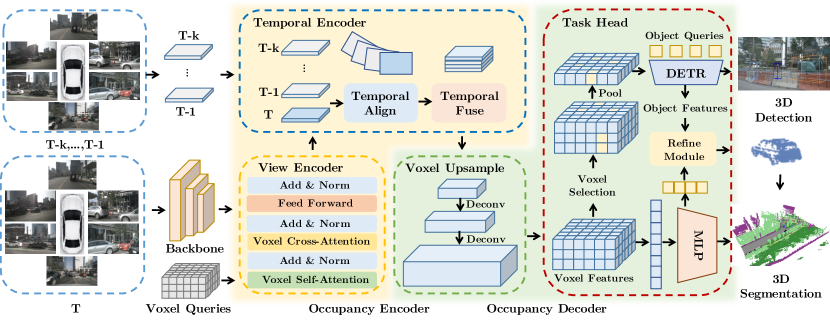
- PanoOcc employs 3D voxel queries to aggregate spatiotemporal features from multi-frame, multi-view images in a coarse-to-fine manner, enabling efficient 3D feature learning.
- The model uses a transformer-based architecture to attend to features across views and time, progressively refining the occupancy representation.
- An occupancy sparsify module is introduced to prune inactive voxels during upsampling, reducing memory consumption by up to 95% (retaining only 5% of voxels).
- The framework jointly optimizes for detection, semantic segmentation, and occupancy prediction using a multi-task loss: focal loss, Lovász-Softmax, and thing-specific loss.
- The method leverages sparse deconvolution in the upsampling path to maintain spatial efficiency while preserving geometric detail.
- It is trained end-to-end using sparse LiDAR point labels as supervision for the voxel representation.

Experimental results
Research questions
- RQ1Can a unified 3D occupancy representation effectively integrate object detection and semantic segmentation from multi-view camera inputs?
- RQ2How can memory efficiency be improved in 3D occupancy prediction without sacrificing performance?
- RQ3To what extent does temporal modeling enhance detection and segmentation of occluded objects like motorcycles and trailers?
- RQ4Does a coarse-to-fine voxel query mechanism outperform traditional 3D voxel grids or tri-plane representations in accuracy and efficiency?
- RQ5Can the proposed sparsification strategy maintain high performance while drastically reducing memory footprint in 3D occupancy learning?
Key findings
- PanoOcc achieves a new state-of-the-art mIoU of 71.7% and NDS of 0.324 on the nuScenes dataset, outperforming prior methods including TPVFormer-Base.
- The model reduces memory consumption to 24G (inference) and 6.0G (inference) compared to TPVFormer-Base’s 33.5G, with a 20% faster inference latency (203ms vs. 268ms).
- The occupancy sparsify module reduces the number of active voxels to just 5% of the original, significantly improving memory efficiency without performance degradation.
- Temporal modeling improves mIoU by 11.7 points for motorcycles and 8.2 points for trailers, demonstrating strong gains for occluded objects.
- The ablation study confirms that Lovász-Softmax loss is critical, as its removal drops mIoU from 65.6 to 59.6.
- The optimal loss weight configuration is λ₁=10.0, λ₂=10.0, λ₃=5.0, yielding the highest mIoU (66.1%) and NDS (0.324).
Read this paper
Open the full text in the Nubint reader and ask about any passage as you read.
Read this paper on NubintThis review was generated by AI from the original paper. Please check the paper before citing it.