
[Paper Review] Parallel Pairwise Correlation Computation On Intel Xeon Phi Clusters
This paper presents LightPCC, the first parallel and distributed all-pairs Pearson correlation coefficient (PCC) computation framework on Intel Xeon Phi clusters, leveraging SIMD, thread-level, and accelerator-level parallelism. It achieves up to 218.2× speedup over sequential ALGLIB and 71.4× over single-threaded MKL on 16 Phis, with strong scalability and a novel bijective workload-balancing framework for symmetric pairwise computation.
Co-expression network is a critical technique for the identification of inter-gene interactions, which usually relies on all-pairs correlation (or similar measure) computation between gene expression profiles across multiple samples. Pearson's correlation coefficient (PCC) is one widely used technique for gene co-expression network construction. However, all-pairs PCC computation is computationally demanding for large numbers of gene expression profiles, thus motivating our acceleration of its execution using high-performance computing. In this paper, we present LightPCC, the first parallel and distributed all-pairs PCC computation on Intel Xeon Phi (Phi) clusters. It achieves high speed by exploring the SIMD-instruction-level and thread-level parallelism within Phis as well as accelerator-level parallelism among multiple Phis. To facilitate balanced workload distribution, we have proposed a general framework for symmetric all-pairs computation by building bijective functions between job identifier and coordinate space for the first time. We have evaluated LightPCC and compared it to two CPU-based counterparts: a sequential C++ implementation in ALGLIB and an implementation based on a parallel general matrix-matrix multiplication routine in Intel Math Kernel Library (MKL) (all use double precision), using a set of gene expression datasets. Performance evaluation revealed that with one 5110P Phi and 16 Phis, LightPCC runs up to $20.6 imes$ and $218.2 imes$ faster than ALGLIB, and up to $6.8 imes$ and $71.4 imes$ faster than single-threaded MKL, respectively. In addition, LightPCC demonstrated good parallel scalability in terms of number of Phis. Source code of LightPCC is publicly available at http://lightpcc.sourceforge.net.
Motivation & Objective
- To accelerate computationally intensive all-pairs PCC computation for large-scale gene expression datasets used in co-expression network construction.
- To address the performance bottleneck of sequential and CPU-based PCC computation in genome-wide association studies and permutation testing.
- To exploit the full parallelism of Intel Xeon Phi clusters—SIMD, multi-threading, and inter-Phi acceleration—for high-performance correlation analysis.
- To design a general, bijective workload distribution framework that ensures balanced job assignment across processing elements in symmetric all-pairs computations.
- To evaluate LightPCC’s performance against state-of-the-art CPU-based implementations (ALGLIB and MKL) on real and synthetic gene expression data.
Proposed method
- LightPCC uses a C++ template-based implementation to exploit SIMD instruction-level parallelism within each Xeon Phi's vector units.
- It leverages thread-level parallelism across multiple cores on each Phi to process independent PCC computations concurrently.
- The framework enables accelerator-level parallelism by distributing jobs across multiple Phis in a cluster using a master-slave model.
- A novel bijective mapping function is introduced to uniquely assign job identifiers to coordinate pairs in the upper triangle of the symmetric PCC matrix, ensuring load balance.
- The algorithm reformulates PCC computation using standard algebraic identities to enable efficient vectorization and GEMM-like optimization.
- Workload distribution is managed via a symmetric job matrix where each unique pair (i,j) with i < j is assigned a unique ID, enabling reversible coordinate reconstruction.

Experimental results
Research questions
- RQ1Can a distributed and parallel PCC computation framework achieve significant speedup over sequential and CPU-optimized implementations on large-scale gene expression data?
- RQ2How effectively can multi-level parallelism (SIMD, multi-threading, inter-Phi) be exploited on Intel Xeon Phi clusters for symmetric all-pairs correlation?
- RQ3Does the proposed bijective job-ID to coordinate mapping enable balanced and scalable workload distribution across multiple Phis?
- RQ4What is the performance gain of LightPCC compared to ALGLIB and MKL across varying numbers of Phis and dataset sizes?
- RQ5How does LightPCC scale with increasing numbers of Phis, and what is its maximum achievable speedup on real human genome data?
Key findings
- On a single 5110P Phi, LightPCC achieves a 13.7× speedup over ALGLIB and a 4.7× speedup over single-threaded MKL.
- With 16 Phis, LightPCC runs up to 218.2× faster than ALGLIB and 71.4× faster than single-threaded MKL on the real human genome dataset.
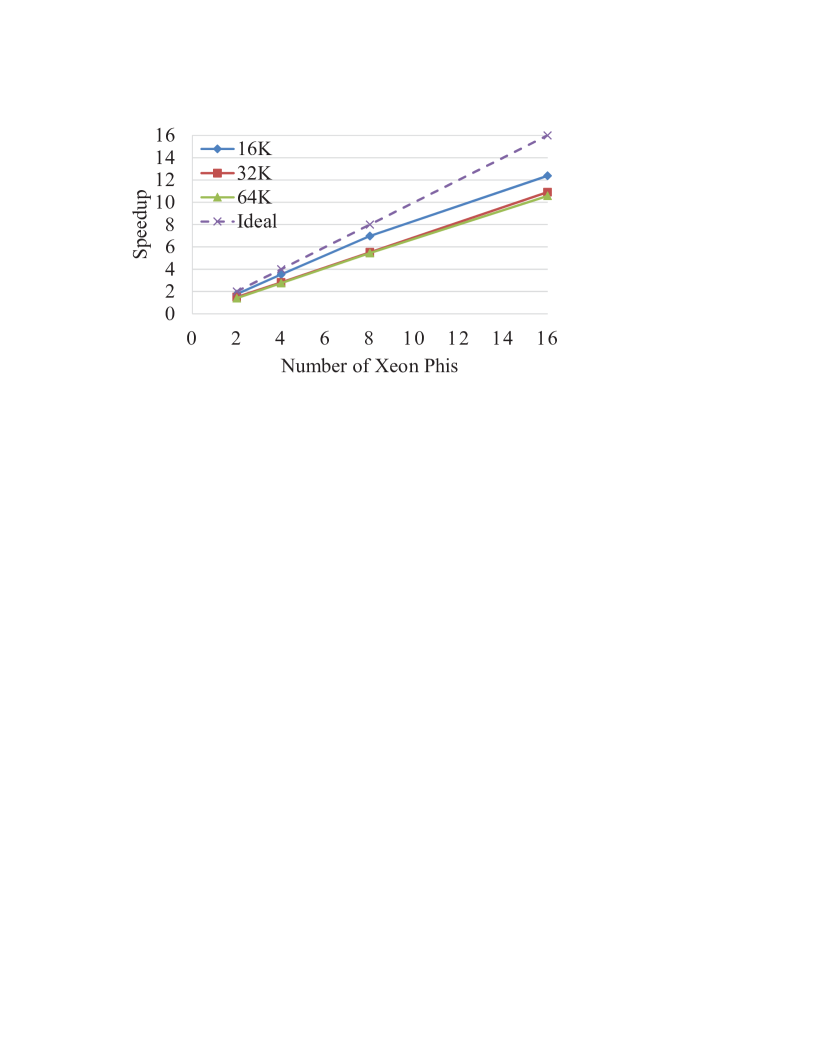
- LightPCC demonstrates strong parallel scalability, achieving a 11.9× speedup on 16 Phis compared to a single Phi on real data.
- The framework achieves a maximum speedup of 4.3× over 16-threaded MKL when using 16 Phis, outperforming it only beyond 4 Phis.
- The bijective workload distribution framework ensures balanced job assignment, enabling efficient utilization of all Phis in the cluster.
- Performance evaluation on both artificial and real datasets confirms consistent and scalable performance gains across varying problem sizes and hardware configurations.
Read this paper
Open the full text in the Nubint reader and ask about any passage as you read.
Read this paper on NubintThis review was generated by AI from the original paper. Please check the paper before citing it.