
[Paper Review] Parameter Efficient Fine Tuning: A Comprehensive Analysis Across Applications
This survey analyzes Parameter Efficient Fine-Tuning (PEFT) methods across domains, comparing strategies like LoRA, DoRA, and LoReFT, and surveying their applications and trade-offs.
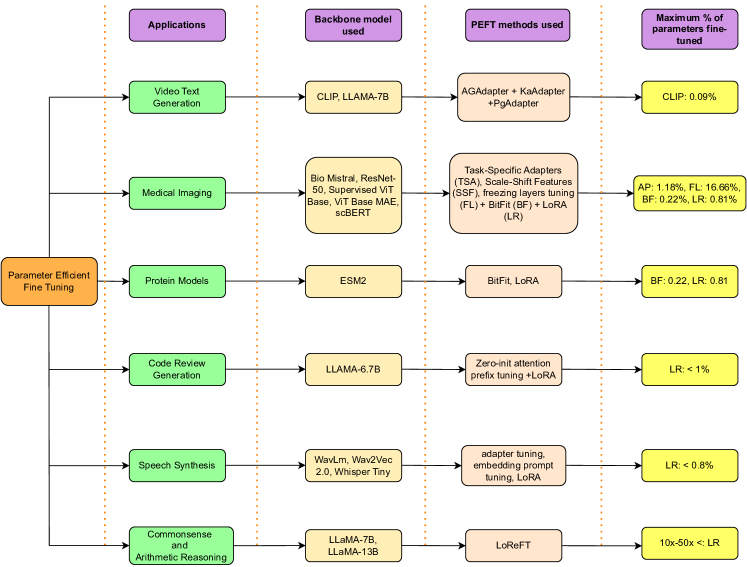
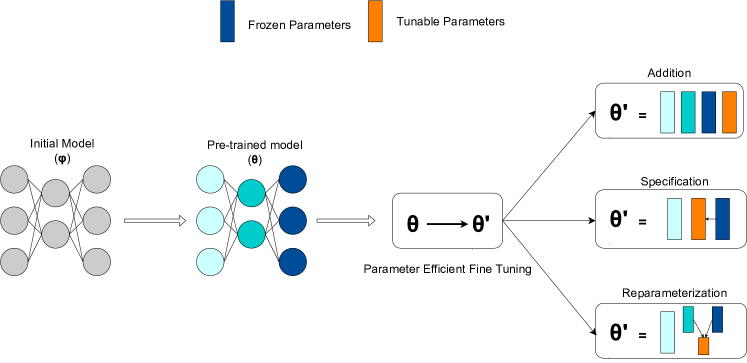
The rise of deep learning has marked significant progress in fields such as computer vision, natural language processing, and medical imaging, primarily through the adaptation of pre-trained models for specific tasks. Traditional fine-tuning methods, involving adjustments to all parameters, face challenges due to high computational and memory demands. This has led to the development of Parameter Efficient Fine-Tuning (PEFT) techniques, which selectively update parameters to balance computational efficiency with performance. This review examines PEFT approaches, offering a detailed comparison of various strategies highlighting applications across different domains, including text generation, medical imaging, protein modeling, and speech synthesis. By assessing the effectiveness of PEFT methods in reducing computational load, speeding up training, and lowering memory usage, this paper contributes to making deep learning more accessible and adaptable, facilitating its wider application and encouraging innovation in model optimization. Ultimately, the paper aims to contribute towards insights into PEFT's evolving landscape, guiding researchers and practitioners in overcoming the limitations of conventional fine-tuning approaches.
Motivation & Objective
- Provide a comprehensive overview of recent advances in PEFT methods.
- Compare PEFT strategies in terms of efficiency, training speed, and memory usage.
- Highlight applications across text, vision, biology, and speech domains.
- Identify challenges and future research directions to democratize deep learning via PEFT.
Proposed method
- Discuss foundational issues with full fine-tuning and the motivation for PEFT.
- Present a representative PEFT equation: DII(b,s,R)=b+R^{ op}(Rs-Rb) to guide hidden-state alignment.
- Compare a range of PEFT techniques (LoRA, DoRA, Prefix Tuning, BitFit, etc.) and their parameter reductions.
- Summarize performance and efficiency trade-offs across datasets and model sizes.
- Illustrate empirical findings through cross-domain applications and tables of results.
Experimental results
Research questions
- RQ1How do PEFT methods compare in terms of parameter efficiency and performance across various tasks?
- RQ2What are the key trade-offs and limitations of PEFT approaches in different domains (NLP, vision, biology, audio)?
- RQ3Which PEFT techniques offer best practical balance between accuracy, training speed, and resource usage across applications?
Key findings
- LoRA generally achieves strong parameter efficiency with notable performance gains.
- LoReFT can outperform several PEFT methods on commonsense reasoning with very small trainable parameter fractions.
- In arithmetic reasoning, LoRA and adapters often outperform LoReFT, indicating task-dependent effectiveness.
- Across applications, PEFT methods significantly reduce training resources while maintaining competitive performance.
- 3D and video-text tasks show notable gains with specialized adapters like AGAdapter and KAdaptation, confirming cross-domain effectiveness.
Read this paper
Open the full text in the Nubint reader and ask about any passage as you read.
Read this paper on NubintThis review was generated by AI from the original paper. Please check the paper before citing it.