
[Paper Review] Parameter-Efficient Fine-Tuning Design Spaces
The paper introduces design spaces for parameter-efficient fine-tuning (PEFT), discovers universal design patterns, and shows new PEFT methods that outperform existing strategies across multiple backbones and NLP tasks.
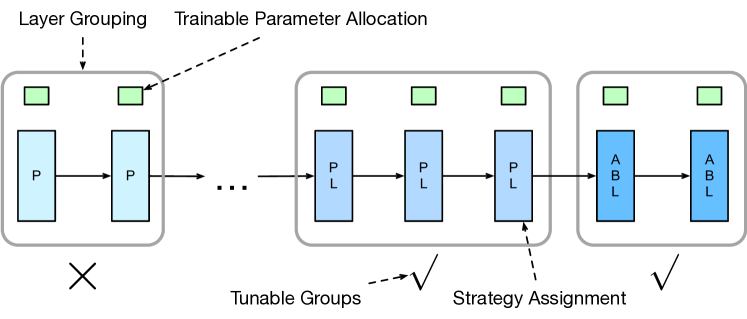
Parameter-efficient fine-tuning aims to achieve performance comparable to fine-tuning, using fewer trainable parameters. Several strategies (e.g., Adapters, prefix tuning, BitFit, and LoRA) have been proposed. However, their designs are hand-crafted separately, and it remains unclear whether certain design patterns exist for parameter-efficient fine-tuning. Thus, we present a parameter-efficient fine-tuning design paradigm and discover design patterns that are applicable to different experimental settings. Instead of focusing on designing another individual tuning strategy, we introduce parameter-efficient fine-tuning design spaces that parameterize tuning structures and tuning strategies. Specifically, any design space is characterized by four components: layer grouping, trainable parameter allocation, tunable groups, and strategy assignment. Starting from an initial design space, we progressively refine the space based on the model quality of each design choice and make greedy selection at each stage over these four components. We discover the following design patterns: (i) group layers in a spindle pattern; (ii) allocate the number of trainable parameters to layers uniformly; (iii) tune all the groups; (iv) assign proper tuning strategies to different groups. These design patterns result in new parameter-efficient fine-tuning methods. We show experimentally that these methods consistently and significantly outperform investigated parameter-efficient fine-tuning strategies across different backbone models and different tasks in natural language processing.
Motivation & Objective
- Understand whether there are overarching design patterns for PEFT beyond hand-crafted individual strategies.
- Propose a design-space framework that parameterizes layer grouping, parameter allocation, tunable groups, and strategy assignment.
- Empirically identify design patterns that generalize across backbones (T5, RoBERTa, BART) and tasks (GLUE, generation).
- Demonstrate new PEFT methods derived from discovered patterns that surpass existing PEFT approaches under low-parameter budgets.
Proposed method
- Define a PEFT design space consisting of four components: layer grouping, trainable parameter allocation, tunable groups, and strategy assignment.
- Progressively refine unconstrained design spaces by enforcing constraints and evaluating model quality via random sampling and low-epoch fine-tuning on GLUE.
- Identify design patterns that consistently improve performance across patterns (e.g., spindle layer grouping, uniform parameter allocation, tuning all groups, assigning diverse strategies to groups).
- Instantiate new PEFT methods that incorporate discovered patterns and compare against adapters, prefixes, BitFit, and LoRA across multiple backbones.
- Validate patterns on multiple backbones (T5-base, T5-3b, RoBERTa-base/large, BART-base/large) and tasks including GLUE and generation."],
- research_questions rigidly_more_concise
Experimental results
Research questions
- RQ1What design-space patterns yield the best performance for PEFT across different backbones?
- RQ2Do layer grouping, parameter allocation, tunable groups, and strategy assignment interact to produce transferable design principles?
- RQ3Can discovered design patterns lead to new PEFT methods that outperform existing strategies on diverse NLP tasks?
- RQ4Are the identified patterns robust across both understanding tasks (GLUE) and generation tasks (summarization, translation)?
Key findings
- A spindle pattern for layer grouping consistently outperforms other groupings on GLUE with T5-base.
- Uniform allocation of trainable parameters across layers yields highest GLUE average in the explored spaces.
- Tuning all layer groups is beneficial for performance.
- Assigning different tuning strategies to different groups yields improved results over uniform strategy assignment.
- PEFT methods built from these patterns (S4-model, S4-3b-model) exceed strong baselines and can even beat full fine-tuning under low-parameter budgets in several settings.
- Pattern-derived methods generalize across backbones (T5, RoBERTa, BART) and NLP tasks (classification, generation).

Read this paper
Open the full text in the Nubint reader and ask about any passage as you read.
Read this paper on NubintThis review was generated by AI from the original paper. Please check the paper before citing it.