
[Paper Review] Parameter-Efficient Fine-Tuning for Foundation Models
This survey systematically reviews parameter-efficient fine-tuning (PEFT) methods across foundation models, categorizing approaches (Selective, Additive, Prompt, Reparameterization, Hybrid) and outlining trends, applications, and future directions.
This survey delves into the realm of Parameter-Efficient Fine-Tuning (PEFT) within the context of Foundation Models (FMs). PEFT, a cost-effective fine-tuning technique, minimizes parameters and computational complexity while striving for optimal downstream task performance. FMs, like ChatGPT, DALL-E, and LLaVA specialize in language understanding, generative tasks, and multimodal tasks, trained on diverse datasets spanning text, images, and videos. The diversity of FMs guides various adaptation strategies for PEFT. Therefore, this survey aims to provide a comprehensive overview of PEFT techniques applied to diverse FMs and address critical gaps in understanding the techniques, trends, and applications. We start by providing a detailed development of FMs and PEFT. Subsequently, we systematically review the key categories and core mechanisms of PEFT across diverse FMs to offer a comprehensive understanding of trends. We also explore the most recent applications across various FMs to demonstrate the versatility of PEFT, shedding light on the integration of systematic PEFT methods with a range of FMs. Furthermore, we identify potential research and development directions for improving PEFTs in the future. This survey provides a valuable resource for both newcomers and experts seeking to understand and use the power of PEFT across FMs. All reviewed papers are listed at \url{https://github.com/THUDM/Awesome-Parameter-Efficient-Fine-Tuning-for-Foundation-Models}.
Motivation & Objective
- Explain foundation models and the need for PEFT to reduce training costs.
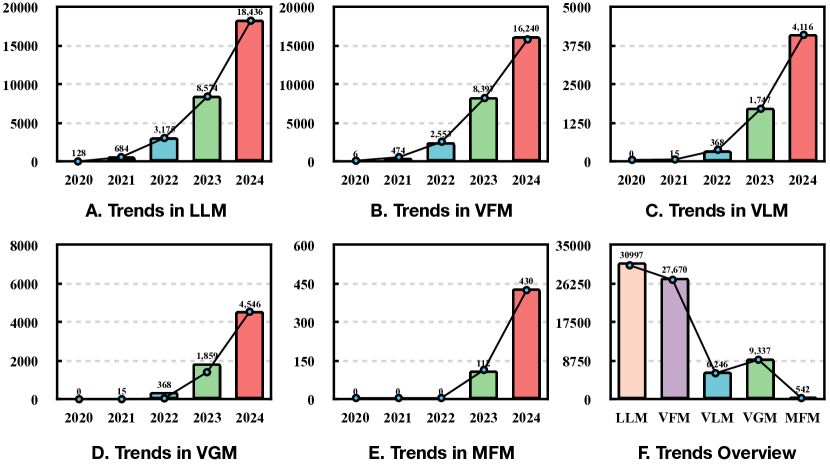
- Survey and categorize PEFT methods across five FM structures (LLM, VFM, VLM, MFM, VGM).
- Analyze design choices, trade-offs, and applicability of PEFT techniques.
- Summarize current applications and identify open challenges and future directions.
Proposed method
- Define and categorize foundation models by input modality and task.
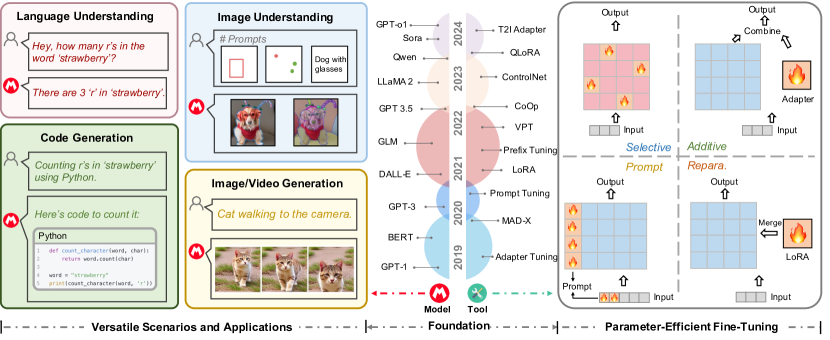
- Introduce five PEFT categories: Selective, Additive, Prompt, Reparameterization, and Hybrid PEFT.
- Detail representative techniques and mechanisms within each category (e.g., adapters, prompts, masks, and reparameterization).
- Compare pros and cons and discuss deployment considerations across diverse FMs.
- Survey recent applications to LLMs, VFMs, VLMs, MFMs, and VGMs.
- Highlight future research directions and potential integrative frameworks.
Experimental results
Research questions
- RQ1What are the main PEFT strategies used to adapt foundation models across different modalities?
- RQ2How do selective, additive, prompt, reparameterization, and hybrid PEFT methods compare in terms of trainable parameters, performance, and deployment trade-offs?
- RQ3What are the current application trends and gaps in PEFT for LLMs, VFMs, VLMs, MFMs, and VGMs?
- RQ4What future directions can unify PEFT methods across diverse foundation models?
Key findings
- PEFT significantly reduces trainable parameters and computational overhead while aiming for near-full fine-tuning performance.
- Five PEFT families are identified: selective, additive, prompt, reparameterization, and hybrid, each with distinct mechanisms and trade-offs.
- Across LLMs, VFMs, VLMs, MFMs, and VGMs, adapters, prompts, and parameterizations are the dominant techniques.
- Automatic and automatic-criteria-based selection methods offer flexible but memory/time trade-offs compared to fixed selective tuning.
- Hybrid approaches and cross-modal adaptations show promise for broader transfer learning and efficiency.
- Current surveys indicate growing activity in PEFT with strong emphasis on LLMs and vision foundation models.
Read this paper
Open the full text in the Nubint reader and ask about any passage as you read.
Read this paper on NubintThis review was generated by AI from the original paper. Please check the paper before citing it.