
[Paper Review] Particle discrimination in a NaI crystal using the COSINUS remote TES design
This paper demonstrates event-by-event particle discrimination in a cryogenic sodium iodide (NaI) scintillating calorimeter using the COSINUS remote TES (remoTES) design. By simultaneously measuring phonons and scintillation light, the prototype achieved clear separation of electron/gamma events from nuclear recoils down to a 15 keV nuclear recoil energy threshold, proving feasibility for direct dark matter detection with NaI crystals in a low-background environment.
The COSINUS direct dark matter experiment situated at Laboratori Nazionali del Gran Sasso in Italy is set to investigate the nature of the annually modulating signal detected by the DAMA/LIBRA experiment. COSINUS has already demonstrated that sodium iodide crystals can be operated at mK temperature as cryogenic scintillating calorimeters using transition edge sensors, despite the complication of handling a hygroscopic and low melting point material. With results from a new COSINUS prototype, we show that particle discrimination on an event-by-event basis in NaI is feasible using the dual-channel readout of both phonons and scintillation light. The detector was mounted in the novel remoTES design and operated in an above-ground facility for 9.06 g$\cdot$d of exposure. With a 3.7 g NaI crystal, e$^-$/$γ$ events could be clearly distinguished from nuclear recoils down to the nuclear recoil energy threshold of 15 keV.
Motivation & Objective
- To demonstrate particle discrimination in cryogenic NaI crystals, a challenging hygroscopic and low-melting-point material, for direct dark matter detection.
- To validate the remoTES design as a viable readout method for fragile absorber materials like NaI.
- To achieve sub-keV energy threshold performance with high event-by-event discrimination capability.
- To provide a foundation for the COSINUS experiment’s goal of testing the DAMA/LIBRA annual modulation signal with improved energy resolution and particle identification.
Proposed method
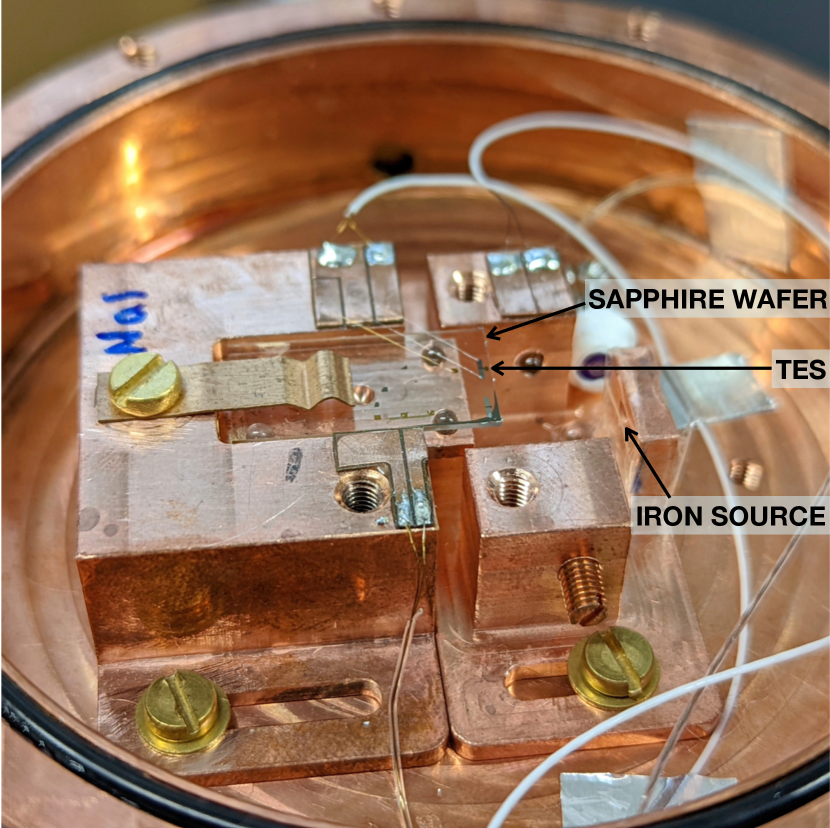
- The COSINUS prototype used a 3.7 g NaI crystal coupled to a remote transition edge sensor (remoTES) on a separate silicon wafer, with gold wire and pad thermal coupling.
- Both phonon and scintillation light signals were recorded for each event, enabling dual-channel readout for particle identification.
- The detector was operated at millikelvin temperatures in an above-ground facility, with calibration using a 57Co gamma source and an AmBe neutron source.
- A likelihood-based bandfit method was applied to reconstruct light yield (LY) versus phonon energy, distinguishing electron/gamma events from nuclear recoils.
- The energy threshold for nuclear recoil detection was determined to be 15 keV, based on the lowest observable event energy in the nuclear recoil band.
- Nonlinearities in the light detector response were accounted for in the parametric fit, particularly affecting the e⁻/γ band at higher energies.
![Figure 1 : Schematic of the remoTES detector. The TES is deposited on a wafer, which is separated from the absorber crystal. The coupling between the absorber and the TES consists of an Au-pad glued on the absorber surface and connected to the TES by two Au-wire bonds [ 6 ] .](https://ar5iv.labs.arxiv.org/html/2307.11066/assets/x1.png)
Experimental results
Research questions
- RQ1Can event-by-event particle discrimination be achieved in a cryogenic NaI detector using simultaneous phonon and scintillation light readout?
- RQ2Is the remoTES design suitable for handling hygroscopic and low-melting-point materials like NaI in a cryogenic calorimetric setup?
- RQ3What is the achievable nuclear recoil energy threshold in a NaI-based cryogenic detector with this dual-channel approach?
- RQ4How does the light yield (LY) of nuclear recoils in NaI compare to electron/gamma events, and does it vary with energy?
- RQ5Can the detector resolve a distinct nuclear recoil band below the electron/gamma band under above-ground conditions?
Key findings
- The remoTES design successfully enabled operation of a 3.7 g NaI crystal as a cryogenic scintillating calorimeter at millikelvin temperatures despite its hygroscopic and low-melting-point nature.
- A baseline energy resolution of 2 keV was achieved in an above-ground environment, demonstrating the robustness of the remoTES approach.
- Electron/gamma events and nuclear recoils were clearly distinguished in a 2D histogram of light yield (LY) versus phonon energy, with a distinct nuclear recoil band appearing below the e⁻/γ band.
- The nuclear recoil band was observed at a quenched light yield of approximately 0.5 at energies above 100 keV, consistent with expected quenching behavior in NaI.
- The nuclear recoil energy threshold was determined to be 15 keV, with events below this energy not resolved due to the detector's energy threshold.
- A downward tilt in the e⁻/γ band at higher energies was attributed to increasing nonlinearity in the light detector response, which was accounted for in the parametric fit.
Better researchstarts right now
From reading papers to final review, dramatically reduce your research time.
No credit card · Free plan available
This review was created by AI and reviewed by human editors.