
[Paper Review] PatchNet: A Simple Face Anti-Spoofing Framework via Fine-Grained Patch Recognition
PatchNet proposes a novel face anti-spoofing framework that reformulates the task as fine-grained patch-type recognition, classifying combinations of capture devices and presenting materials using local image patches. By leveraging asymmetric margin-based and self-supervised similarity losses, it achieves state-of-the-art performance on intra-dataset, cross-dataset, and domain generalization benchmarks, enabling robust detection of unseen spoof types through localized feature learning.
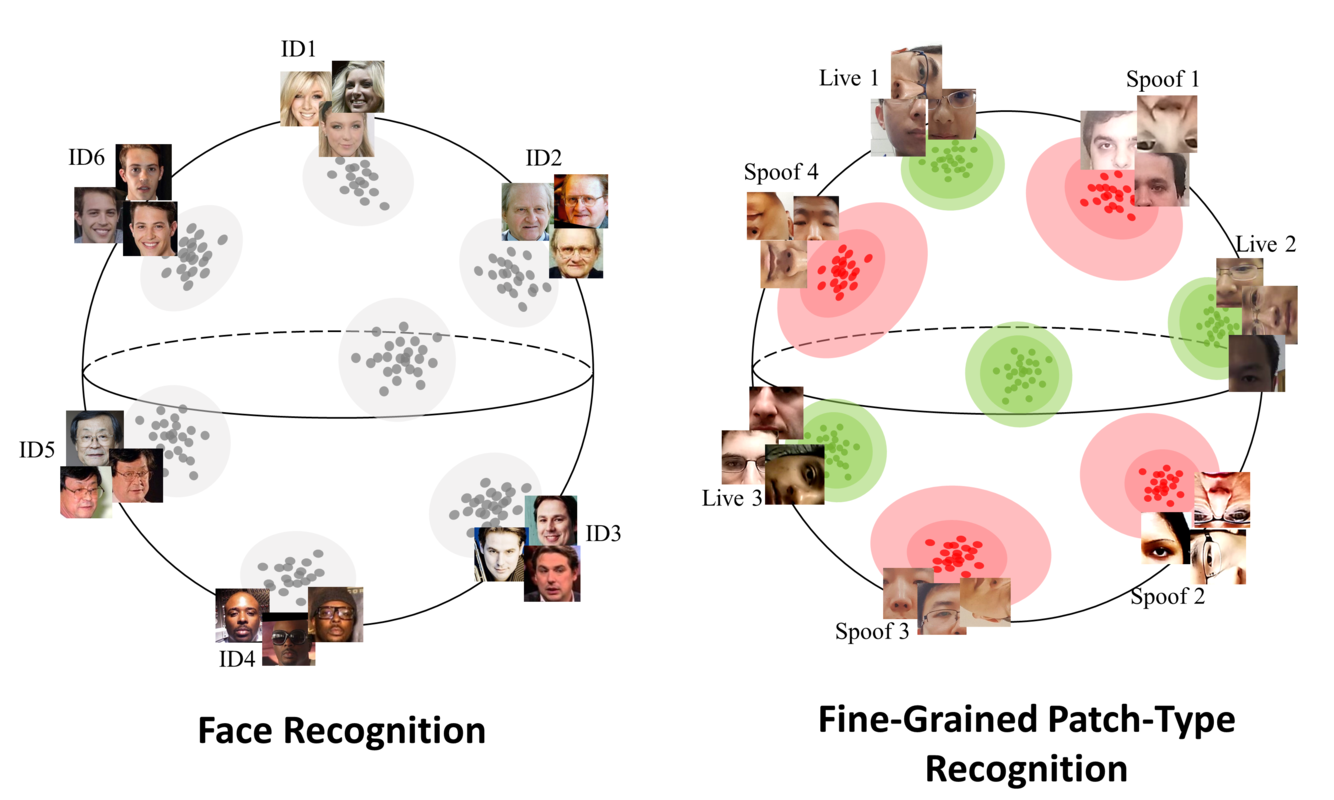
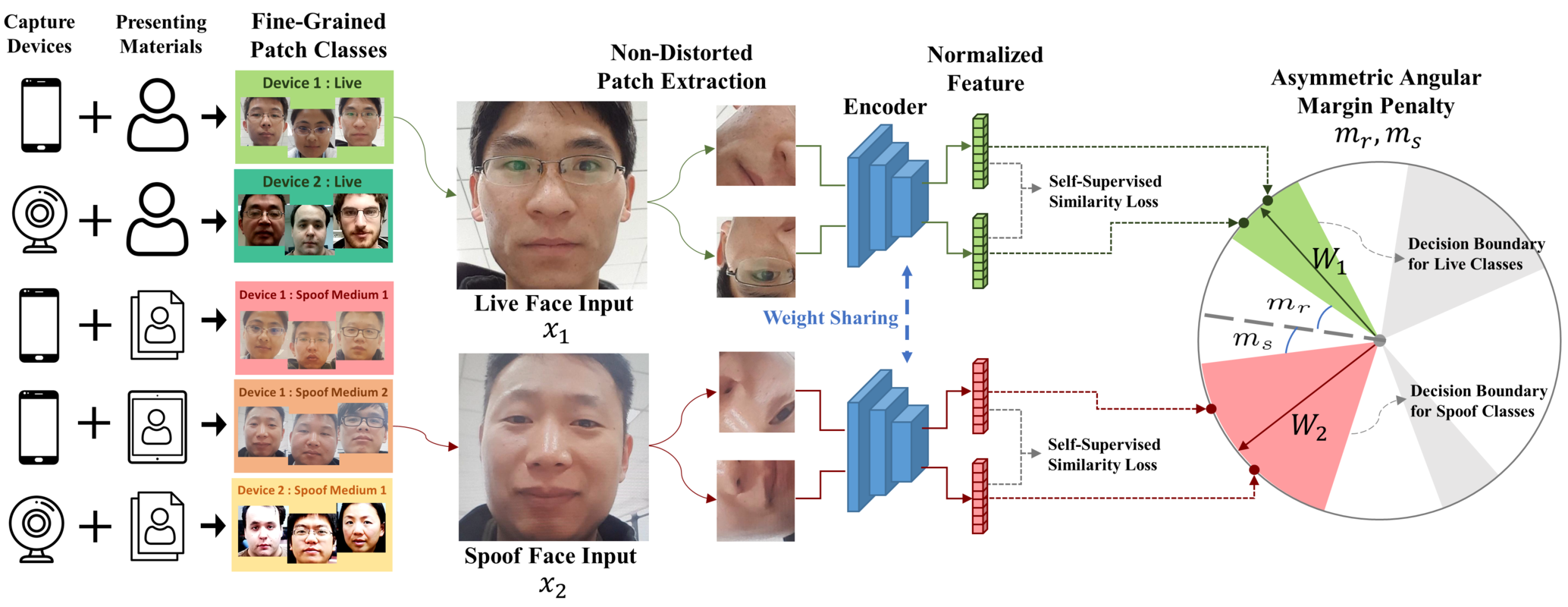
Face anti-spoofing (FAS) plays a critical role in securing face recognition systems from different presentation attacks. Previous works leverage auxiliary pixel-level supervision and domain generalization approaches to address unseen spoof types. However, the local characteristics of image captures, i.e., capturing devices and presenting materials, are ignored in existing works and we argue that such information is required for networks to discriminate between live and spoof images. In this work, we propose PatchNet which reformulates face anti-spoofing as a fine-grained patch-type recognition problem. To be specific, our framework recognizes the combination of capturing devices and presenting materials based on the patches cropped from non-distorted face images. This reformulation can largely improve the data variation and enforce the network to learn discriminative feature from local capture patterns. In addition, to further improve the generalization ability of the spoof feature, we propose the novel Asymmetric Margin-based Classification Loss and Self-supervised Similarity Loss to regularize the patch embedding space. Our experimental results verify our assumption and show that the model is capable of recognizing unseen spoof types robustly by only looking at local regions. Moreover, the fine-grained and patch-level reformulation of FAS outperforms the existing approaches on intra-dataset, cross-dataset, and domain generalization benchmarks. Furthermore, our PatchNet framework can enable practical applications like Few-Shot Reference-based FAS and facilitate future exploration of spoof-related intrinsic cues.
Motivation & Objective
- To address the limitation of existing face anti-spoofing methods that overfit to dataset biases and fail on unseen spoof types.
- To exploit local capture characteristics—specifically, the combination of capturing devices and presenting materials—as intrinsic cues for spoof detection.
- To develop a training framework that enhances feature generalization by focusing on fine-grained patch-level recognition rather than whole-image classification.
- To enable practical applications such as few-shot reference-based anti-spoofing and patch-type retrieval using the learned embedding space.
Proposed method
- Reformulates face anti-spoofing as a fine-grained patch-type recognition task, where each patch is classified based on its capture device and presenting material.
- Crops fixed-size, non-distorted patches directly from raw face images to preserve discriminative local cues and avoid distortion from resizing.
- Introduces an Asymmetric Margin-based Softmax Loss that applies a larger angular margin to live-class embeddings to address class imbalance and improve discrimination.
- Proposes a Self-Supervised Similarity Loss to enforce feature invariance under spatial transformations (e.g., rotation, location shifts) within a single capture.
- Trains a deep neural network to embed patches into a normalized hypersphere, enabling cosine similarity-based comparison for downstream applications.
- Utilizes the resulting normalized embedding space for applications such as few-shot reference-based FAS and patch-type retrieval.
Experimental results
Research questions
- RQ1Can fine-grained patch-type recognition improve generalization in face anti-spoofing beyond binary live/spoof classification?
- RQ2How does modeling the combination of capture device and presenting material as patch types enhance robustness to unseen spoof types?
- RQ3To what extent do asymmetric margin and self-supervised similarity losses improve feature discrimination and invariance in the patch embedding space?
- RQ4Can the learned patch embedding space enable practical applications like few-shot reference-based anti-spoofing?
- RQ5How does performance vary when testing on individual capture devices, and can patch-level analysis guide system improvements?
Key findings
- PatchNet achieves state-of-the-art performance on intra-dataset, cross-dataset, and domain generalization benchmarks, with an AUC of 98.46% on the O&C&I to M protocol and 94.58% on O&M&I to C.
- On individual capture devices, PatchNet achieves 99.54% AUC on M1 and 98.63% on M2, with 98.13% on C3, demonstrating strong robustness even on lower-quality devices.
- With 10-shot live reference features, PatchNet boosts performance to 99.8% AUC on M1 and 99.2% on C3, showing high practicality in few-shot scenarios.
- Patch-type retrieval using a live sample from the O dataset successfully identifies relevant live and spoof types, with top-7 matches including high-similarity types from M and C datasets.
- Removing ambiguous live types (e.g., C2_L, C1_L, I_L) from testing improves AUC to 95.27%, and redefining them as spoof classes boosts it to 95.87%.
- The ablation study confirms that both the asymmetric margin loss and self-supervised similarity loss contribute significantly to performance gains across all benchmarks.
Read this paper
Open the full text in the Nubint reader and ask about any passage as you read.
Read this paper on NubintThis review was generated by AI from the original paper. Please check the paper before citing it.