
[Paper Review] Path instabilities and drag in the settling of single spheres
This experimental study investigates the settling dynamics of single spheres in quiescent fluid across a wide range of particle-to-fluid density ratios (Γ ∈ [1.1, 7.9]) and Galileo numbers (Ga ∈ [100, 340]). It validates numerically predicted regimes—Vertical Periodic at low Γ and Planar Rotating at high Γ—while revealing complex path instabilities, including semi-helical trajectories and multi-stable coexistence of planar and non-planar motions. The key contribution is the development of new drag and terminal velocity correlations directly in terms of the control parameter Ga, rather than the response parameter Reₚ, and the demonstration that finite density ratio effects significantly influence drag, challenging the common assumption of negligible Γ-dependence in standard correlations.
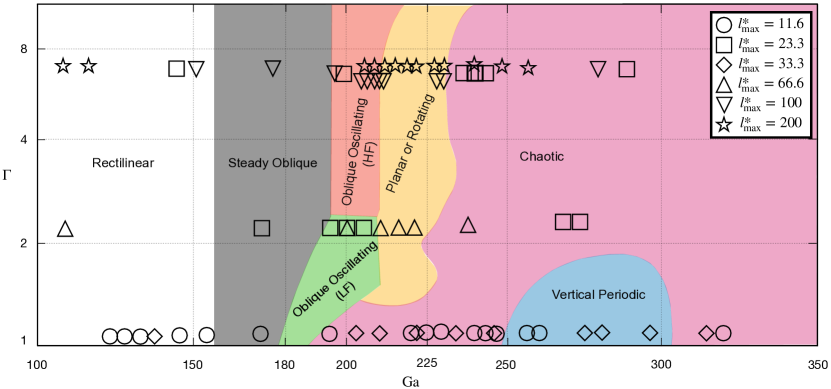
The settling behavior of individual spheres in a quiescent fluid was studied experimentally. The dynamics of the spheres was analyzed in the parameter space of particle-to-fluid density ratio ($Γ$) and Galileo number ($\mathrm{Ga}$), with $Γ\in (1.1, 7.9)$ and $\mathrm{Ga} \in (100, 340)$. The experimental results showed for the first time that the mean trajectory angle with the vertical exhibits a complex behavior as $\mathrm{Ga}$ and $Γ$ are varied. Numerically predicted regimes such as Vertical Periodic and Planar Rotating were validated at high $Γ$ values. In particular, for the denser spheres, a clear transition from planar to non-planar trajectories was observed, accompanied by the emergence of semi-helical trajectories corresponding to the Planar Rotating Regime. The spectra of trajectory oscillations were also quantified as a function of $\mathrm{Ga}$, confirming the existence of oblique oscillating regimes at both low and high frequencies. The amplitudes of the perpendicular velocities in these regimes were also quantified and compared with numerical simulations in the literature. The terminal velocity and drag of the spheres were found to depend on the particle-to-fluid density ratio, and correlations between the drag coefficient and particle Reynolds number ($Re_p$) as a function of Ga were established, allowing for the estimation of drag and settling velocity using $\mathrm{Ga}$, a control parameter, rather than the response parameter $Re_p$.
Motivation & Objective
- To experimentally characterize the path instabilities and drag forces of single spheres settling in quiescent fluid across a broad parameter space of Γ and Ga.
- To validate numerically predicted dynamical regimes—such as Vertical Periodic and Planar Rotating—under experimentally accessible conditions.
- To quantify trajectory oscillation spectra, including low- and high-frequency oblique oscillating regimes, and assess their dependence on Ga and Γ.
- To establish new correlations between terminal Reynolds number and drag coefficient directly in terms of the control parameter Ga, rather than the response parameter Reₚ.
- To assess the validity of assuming negligible density ratio (Γ) dependence in standard drag correlations, particularly for finite-density particles.
Proposed method
- Conducted controlled experiments using spheres of varying density (Γ = 1.1 to 7.9) and diameter (dₚ) in a quiescent fluid to measure settling trajectories and terminal velocities.
- Employed particle tracking velocimetry (PTV) to reconstruct 3D trajectories and extract oscillation amplitudes and frequencies in the transverse direction.
- Defined the Galileo number as Ga = U_g dₚ / ν, with U_g = √(|Γ−1|gdₚ), to serve as the primary control parameter, replacing Reₚ in drag correlations.
- Quantified the dimensionless oscillation frequency f* and amplitude of transverse velocity components to identify oblique oscillating and helical regimes.
- Compared experimental drag coefficients C_D and terminal Reynolds numbers Reₚ with numerical simulations and classical fixed-sphere correlations.
- Analyzed the coexistence of planar (oblique oscillating) and non-planar (helical) trajectories in the high-Γ regime to assess multi-stability.
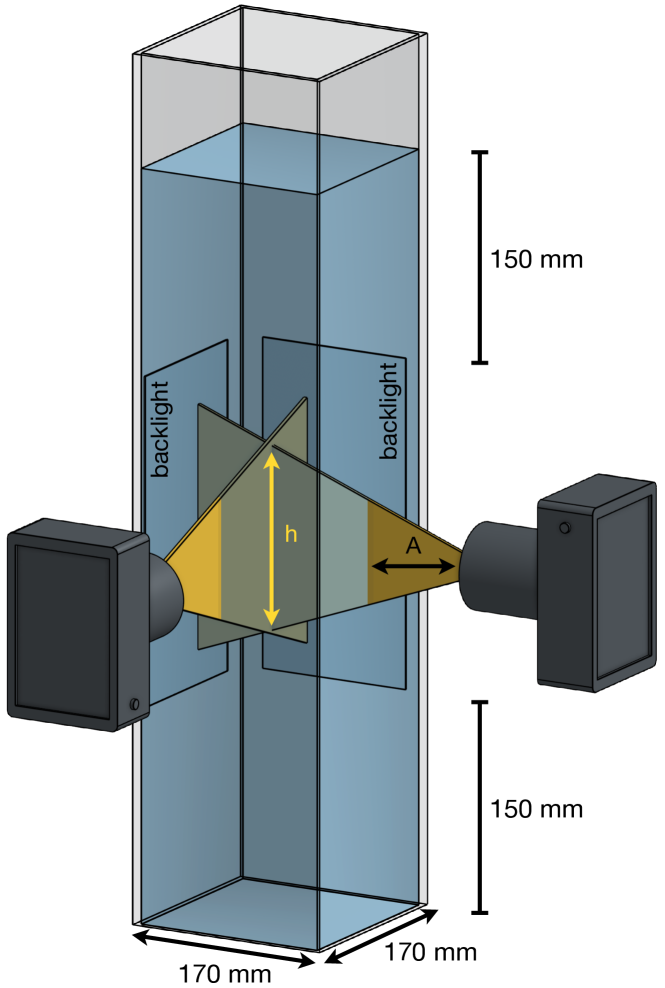
Experimental results
Research questions
- RQ1How do the trajectory dynamics of settling spheres evolve across the Γ–Ga parameter space, particularly in regions with high Γ (Γ > 3.9) previously unexplored experimentally?
- RQ2To what extent do experimentally observed path instabilities—such as oblique oscillations and semi-helical trajectories—match numerically predicted regimes like Vertical Periodic and Planar Rotating?
- RQ3What is the role of the Galileo number as a control parameter in predicting terminal velocity and drag, compared to the conventional use of Reynolds number?
- RQ4How significant is the explicit dependence of the drag coefficient on the particle-to-fluid density ratio Γ, beyond its implicit inclusion through Reₚ?
- RQ5In what range of Ga and Γ do multi-stable regimes—where both planar and helical trajectories coexist—emerge, and how frequently are they observed?
Key findings
- The experimental data confirmed the existence of the Vertical Periodic regime at low Γ (Γ = 1.1) and the Planar Rotating regime at high Γ (Γ = 7.9), validating numerical predictions.
- For Γ = 7.9, a High-Frequency Oblique Oscillating Regime was observed around Ga ≈ 200 with a dimensionless frequency f* ≈ 0.18, which had not been previously reported in experiments.
- Helical trajectories were observed coexisting with the High-Frequency Oblique Oscillating Regime over a broad Ga range (≈200–220), indicating a larger region of multi-stability than previously reported in simulations.
- The radius of observed helical trajectories was estimated at ~7 particle diameters, and the pitch at several hundred particle diameters, consistent with prior experimental and numerical findings.
- A systematic trend was observed where the drag coefficient for the lightest particles (Γ = 1.1) was up to 30% higher than for the densest (Γ = 7.9), indicating a significant and non-negligible dependence on Γ.
- New empirical correlations were established linking terminal Reynolds number and drag coefficient directly to Ga, offering a more practical and physically grounded alternative to Reₚ-based correlations for predicting settling velocity and drag.
Read this paper
Open the full text in the Nubint reader and ask about any passage as you read.
Read this paper on NubintThis review was generated by AI from the original paper. Please check the paper before citing it.