
[Paper Review] Paxion: Patching Action Knowledge in Video-Language Foundation Models
Paxion patches action knowledge into frozen video-language models with a Knowledge Patcher and Knowledge Fuser, using a novel Discriminative Video Dynamics Modeling objective to improve action understanding while preserving object-level capabilities.
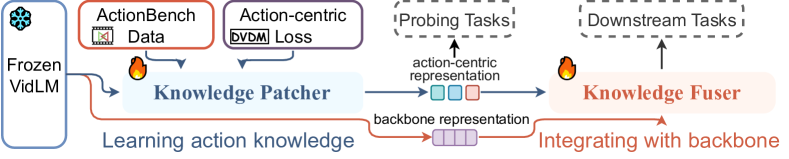
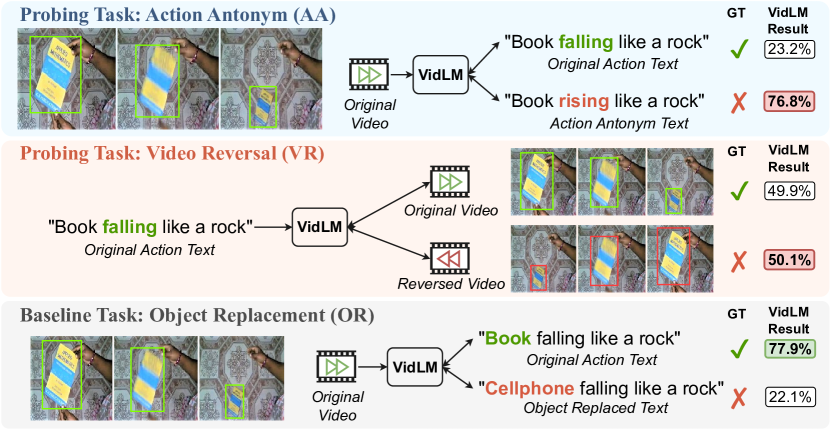
Action knowledge involves the understanding of textual, visual, and temporal aspects of actions. We introduce the Action Dynamics Benchmark (ActionBench) containing two carefully designed probing tasks: Action Antonym and Video Reversal, which targets multimodal alignment capabilities and temporal understanding skills of the model, respectively. Despite recent video-language models' (VidLM) impressive performance on various benchmark tasks, our diagnostic tasks reveal their surprising deficiency (near-random performance) in action knowledge, suggesting that current models rely on object recognition abilities as a shortcut for action understanding. To remedy this, we propose a novel framework, Paxion, along with a new Discriminative Video Dynamics Modeling (DVDM) objective. The Paxion framework utilizes a Knowledge Patcher network to encode new action knowledge and a Knowledge Fuser component to integrate the Patcher into frozen VidLMs without compromising their existing capabilities. Due to limitations of the widely-used Video-Text Contrastive (VTC) loss for learning action knowledge, we introduce the DVDM objective to train the Knowledge Patcher. DVDM forces the model to encode the correlation between the action text and the correct ordering of video frames. Our extensive analyses show that Paxion and DVDM together effectively fill the gap in action knowledge understanding (~50% to 80%), while maintaining or improving performance on a wide spectrum of both object- and action-centric downstream tasks. The code and data will be made publicly available for research purposes at https://github.com/MikeWangWZHL/Paxion.git.
Motivation & Objective
- Define Action Dynamics Benchmark (ActionBench) to probe action knowledge across multimodal and temporal dimensions.
- Diagnose deficiencies in state-of-the-art VidLMs' action understanding versus object bias.
- Propose Paxion framework to patch action knowledge into frozen VidLM backbones without hurting VL performance.
- Introduce Discriminative Video Dynamics Modeling (DVDM) losses to better learn action-text and frame dynamics.
- Demonstrate improved performance on action-centric downstream tasks while retaining object-centric capabilities.
Proposed method
- Introduce Knowledge Patcher (KP) based on Perceiver for lightweight action-centric feature augmentation of a frozen VidLM backbone.
- Develop Discriminative Video Dynamics Modeling (DVDM) with Video-Action Contrastive (VAC) and Action-Temporal Matching (ATM) losses to learn action dynamics.
- Show that VTC alone is insufficient for action knowledge; DVDM provides the necessary discriminative signals.
- Integrate KP with a Knowledge Fuser (KF) using cross-attention to fuse action-centric and object-centric representations for downstream tasks.
- Evaluate Paxion on ActionBench and downstream tasks including Video-Text Retrieval, Video-to-Action Retrieval, and NExT-QA with zero-shot domain transfer considerations.
Experimental results
Research questions
- RQ1Can state-of-the-art VidLMs demonstrate robust action knowledge beyond object recognition?
- RQ2Does a patch-based, frozen-backbone approach with a discriminative dynamics objective improve action understanding without sacrificing VL performance?
- RQ3How does fusing action-centric patches with backbone representations affect a range of downstream tasks (object-, action-, and temporal-centric)?
Key findings
- ActionBench reveals near-random performance of leading VidLMs on Action Antonym and Video Reversal, indicating weak action knowledge and a bias toward objects.
- Paxion with DVDM significantly improves action understanding (AA and VR) while maintaining or improving object-based task performance.
- KP with VTC+DVDM dramatically increases AA/VR scores (e.g., from 58.8/46.2 to 90.1/75.5 on InternVideo variants) and yields strong overall Avg gains.
- Knowledge Fuser (KF) enhances downstream task performance by balancing action-centric and object-centric representations, notably improving temporal-intensive tasks like Temporal-SSv2 and NExT-QA.
- Paxion demonstrates robustness to domain shift and positive transfer in zero-shot settings when KF is used, illustrating improved generalization.
Read this paper
Open the full text in the Nubint reader and ask about any passage as you read.
Read this paper on NubintThis review was generated by AI from the original paper. Please check the paper before citing it.