
[Paper Review] PC-Droid: Faster diffusion and improved quality for particle cloud generation
PC-Droid introduces a state-of-the-art diffusion model for particle cloud generation in high-energy physics, leveraging an improved EDM noise scheduler, advanced ODE solvers, and consistency distillation to achieve generation speeds up to two orders of magnitude faster than PC-JeDi and three orders faster than Delphes, while maintaining or improving generation quality across all jet types and metrics.
Building on the success of PC-JeDi we introduce PC-Droid, a substantially improved diffusion model for the generation of jet particle clouds. By leveraging a new diffusion formulation, studying more recent integration solvers, and training on all jet types simultaneously, we are able to achieve state-of-the-art performance for all types of jets across all evaluation metrics. We study the trade-off between generation speed and quality by comparing two attention based architectures, as well as the potential of consistency distillation to reduce the number of diffusion steps. Both the faster architecture and consistency models demonstrate performance surpassing many competing models, with generation time up to two orders of magnitude faster than PC-JeDi and three orders of magnitude faster than Delphes.
Motivation & Objective
- To develop a faster and higher-fidelity diffusion model for generating particle jets as point clouds in high-energy physics simulations.
- To reduce inference time while maintaining or improving generation quality compared to existing surrogate models like PC-JeDi and Delphes.
- To explore the trade-off between generation speed and quality using attention-based architectures and consistency models.
- To enable joint training across all jet types for improved generalization and unconditional generation capability.
- To establish new benchmarks for particle cloud generation using standard metrics and real-world hardware evaluation.
Proposed method
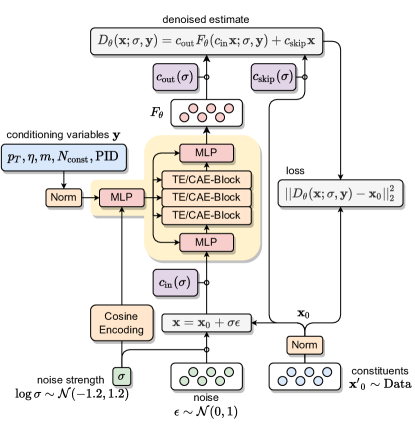
- Adopts the EDM (Denoising Score-Based) diffusion formulation with a simplified SDE and ODE, using $\gamma(t) = 1$ and $\sigma(t) = t$, enabling straighter reverse trajectories and fewer truncation errors.
- Employs log-normal sampling of noise rates $\sigma \sim \mathcal{N}(-1.2, 1.2)$ to focus training on intermediate noise levels where performance gains are most impactful.
- Introduces $\sigma$-dependent scaling and skip connections ($c_{\text{in}}, c_{\text{out}}, c_{\text{skip}}$) to maintain unit variance and allow bypassing the network at low noise levels.
- Reformulates the loss as $\mathcal{L} = \|D_\theta(\boldsymbol{x}; \sigma, \boldsymbol{y}) - \boldsymbol{x}_0\|^2_2$, directly minimizing reconstruction error instead of noise prediction.
- Utilizes advanced ODE integration solvers from the k-diffusion library, with DPM2 showing superior performance for consistency model training.
- Trains consistency distillation models (CD1, CD5) using PC-Droid as teacher, enabling one-step generation with acceptable fidelity and performance saturation by five steps.
Experimental results
Research questions
- RQ1Can a re-imagined diffusion formulation significantly reduce inference time while improving generation quality for particle cloud generation?
- RQ2How do modern ODE solvers and improved network normalization techniques affect the fidelity and speed of jet particle cloud generation?
- RQ3To what extent can consistency models enable one-step generation with competitive quality compared to standard diffusion models?
- RQ4What is the performance trade-off between generation speed and quality across different architectures and distillation strategies?
- RQ5Can joint training across all jet types improve generalization and enable unconditional generation without performance degradation?
Key findings
- PC-Droid achieves state-of-the-art performance across all jet types and evaluation metrics, surpassing both PC-JeDi and Delphes in fidelity and speed.
- The fastest model (CD1) generates top jets in approximately three times the time of EPiC-GAN but achieves an FPND score one order of magnitude closer to the ideal Delphes benchmark.
- CD5 (five-step consistency model) is 2.5 times faster than the eight-step FPCD (PD8) model while improving all metrics, including $\mathrm{W}_1^{\mathrm{M}}$ and $\mathrm{W}_1^{\tau_{32}}$.
- The full PC-Droid model is 250 times slower than EPiC-GAN but achieves near-ideal performance in all metrics except $\mathrm{W}_1^{\tau_{32}}$, which remains slightly off.
- Consistency models demonstrate that performance saturates after five steps, with CD1 showing a mass smear but acceptable substructure reproduction, particularly for $\tau_{32}$.
- The improved noise scheduler and network normalization reduce truncation errors and allow stable training with fewer reverse steps, enabling faster inference without sacrificing quality.
Read this paper
Open the full text in the Nubint reader and ask about any passage as you read.
Read this paper on NubintThis review was generated by AI from the original paper. Please check the paper before citing it.