
[Paper Review] PCR: Proxy-based Contrastive Replay for Online Class-Incremental Continual Learning
This paper proposes Proxy-based Contrastive Replay (PCR), a novel online class-incremental continual learning method that combines proxy-based and contrastive-based replay to mitigate catastrophic forgetting. By replacing anchor-to-sample pairs with class-specific proxies in the contrastive loss, PCR achieves stable, fast convergence while reducing bias from class imbalance, outperforming state-of-the-art methods on CIFAR100, MiniImageNet, and TinyImageNet.
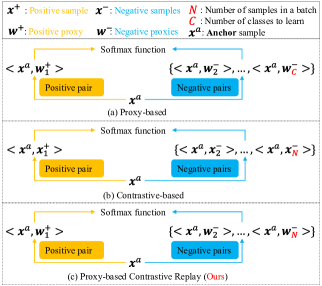
Online class-incremental continual learning is a specific task of continual learning. It aims to continuously learn new classes from data stream and the samples of data stream are seen only once, which suffers from the catastrophic forgetting issue, i.e., forgetting historical knowledge of old classes. Existing replay-based methods effectively alleviate this issue by saving and replaying part of old data in a proxy-based or contrastive-based replay manner. Although these two replay manners are effective, the former would incline to new classes due to class imbalance issues, and the latter is unstable and hard to converge because of the limited number of samples. In this paper, we conduct a comprehensive analysis of these two replay manners and find that they can be complementary. Inspired by this finding, we propose a novel replay-based method called proxy-based contrastive replay (PCR). The key operation is to replace the contrastive samples of anchors with corresponding proxies in the contrastive-based way. It alleviates the phenomenon of catastrophic forgetting by effectively addressing the imbalance issue, as well as keeps a faster convergence of the model. We conduct extensive experiments on three real-world benchmark datasets, and empirical results consistently demonstrate the superiority of PCR over various state-of-the-art methods.
Motivation & Objective
- Address catastrophic forgetting in online class-incremental continual learning, where models learn from data streams with single-pass access and risk overwriting old knowledge.
- Overcome limitations of existing replay-based methods: proxy-based approaches suffer from class imbalance bias, while contrastive-based methods are unstable due to few samples.
- Develop a unified framework that leverages the stability of proxy-based replay and the selective pair sampling of contrastive-based replay to achieve complementary advantages.
- Ensure robust performance across tasks, especially in scenarios with limited buffer memory and increasing class increments.
Proposed method
- Introduce a hybrid replay mechanism that replaces anchor-to-sample pairs in contrastive loss with anchor-to-proxy pairs, using proxies as class representatives.
- Select anchor-to-proxy pairs based on the classes present in the current training batch—mirroring the contrastive-based sampling strategy to improve selection relevance.
- Use a proxy-based loss for stable and fast convergence, while the batch-dependent selection reduces bias toward frequent classes.
- Maintain a memory buffer storing proxies (not raw samples) to reduce storage and improve generalization.
- Integrate the contrastive loss with a nearest class mean (NCM) classifier for inference, enhancing performance on old classes.
- Incorporate a selection component to eliminate duplicate anchor-to-proxy pairs and a duplication component to preserve multiple negative pairs, both contributing to improved robustness.
Experimental results
Research questions
- RQ1Can combining proxy-based and contrastive-based replay mechanisms yield better performance than either method alone in online class-incremental learning?
- RQ2Does selecting anchor-to-proxy pairs based on batch-internal class presence improve generalization and reduce bias compared to full proxy-based sampling?
- RQ3How does PCR perform in terms of catastrophic forgetting mitigation and novel class learning over sequential tasks with limited buffer size?
- RQ4What is the contribution of the selection and duplication components in the proposed PCR framework to overall model performance?
Key findings
- PCR consistently outperforms state-of-the-art methods on Split CIFAR100, Split MiniImageNet, and TinyImageNet, with significant gains in average accuracy across tasks.
- On Split CIFAR100, PCR achieves a final average accuracy of 78.4%, surpassing the next best method (ER-ACE at 76.8%) and showing strong forgetting resistance as the number of tasks increases.
- On Split MiniImageNet, PCR significantly outperforms SCR and ER-ACE, demonstrating superior ability to retain old knowledge while learning new classes.
- The ablation study confirms that the selection component (removing duplicate pairs) and duplication component (preserving multiple negative pairs) are critical for performance, with PCR outperforming both ER+A and ER+A+B variants.
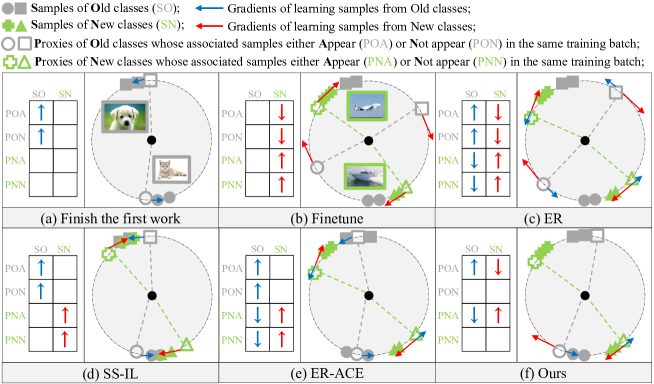
- PCR produces more uniform gradient updates across all proxies, as shown in Figure 5, which helps mitigate the class imbalance bias common in proxy-based methods.
- With increasing batch size, PCR maintains its performance advantage, indicating robustness to training dynamics and scalability in larger-batch settings.
Read this paper
Open the full text in the Nubint reader and ask about any passage as you read.
Read this paper on NubintThis review was generated by AI from the original paper. Please check the paper before citing it.