
[Paper Review] PE-YOLO: Pyramid Enhancement Network for Dark Object Detection
This paper proposes PE-YOLO, an end-to-end dark object detection framework that integrates a Pyramid Enhancement Network (PENet) with YOLOv3 to improve detection in low-light conditions. PENet uses Laplacian pyramid decomposition, a Detail Processing Module (DPM) with context and edge branches, and a Low-Frequency Enhancement Filter (LEF) to restore details and suppress noise, achieving 78.0% mAP and 53.6 FPS on the ExDark dataset without additional supervision.
Current object detection models have achieved good results on many benchmark datasets, detecting objects in dark conditions remains a large challenge. To address this issue, we propose a pyramid enhanced network (PENet) and joint it with YOLOv3 to build a dark object detection framework named PE-YOLO. Firstly, PENet decomposes the image into four components of different resolutions using the Laplacian pyramid. Specifically we propose a detail processing module (DPM) to enhance the detail of images, which consists of context branch and edge branch. In addition, we propose a low-frequency enhancement filter (LEF) to capture low-frequency semantics and prevent high-frequency noise. PE-YOLO adopts an end-to-end joint training approach and only uses normal detection loss to simplify the training process. We conduct experiments on the low-light object detection dataset ExDark to demonstrate the effectiveness of ours. The results indicate that compared with other dark detectors and low-light enhancement models, PE-YOLO achieves the advanced results, achieving 78.0% in mAP and 53.6 in FPS, respectively, which can adapt to object detection under different low-light conditions. The code is available at https://github.com/XiangchenYin/PE-YOLO.
Motivation & Objective
- To address the challenge of robust object detection in low-light conditions where existing models degrade due to poor image quality.
- To develop a lightweight, end-to-end trainable framework that enhances low-light images without requiring paired ground-truth images.
- To improve feature representation in dark scenes by capturing both high-frequency details and low-frequency semantics.
- To achieve high detection accuracy and real-time inference speed in low-light object detection.
Proposed method
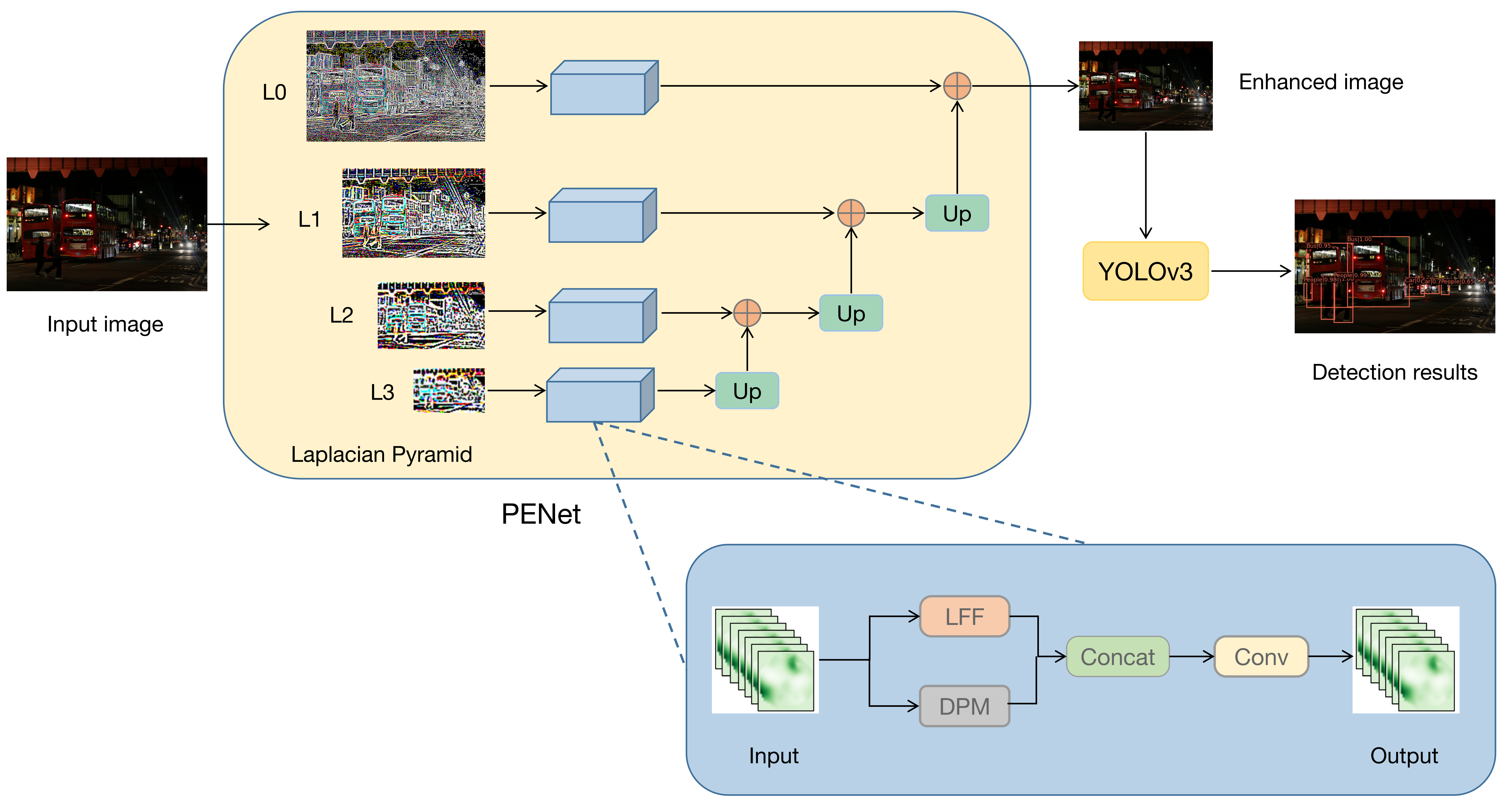
- PENet decomposes input images into four resolution levels using the Laplacian pyramid to enable multi-scale feature enhancement.
- The Detail Processing Module (DPM) consists of a context branch that captures long-range dependencies and an edge branch that enhances texture details.
- The Low-Frequency Enhancement Filter (LEF) applies a dynamic low-pass filter to extract semantic-rich low-frequency components and suppress high-frequency noise.
- PE-YOLO jointly trains PENet and YOLOv3 using only standard detection loss, enabling end-to-end optimization without auxiliary supervision.
- The framework processes features at multiple pyramid levels, fusing enhanced representations before detection.
- The model is trained end-to-end on the ExDark dataset using standard YOLOv3 loss functions, avoiding the need for paired low-light and normal-light images.
Experimental results
Research questions
- RQ1Can a multi-scale pyramid-based enhancement network improve object detection performance in low-light conditions?
- RQ2How effective is a detail processing module with separate context and edge branches in restoring image details under low illumination?
- RQ3To what extent does low-frequency semantic enhancement improve detection accuracy without amplifying noise?
- RQ4Can an end-to-end training strategy with only detection loss achieve state-of-the-art performance in dark object detection?
Key findings
- PE-YOLO achieves 78.0% mAP on the ExDark dataset, outperforming YOLOv3, DENet, IAT-YOLO, and other state-of-the-art dark detectors.
- The model achieves 53.6 FPS, demonstrating strong real-time inference capability despite the added enhancement module.
- Ablation studies show that each component—context branch, edge branch, and LEF—contributes incrementally to mAP, with the full model reaching 78.0%.
- The DPM with both context and edge branches improves mAP by 1.6 percentage points over baseline YOLOv3.
- The LEF component increases mAP by 0.4 percentage points compared to DPM-only, confirming its role in preserving semantic consistency.
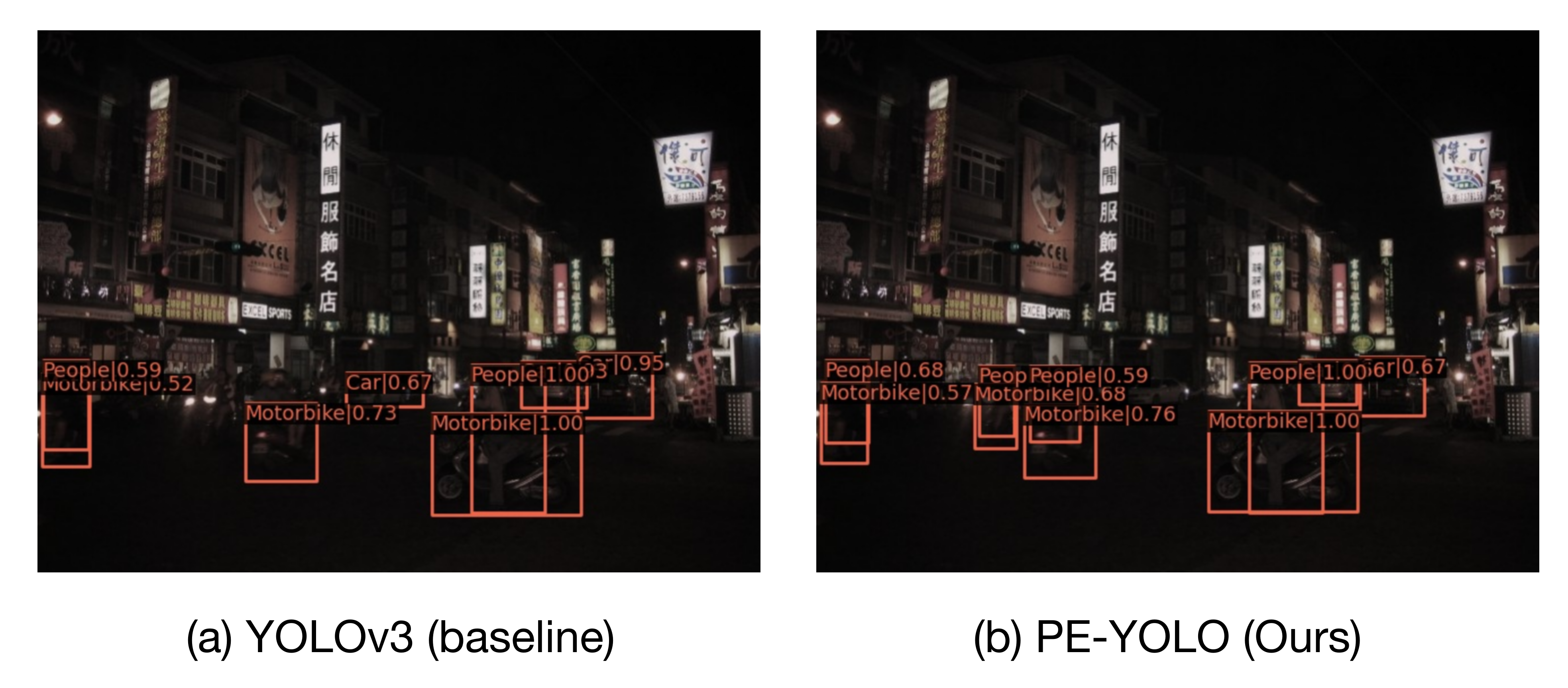
- Visual comparisons show that PE-YOLO suppresses noise better than MBLLEN and Zero-DCE, leading to more accurate detection in dark scenes.
Read this paper
Open the full text in the Nubint reader and ask about any passage as you read.
Read this paper on NubintThis review was generated by AI from the original paper. Please check the paper before citing it.