
[Paper Review] Pediatric Wrist Fracture Detection in X-rays via YOLOv10 Algorithm and Dual Label Assignment System
The paper evaluates YOLOv10 variants for pediatric wrist fracture detection on the GRAZPEDWRI-DX dataset, showing YOLOv10-M achieves state-of-the-art mAP@50-95 (51.9%) and outperforms YOLOv9 benchmarks.
Wrist fractures are highly prevalent among children and can significantly impact their daily activities, such as attending school, participating in sports, and performing basic self-care tasks. If not treated properly, these fractures can result in chronic pain, reduced wrist functionality, and other long-term complications. Recently, advancements in object detection have shown promise in enhancing fracture detection, with systems achieving accuracy comparable to, or even surpassing, that of human radiologists. The YOLO series, in particular, has demonstrated notable success in this domain. This study is the first to provide a thorough evaluation of various YOLOv10 variants to assess their performance in detecting pediatric wrist fractures using the GRAZPEDWRI-DX dataset. It investigates how changes in model complexity, scaling the architecture, and implementing a dual-label assignment strategy can enhance detection performance. Experimental results indicate that our trained model achieved mean average precision (mAP@50-95) of 51.9\% surpassing the current YOLOv9 benchmark of 43.3\% on this dataset. This represents an improvement of 8.6\%. The implementation code is publicly available at https://github.com/ammarlodhi255/YOLOv10-Fracture-Detection
Motivation & Objective
- Assess the effectiveness of YOLOv10 variants for detecting pediatric wrist fractures on the GRAZPEDWRI-DX dataset.
- Compare YOLOv10 variants to YOLOv9 benchmarks across key detection metrics.
- Analyze how model complexity impacts fracture detection performance.
- Identify the best-performing YOLOv10 variant for overall pathology detection, including fractures.
Proposed method
- Train and evaluate multiple YOLOv10 variants (N, S, M, L, X) and compare to YOLOv9 baselines on GRAZPEDWRI-DX.
- Use pre-training on COCO, then fine-tune on the dataset split (train/val/test).
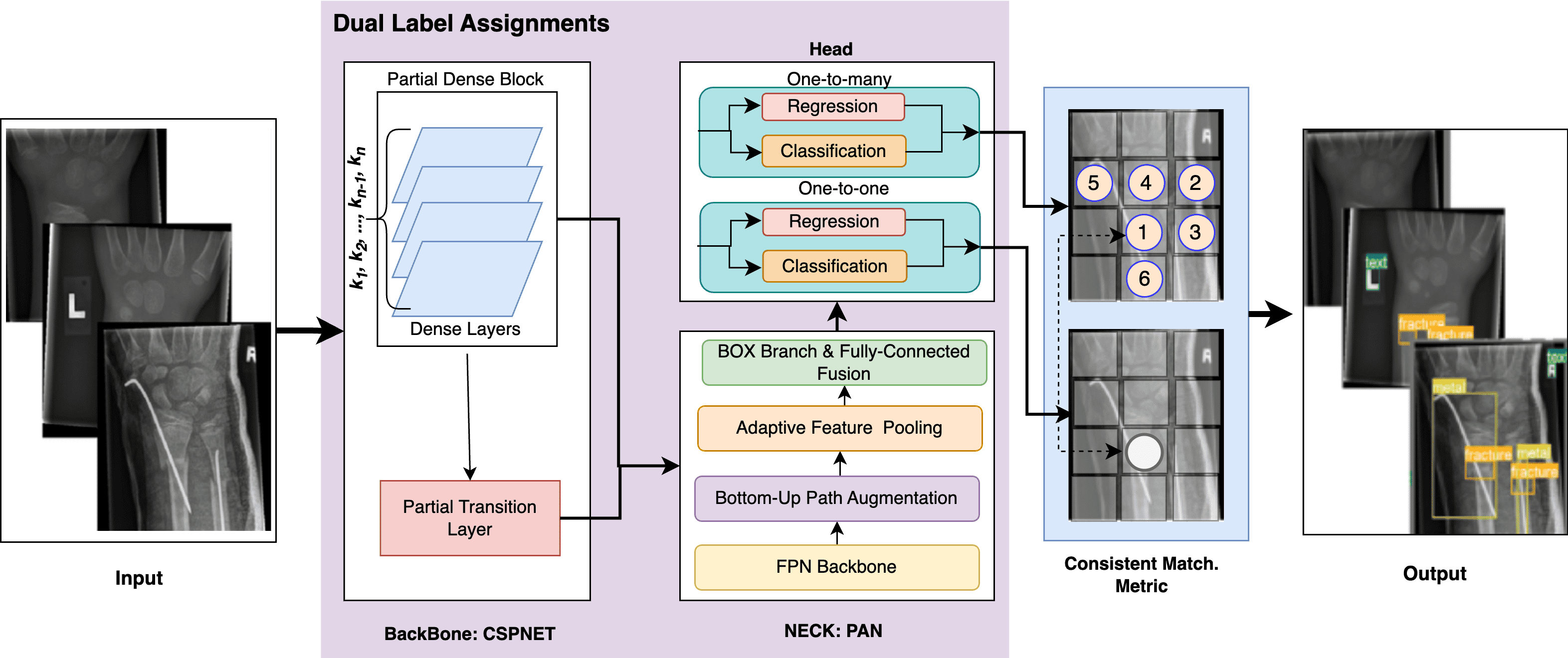
- Employ a dual-label assignment system to replace traditional NMS in training.
- Incorporate architectural innovations: Compact Inverted Block (CIB), decoupled classification head, spatial-channel decoupled downsampling, rank-guided block design, large-kernel convolutions, and Partial Self-Attention (PSA).
- Assess performance via mAP@50, mAP@50-95, F1, fracture-specific metrics, Params, and FLOPs.
Experimental results
Research questions
- RQ1How do YOLOv10 variants perform on pediatric wrist fracture detection compared to YOLOv9 on GRAZPEDWRI-DX?
- RQ2What is the impact of increasing model complexity on fracture detection performance, particularly mAP@50-95?
- RQ3Which YOLOv10 variant provides the best balance of accuracy, efficiency, and resource usage for wrist pathology detection?
Key findings
- YOLOv10 variants generally outperform YOLOv9 variants on all metrics except the Nano variant, with the X variant achieving the highest mAP@50 (76.2%).
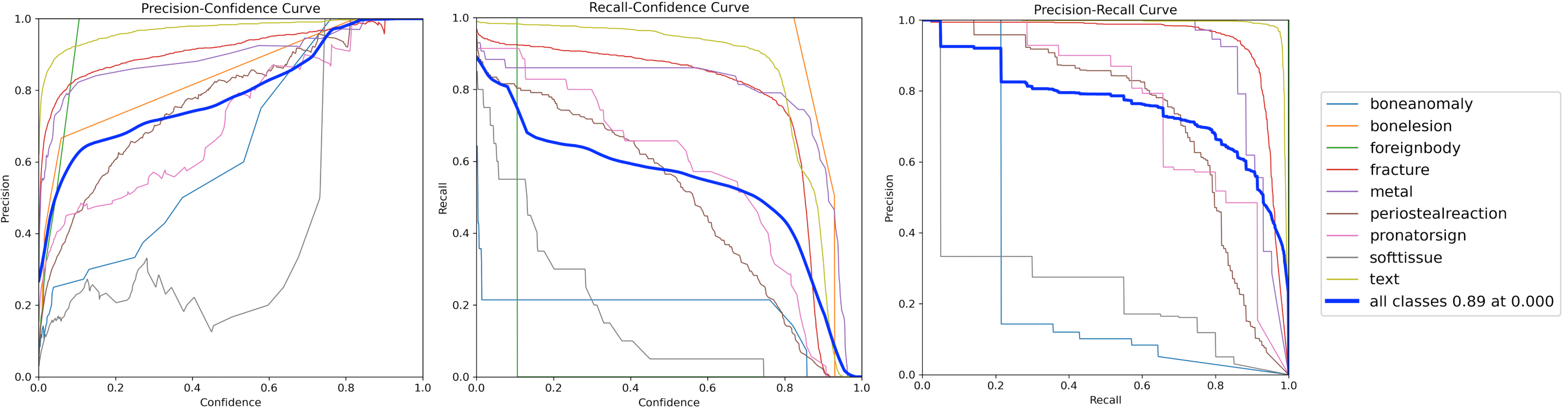
- The YOLOv10-M variant achieves the highest mAP@50-95 (51.9%) and the best balance across metrics for all classes, including fractures.
- For fracture pathology, YOLOv10-M yields mAP@50 94.0%, mAP@50-95 58.4%, and fracture sensitivity 92.5%.
- Increasing model complexity beyond the M variant does not improve mAP@50-95 and can reduce it, suggesting an optimal model size at M for this task.
- Overall, YOLOv10 variants provide improved performance with fewer parameters and FLOPs than some YOLOv9 counterparts, establishing a new benchmark on GRAZPEDWRI-DX.
Read this paper
Open the full text in the Nubint reader and ask about any passage as you read.
Read this paper on NubintThis review was generated by AI from the original paper. Please check the paper before citing it.