
[Paper Review] Perception, performance, and detectability of conversational artificial intelligence across 32 university courses
This study evaluates ChatGPT's performance across 32 university courses, comparing it to student work, and tests the detectability of AI-generated text using two classifiers. It finds ChatGPT outperforms or matches students in most courses, while current detection tools suffer from high false positives and are easily evaded via simple text obfuscation.
The emergence of large language models has led to the development of powerful tools such as ChatGPT that can produce text indistinguishable from human-generated work. With the increasing accessibility of such technology, students across the globe may utilize it to help with their school work -- a possibility that has sparked discussions on the integrity of student evaluations in the age of artificial intelligence (AI). To date, it is unclear how such tools perform compared to students on university-level courses. Further, students' perspectives regarding the use of such tools, and educators' perspectives on treating their use as plagiarism, remain unknown. Here, we compare the performance of ChatGPT against students on 32 university-level courses. We also assess the degree to which its use can be detected by two classifiers designed specifically for this purpose. Additionally, we conduct a survey across five countries, as well as a more in-depth survey at the authors' institution, to discern students' and educators' perceptions of ChatGPT's use. We find that ChatGPT's performance is comparable, if not superior, to that of students in many courses. Moreover, current AI-text classifiers cannot reliably detect ChatGPT's use in school work, due to their propensity to classify human-written answers as AI-generated, as well as the ease with which AI-generated text can be edited to evade detection. Finally, we find an emerging consensus among students to use the tool, and among educators to treat this as plagiarism. Our findings offer insights that could guide policy discussions addressing the integration of AI into educational frameworks.
Motivation & Objective
- To evaluate the performance of ChatGPT relative to university students across diverse academic disciplines.
- To assess the detectability of ChatGPT-generated text using two AI text classifiers, GPTZero and OpenAI’s classifier.
- To investigate the susceptibility of these classifiers to obfuscation attacks using tools like Quillbot.
- To examine students’ and educators’ perceptions regarding the use of ChatGPT in academic work.
- To inform policy development on AI use in academic integrity and student assessment frameworks.
Proposed method
- Collected 32 university-level course questions and corresponding student answers from NYU Abu Dhabi and other institutions.
- Generated responses to all course questions using ChatGPT for direct comparison with student submissions.
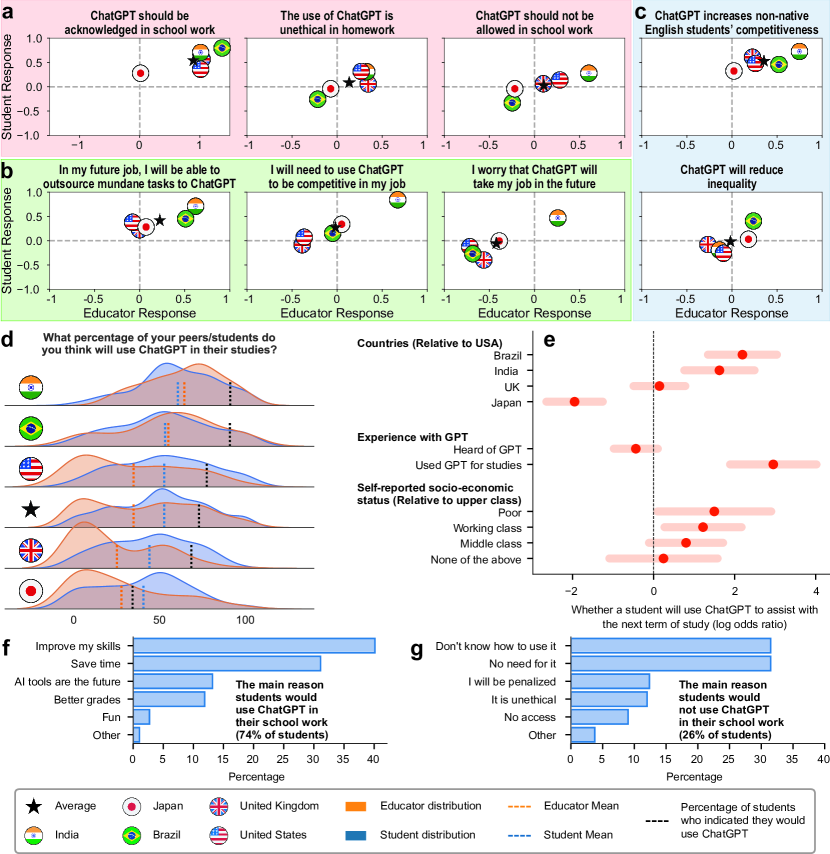
- Administered surveys across five countries and at NYU Abu Dhabi to assess student and faculty perceptions of AI use.
- Applied two AI text classifiers—GPTZero and OpenAI’s classifier—to classify both student and ChatGPT-generated texts.
- Conducted obfuscation attacks by rephrasing ChatGPT outputs using Quillbot at maximum synonym intensity across multiple modes.
- Calculated false positive and false negative rates by constructing normalized confusion matrices for each classifier.
Experimental results
Research questions
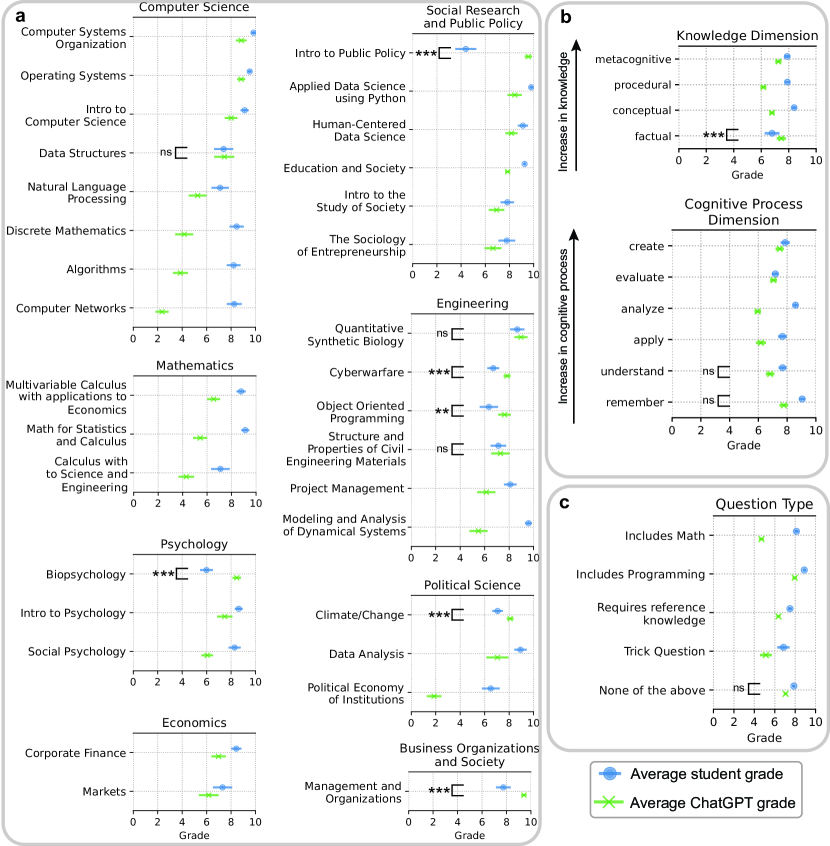
- RQ1How does ChatGPT’s performance compare to that of university students across a broad range of academic courses?
- RQ2To what extent can current AI text classifiers reliably detect ChatGPT-generated text in academic submissions?
- RQ3How effective are obfuscation techniques, such as Quillbot rephrasing, in evading AI detection systems?
- RQ4What are the empirical and normative perceptions of students and educators regarding the use of ChatGPT in academic work?
- RQ5What are the implications of these findings for academic integrity policies in higher education?
Key findings
- ChatGPT outperformed or matched the performance of students in 28 out of 32 university-level courses, with particularly strong results in humanities and social sciences.
- The GPTZero classifier misclassified 32.5% of human-written student responses as AI-generated, indicating a high false positive rate.
- OpenAI’s classifier misclassified 28.3% of human responses as AI-generated, further highlighting detection system unreliability.
- ChatGPT responses were misclassified as human in 12.5% of cases by GPTZero and 15.7% by OpenAI’s classifier, indicating non-trivial false negative rates.
- Obfuscation attacks using Quillbot successfully evaded detection in 68.8% of ChatGPT responses across both classifiers, demonstrating high evasion success.
- An overwhelming majority of educators (87%) across the survey considered AI-generated work as plagiarism, while 73% of students reported using ChatGPT for academic tasks.
Read this paper
Open the full text in the Nubint reader and ask about any passage as you read.
Read this paper on NubintThis review was generated by AI from the original paper. Please check the paper before citing it.